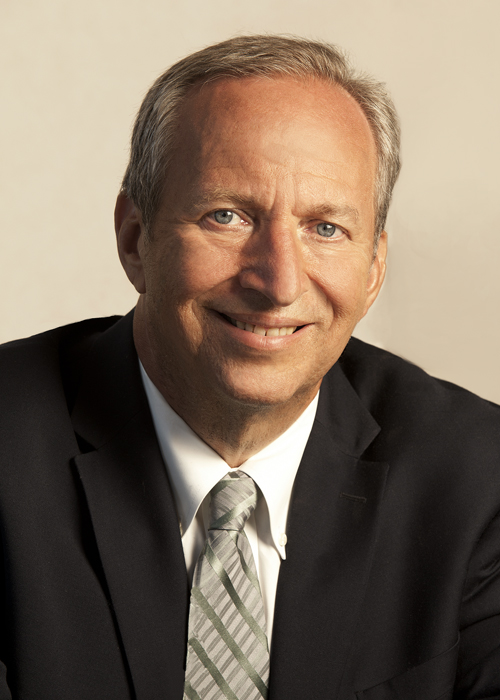
Lawrence Summers
Economist and former United States Secretary of the TreasuryWikipedia
157
MENTIONS
103
EPISODES
66
PODCASTS
Search complete. 157 mentions across 103 episodes found for "Lawrence Summers".
Sep 25, 2026

Aswath DamodaranHOST
That's called a relative standard deviation.
Aswath DamodaranHOST
For those of you who might be keeping track of this bank risk argument that's kind of bubbled up to the surface again, there's a paper that was recently written by Larry Summers and a student of his at Harvard that argues that banks have actually become more risky since regulations were created to make them less risky.
Aswath DamodaranHOST
And the way they measure risk is they look at the standard deviation of banks divided by the, they don't run a beta regression.
Aswath DamodaranHOST
It's a relative standard deviation.

Dave RubinHOST
She is not the first Harvard president to return to teaching.
Dave RubinHOST
Larry Summers, president until 2006, stayed on as an economics professor.
Dave RubinHOST
He resigned in February amid fallout from his association with Epstein.
Dave RubinHOST
Summers said he was deeply ashamed and took full responsibility for my misguided decision to continue communicating with Epstein.

Anthony CheungHOST
QE leads to inflation? Wasn't that the number one fear in 2009, 2010? And inflation may have gone up or may have moved, but nowhere near to the degree that most had thought.
Piers CurranHOST
Yeah, if you go and listen to Larry Summers back in the day, he was saying, oh my God, this QE is going to kill us.
Piers CurranHOST
There's two things... to comment on on that from my mind one is maybe we're now getting the inflation maybe it was just very delayed and all that QE that we stuffed into the pipe years back is now coming home to roost that's one argument people make the other argument is that it actually doesn't cause inflation at all and that's because all the money that the central banks print and try and get into the system it actually doesn't go into the system properly It just ends up sat in the banking system.
Piers CurranHOST
And this is where asset prices get inflated.

Will DaviesGUEST
And therefore, the best an intellectual can do is to sit in amongst those different language games and translate the code of one into the code of another.
Will DaviesGUEST
So that what you want when you go and listen to, say, Larry Summers, God help you, at some festival of ideas or whatever, is someone who can tell you how the US Treasury Department thinks, but to do so in ways that is accessible to someone sitting in a marquee at the Financial Times or something like that.
James ButlerHOST
Yeah, just that question of translation made me think of the other strand that I didn't mention, which is the thought of someone like Bourdieu who says, okay, well, one of the things that's going on with intellectuals, particularly insofar as they intervene in politics, is the conversion of a kind of authority into another kind of authority, right? So you're...
James ButlerHOST
Your status in a particular field entitles you to then intervene in politics in a particular way and allows you the status to do so.

Anna StansburyGUEST
So we've got globalization, technological change, and the third theory would be something about power and institutions.
Anna StansburyGUEST
Like I have this paper, um, that I wrote with Larry Summers a few years ago that was arguing that the decline of the labor share in the US was about worker power, and it was about a decline of worker power over the last four decades relative to the power of companies, and that was what shifted the share of income away from labor and towards capital.
Ben ZweigHOST
So worker power.
Ben ZweigHOST
What is that-- Yeah, like is that general market power? Like is that issues around monopsony? Is it around unions? Like what, what do you, what do you think labor, labor market power is at its core?

Pascal LottazHOST
Today I've got with me Professor David Gibbs of Arizona University and Colonel Lawrence Wilkerson, a former Chief of Staff to the United States Secretary of State Colin Powell.
Pascal LottazHOST
Larry, David, welcome.
David GibbsGUEST
Thank you for having me, for hosting this.
Pascal LottazHOST
Well, thank you for doing this.
24 MINS LATER
Lawrence WilkersonGUEST
It fell apart immediately upon the assumption of office by William Jefferson Clinton.
David GibbsGUEST
I'm sorry, do you want to say something?
Pascal LottazHOST
May I jump in just with maybe a theory or an observation? If I understand you correctly, Larry, then what you're saying is that the intentions there in the early 90s were pretty honest from the circle that you could judge yourself.
Pascal LottazHOST
Would it then be fair to say that within the 1990s, within the span, what we saw was rather a change of personnel that had then different ideas? I mean, just as the president changed to somebody who didn't have all of those heartfelt kind of...

Bobby CapucciHOST
But logic dictates in this moment that they did know.
Bobby CapucciHOST
These people were seen not only by me, Alan Dershowitz argued in a 2015 deposition, they were seen by Larry Summers, they were seen by George Church, and they were seen by Marvin Minsky.
Bobby CapucciHOST
They were seen by most of the most eminent academics and scholars in the world.
Bobby CapucciHOST
That's not a mark of approval there, buddy, all right? You're not giving me confidence because of a bunch of pencil-necked dweebs are hanging out on this island, especially when a lot of them are also being accused.

Eric KoesterGUEST
I've never actually had that thing.
Eric KoesterGUEST
And part of me always felt like there was something wrong with me, right? Like all these people talk about, you know, you read these famous stories about like Sheryl Sandberg and Larry Summers, and you just hear all these things, you know, Steve Jobs mentoring Mark Zuckerberg, you hear all these things.
Eric KoesterGUEST
And I thought, what's wrong with me? Why doesn't anyone want to mentor me? And that's what I figured out.
Eric KoesterGUEST
Like, funny about this is that honestly, you know, You know, about 85% of people say having a mentor is really important in succeeding in life and career.

DixonHOST
They're like, do we sue? Do we try and just find him and beat him up?
GabrielHOST
And they go to Larry Summers.
GabrielHOST
They go to the Harvard president.
DixonHOST
I love the scene when it's like...

Paul BloomHOST
Another debate is a debate concerning sex differences in the capacity for math and science.
Paul BloomHOST
A few years ago, there used to be a president of Harvard known as Larry Summers.
Paul BloomHOST
There are so many reasons to hiss at this point.
Paul BloomHOST
But, and Larry Summers is no longer president of Harvard for various reasons but one reason was this quote.
Paul BloomHOST
which included in his speculations about sex differences, in the special case of science and engineering, there are issues of intrinsic aptitude and particularly of the variability of aptitude.
Paul BloomHOST
He argued or suggested that the underrepresentation of women in the sciences, in academia, is because of an intrinsic aptitude difference.
93 more episodes mention Lawrence Summers.
Create an account to see the whole feed, search across every transcript, and follow the entities you care about.