Large Magellanic Cloud
GalaxyWikipedia
23
MENTIONS
15
EPISODES
10
PODCASTS
Search complete. 23 mentions across 15 episodes found for "Large Magellanic Cloud".
Oct 4, 2026

speaker_4HOST
The quest to push the hierarchical model down to that next level to find a satellite orbiting a satellite, that has been the absolute holy grail for validating LCDM on small scales.
speaker_3HOST
Which brings us to the current record holder for this specific phenomenon, the Large Magellanic Cloud, or the LMC.
speaker_4HOST
A beautiful galaxy.
speaker_3HOST
It is.
speaker_4HOST
Yes, they were satellites of the LMC that got dragged into the Milky Way's halo along with it.
speaker_3HOST
So let me ask you this.
speaker_3HOST
If we have already found satellites of satellites with the Large Magellanic Cloud, why is the discovery of Fornax 7 treated as such a critical, groundbreaking thing? W-why is pushing this search to the Fornax galaxy treated as a totally different regime of physics?
speaker_4HOST
Because comparing the Large Magellanic Cloud to Fornax is like comparing a massive ocean liner to a wooden rowboat.

LeonHOST
... just looking a little bit closer 'cause, uh, there's some pretty cool stuff in it.
SharnaHOST
Yeah, it's, it's actually quite easy to find if you are out in kind of a dark sky area away from light pollution because the constellation of Dorado is home to the Large Magellanic Cloud.
LeonHOST
Ooh.
SharnaHOST
Yeah.
LeonHOST
Hmm.
SharnaHOST
Uh.
LeonHOST
And, um, you said it's the Large Magellanic Cloud.
SharnaHOST
Yeah.

JoshHOST
The Montreal Protocol was signed on September 16th, creating an international agreement to phase out chemicals responsible for damaging the ozone layer.
JoshHOST
Supernova SN 1987A was discovered in February in the Large Magellanic Cloud, becoming the brightest supernova visible from Earth in centuries.
DaveHOST
Hmm.
Baba LouieHOST
Very exciting.

Alex McColganHOST
If this is the case, then they would be the Milky Way's first known binary globular cluster pair.
Alex McColganHOST
We found binary clusters in other galaxies, like in Centaurus A and the Large Magellanic Cloud, but scientists think it might be when these gravitationally bound clusters collide that we get the most massive globular clusters, like Omega Centauri.
Alex McColganHOST
So studying a binary cluster right in our own galaxy could produce some amazing insights into this process.
Alex McColganHOST
It's all speculation at the moment, but it's definitely cool to think about.

speaker_0NARRATOR
However, recent research has introduced significant uncertainty.
speaker_0NARRATOR
New data from the Gaia spacecraft and Hubble telescope, combined with considerations of the Large Magellanic Cloud's gravitational influence, suggests the collision is less certain than once thought.
speaker_0NARRATOR
A head-on collision between Andromeda and Milky Way has only 50% probability.
speaker_0NARRATOR
Astronomers ran 100,000 simulations considering 22 different variables that could affect whether a collision occurs.

Billy HenryNARRATOR
A case in point is the Magellanic Clouds, the largest satellite galaxies of the Milky Way.
Billy HenryNARRATOR
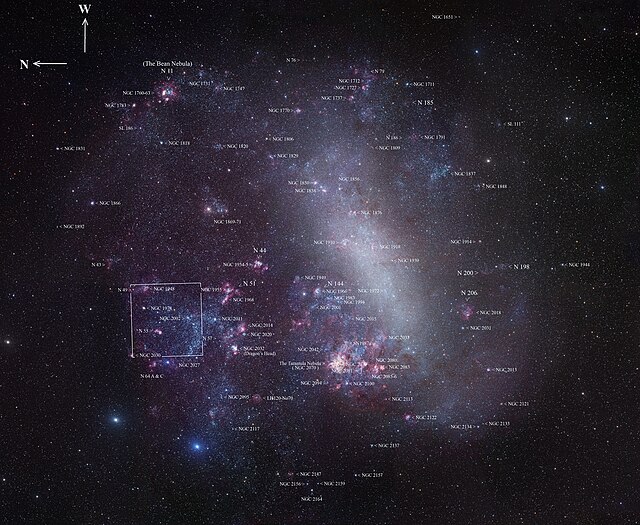
The Large Magellanic Cloud is about 165,000 light years away.
Billy HenryNARRATOR
It's about a third as wide as the Milky Way, and perhaps one-tenth as massive.
Billy HenryNARRATOR
The small cloud is a little smaller and farther away.
Billy HenryNARRATOR
But the observations revealed that most of the stars are moving outward, away from the center of the galaxy.
Billy HenryNARRATOR
And that applied even to the stars in the center itself.
Billy HenryNARRATOR
The most likely cause is the pull of the Large Magellanic Cloud.
Billy HenryNARRATOR
Its gravity is dragging the stars away from their galactic home.

Brian KeatingHOST
The warp violates simple disk geometry.
Brian KeatingHOST
Sagittarius and the Large Magellanic Cloud also drive non-circular motion.
Brian KeatingHOST
They're like outer gravitating masses.
Brian KeatingHOST
These tracers become sparse at great distances, and you have to question whether or not the stars are at actual equilibrium.
Brian KeatingHOST
And as I said, the Milky Way is not some isolated, perfect galaxy that's relaxed in a laboratory just hanging out.
Brian KeatingHOST
The Sagittarius dwarf galaxy nearby, but not part of our galaxy, has reportedly crossed and perturbed our Milky Way's disk.
Brian KeatingHOST
The Large Magellanic Cloud is massive, it's nearby, and it's dynamical.
Brian KeatingHOST
It's rotating.

speaker_1NARRATOR
MOND also faces a challenge here, because it generally predicts an asymptotically flat curve for isolated galaxies.
speaker_1NARRATOR
However, supporters argue MOND's non-linearity allows external gravitational fields to matter, including influences from the Large Magellanic Cloud or the Sagittarius dwarf galaxy.
speaker_1NARRATOR
So we're
Brian KeatingHOST
left with three main possibilities.

AveryHOST
And the southern thread is foundational.
AveryHOST
The whole field starts with SGR 0526-66 in the Large Magellanic Cloud in 1979, and the modern end runs through the Murchison Widefield Array in Western Australia.
AnnaHOST
Now, I believe you also have a story that we ran out of time to run during the week.
AveryHOST
Indeed, the one we didn't run during the week, and it's a proper story.

AveryHOST
And the southern thread is foundational.
AveryHOST
The whole field starts with SGR 0526-66 in the Large Magellanic Cloud in 1979, and the modern end runs through the Murchison Widefield Array in Western Australia.
AnnaHOST
Now, I believe you also have a story that we ran out of time to run during the week.
AveryHOST
Indeed.
5 more episodes mention Large Magellanic Cloud.
Create an account to see the whole feed, search across every transcript, and follow the entities you care about.