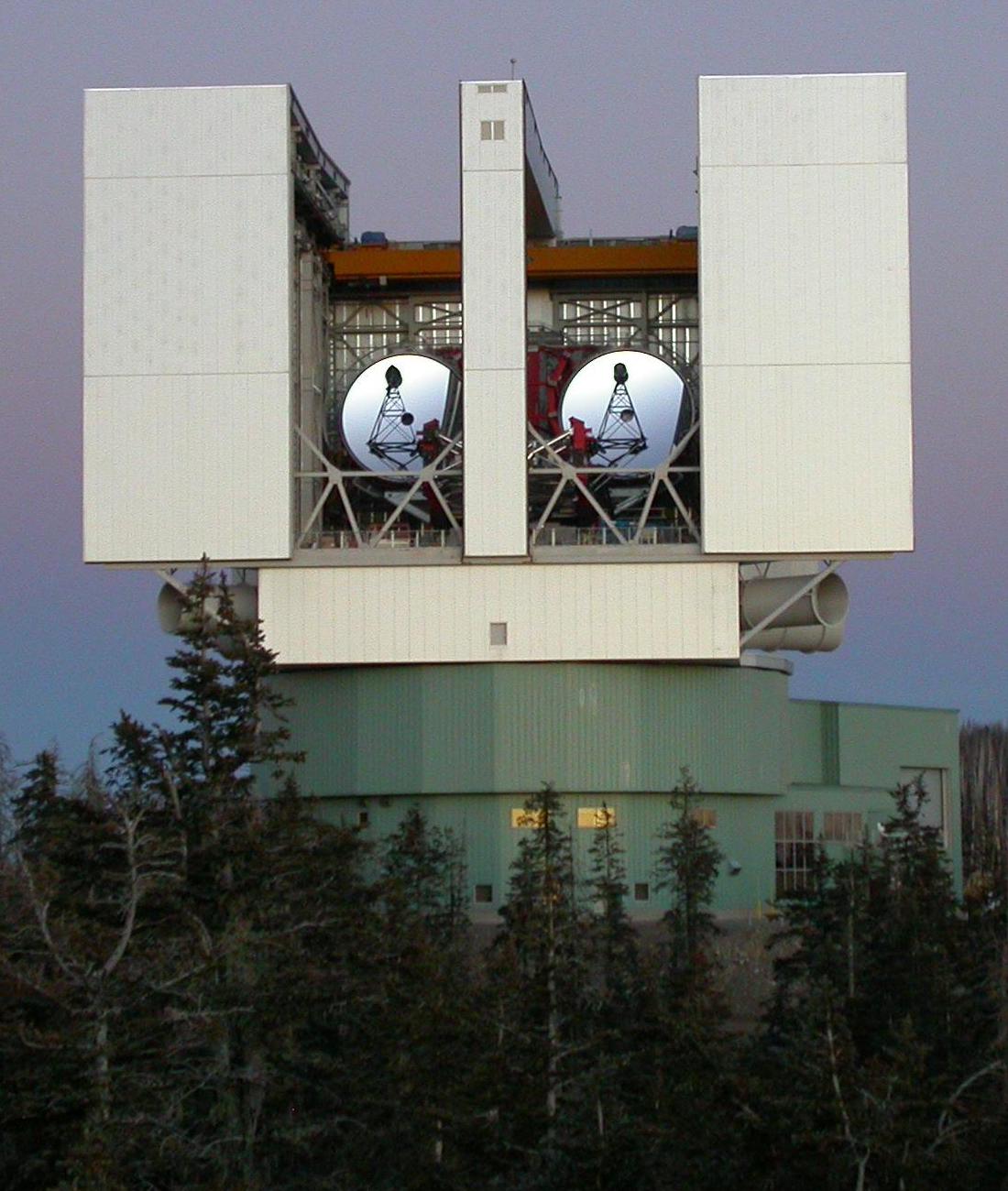
Large Binocular Telescope

Large Binocular Telescope

Observatory in Graham County, ArizonaWikipedia

Search complete. 4 mentions across 3 episodes found for "Large Binocular Telescope".

Oct 23, 2026

TessHOST
3:52
Scientists have now measured the original abundance of helium more precisely than ever before.
TessHOST
3:58
They used 130 hours of observations from the Large Binocular Telescope and studied 15 unusually pristine galaxies.
TessHOST
4:07
These galaxies contain relatively little material produced by later generations of stars.
TessHOST
4:13
That makes them something like chemical time capsules.

Unknown podcast

Happy Day News — 2026-10-21: Hornbill 3D-Printed Beak, Helium From 15 Galaxies and More

Oct 21 · 1 Mention

speaker_1HOST
0:53
In an October 20, 2026 article, the University of Minnesota said the measurement reached unprecedented precision and marks a major advance in precision cosmology.
speaker_1HOST
1:05
An international research team, including University of Minnesota Twin Cities, scientists used 130 hours of observations on the Large Binocular Telescope, described as one of the world's most powerful telescopes.
speaker_1HOST
1:19
The findings are presented across five published papers in the Astrophysical Journal.
speaker_1HOST
1:25
The work connects directly to the Big Bang theory, which says the universe began expanding from an extraordinarily hot, dense state approximately 13.8 billion years ago.

Unknown podcast

The First Elements: What Helium Reveals About the Early Universe

Oct 18 · 2 Mentions

speaker_3HOST
17:55
You have to be much, much more clever than that.
speaker_3HOST
17:58
And this is where the Large Binocular Telescope Primordial Helium Abundance Project enters the picture.
speaker_2HOST
18:02
The LBTYP project.
speaker_3HOST
18:04
Yes.
speaker_2HOST
21:04
So hydrogen emits a specific barcode of light and helium emits a totally different barcode of light?
speaker_3HOST
21:10
Precisely.
speaker_3HOST
21:12
By capturing the light from these distant galaxies with a massive instrument like the Large Binocular Telescope and running that light through a spectrograph, astronomers can actually split the light into its constituent wavelengths.
speaker_2HOST
21:23
Like a prism?

We value your privacy

We use cookies to understand how you use our platform and to improve your experience. Click “Accept All” to consent, or “Decline non-essential” to opt out of non-essential cookies. Read our Privacy Policy.