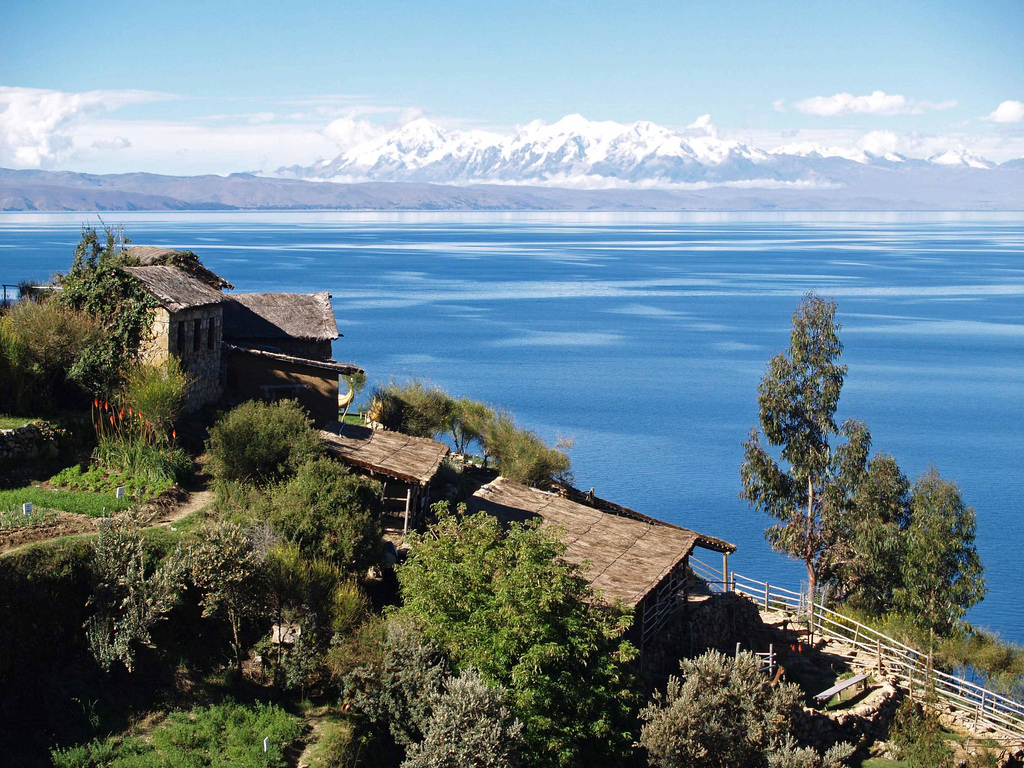
Lake Titicaca
Lake in South AmericaWikipedia
148
MENTIONS
74
EPISODES
60
PODCASTS
Search complete. 148 mentions across 74 episodes found for "Lake Titicaca".
Oct 30, 2026

Ryan Daniel GableGUEST
And those were distinct to the Nile Valley area.
Ryan Daniel GableGUEST
In fact, I think they made boats around Lake Titicaca that were constructed almost identically to the reed boats that were made around the Nile.
Ryan Daniel GableGUEST
So there's absolutely a connection.
William RamseyHOST
The new world wasn't that new.

William TomkoNARRATOR
arrived at a low peninsula on the north shore of the lake tucker and i pitched our camp sent our mules back to puyuska for fodder and set up the acme folding boat which we had brought so many miles on muleback for the sounding operations the acme proved easy to assemble although this was our first experience with it its lightness enabled it to be floated at the edge of the lake even in very shallow water and its rigidity was much appreciated in the late afternoon when the high winds raised a vicious little sea rowing out on waters while we were told by the natives had never before been navigated by craft of any kind I began to take soundings.
William TomkoNARRATOR
Lake Titicaca is over nine hundred feet deep.
William TomkoNARRATOR
It would be aggravating if Lake Parinacochas should prove to be over a thousand, for I had brought no extra line.
William TomkoNARRATOR
Even nine hundred feet would make sounding slow work, and the lake covered an area of over seventy square miles.
36 MINS LATER
speaker_9NARRATOR
This is a LibriVox recording.
speaker_9NARRATOR
All LibriVox recordings are in the public domain.
speaker_9NARRATOR
For more information or to volunteer, please visit LibriVox.org. inca lands by hiram bingham chapter v titicaca araquipa is one of the pleasantest places in the world mountain air bright sunshine warm days cool nights and a sparkling atmosphere dear to the hearts of star-gazers the city lies on a plateau surrounded by mighty snow-capped volcanoes kachani twenty thousand feet el misti nineteen thousand feet and pictu pictu eighteen thousand feet arequipa has only one nightmare earthquakes about twice in a century the spirits of the sleeping volcanoes stir roll over and go to sleep again but they shake the bed and arequipa rests on their bed the possibility of a terremoto is always present in the subconscious mind of the arequipeno one evening i happened to be dining with a friend at the hospitable arequipa club suddenly the windows rattled violently and we heard a loud explosion at least that is what it sounded like to me to the members of the club however it meant only one thing an earthquake everybody rushed out the streets were already crowded with hysterical people crying shouting and running toward the great open plaza in front of the beautiful cathedral here some dropped on their knees in gratitude at having escaped from falling walls others prayed to the god of earthquakes to spare their city yet no walls had fallen in the business district a great column of black smoke was rising gradually it became known to the panic-stricken throngs that the noise and the trembling had not been due to an earthquake but to an explosion in a large warehouse which had contained gasoline kerosene dynamite and giant powder in this city of thirty-five thousand people the second largest of peru fires are so very rare not even annual scarcely biennial that there were no fire-engines a bucket brigade was formed and tried to quench the roaring furnace by dipping water from one of the azqueas or canals that run through the streets the fire continued to belch forth dense masses of smoke and flame in any american city such a blaze would certainly become a great conflagration while the fire was at its height i went into an adjoining building to see whether any help could be rendered to my utter amazement the surface of the wall next to the fiery furnace was not even warm such is the result of building houses with massive walls of stone furthermore the roofs in arequipa are of tiles consequently no harm was done by sparks so without a fire department this really terrible fire was limited to one warehouse the next day the newspapers talked about the dire necessity of securing fire-engines it was difficult for me to see what good a fire-engine could have done nothing could have saved the warehouse itself once the fire got under way and surely the houses next door would have suffered more had they been deluged with streams of water the facts are almost incredible to an american we take it as a matter of course that cities should have fires and explosions in arequipa everybody thought it was an earthquake a day's run by an excellent railroad takes one to puno the chief port of lake titicaca elevation twelve thousand five hundred feet puno boasts a soldiers monument and a new theatre really a movie palace there is a good harbour although dredging is necessary to provide for steamers like the inca repairs to the lake boats are made on a marine or rather a lacustrine railway the bay of puno grows quantities of totoras giant bulrushes sometimes twelve feet long ages ago the lake dwellers learned to dry the totoras tie them securely in long bundles fasten the bundles together turn up the ends fix smaller bundles along the sides as a freeboard and so construct a fishing-boat or of course the balsas eventually become water-logged and spend a large part of their existence on the shore drying in the sun even so they are not very buoyant i can testify that it is difficult to use them without getting one's shoes wet as a matter of fact one should go barefooted or wear sandals as the natives do the balsas are clumsy and difficult to paddle the favorite method of locomotion or to pole or when the wind favors sail the mast is an a-shaped contraption twelve feet high made of two light poles tied together and fastened one to each side of the craft slightly forward of the amidships poles are extremely scarce in this region lumber has to be brought from puget sound six thousand miles away so nearly all the masts i saw were made of small pieces of wood spliced two or three times to the apex of the a is attached a forked stick over which run the halyards the rectangular sail is nothing more nor less than a large mat made of rushes a short fore stay fastened to the sides of the yey about four feet above the hull prevents the mast from falling when the sail is hoisted the main halyards take the place of a back stay the balsas cannot beat to windward but behave very well in shallow water with a favoring breeze when the wind is contrary the boatmen must pole they are extremely careful not to fall overboard for the water in the lake is cold fifty five degrees fahrenheit and none of them know how to swim lake titicaca itself never freezes over although during the winter ice forms at night on the shallow bays and near the shore when the indians wish to go in the shallowest waters they use a very small balsa not over eight feet long barely capable of supporting the weight of one man on the other hand large balsas constructed for use in crossing the rough waters of the deeper portions of the lake are capable of carrying a dozen people and their luggage once i saw plamen and his team of oxen being ferried across the lake on a bulrush raft to give greater security two bolses are sometimes fastened together in the fashion of a double canoe
William TomkoNARRATOR
one of the

William TomkoNARRATOR
Rowing out on waters, while we were told by the natives I'd never before been navigated by craft of any kind, I began to take soundings.
William TomkoNARRATOR
Lake Titicaca is over nine hundred feet deep.
William TomkoNARRATOR
It would be aggravating if Lake Parinacochas should prove to be over a thousand, for I had brought no extra line.
William TomkoNARRATOR
Even nine hundred feet would make sounding slow work, and the lake covered an area of over seventy square miles.
35 MINS LATER
William TomkoNARRATOR
What could be the meaning of the rapidly brightening eastern sky? while we watched and marvelled the pure white light grew brighter and brighter until we cried out in ecstasy as a dazzling luminary rose majestically above the horizon a splendour neither of the sun nor of the moon shone upon us it was the morning star For sheer beauty, divine enchanting ravishment, Venus that day surpassed anything I have ever seen.
William TomkoNARRATOR
In the words of the great Eastern poet, who had often seen such a sight in the deserts of Asia, the morning stars sang together, and all the sons of God shouted for joy.
William TomkoNARRATOR
CHAPTER V. titicaca araquipa is one of the pleasantest places in the world mountain air bright sunshine warm days cool nights and a sparkling atmosphere dear to the hearts of star-gazers the city lies on a plateau surrounded by mighty snow-capped volcanoes kachani twenty thousand feet el misti nineteen thousand feet and pictu pictu eighteen thousand feet arequipa has only one nightmare earthquakes about twice in a century the spirits of the sleeping volcanoes stir roll over and go to sleep again but they shake the bed and arequipa rests on their bed the possibility of a terremoto is always present in the subconscious mind of the arequipeno one evening i happened to be dining with a friend at the hospitable arequipa club suddenly the windows rattled violently and we heard a loud explosion at least that is what it sounded like to me to the members of the club however it meant only one thing an earthquake everybody rushed out the streets were already crowded with hysterical people crying shouting and running toward the great open plaza in front of the beautiful cathedral here some dropped on their knees in gratitude at having escaped from falling walls others prayed to the god of earthquakes to spare their city yet no walls had fallen in the business district a great column of black smoke was rising gradually it became known to the panic-stricken throngs that the noise and the trembling had not been due to an earthquake but to an explosion in a large warehouse which had contained gasoline kerosene dynamite and giant powder in this city of thirty-five thousand people the second largest of peru fires are so very rare not even annual scarcely biennial that there were no fire-engines a bucket brigade was formed and tried to quench the roaring furnace by dipping water from one of the azqueas or canals that run through the streets the fire continued to belch forth dense masses of smoke and flame in any american city such a blaze would certainly become a great conflagration while the fire was at its height i went into an adjoining building to see whether any help could be rendered to my utter amazement the surface of the wall next to the fiery furnace was not even warm such is the result of building houses with massive walls of stone furthermore the roofs in arequipa are of tiles consequently no harm was done by sparks so without a fire department this really terrible fire was limited to one warehouse the next day the newspapers talked about the dire necessity of securing fire-engines it was difficult for me to see what good a fire-engine could have done nothing could have saved the warehouse itself once the fire got under way and surely the houses next door would have suffered more had they been deluged with streams of water the facts are almost incredible to an american we take it as a matter of course that cities should have fires and explosions in arequipa everybody thought it was an earthquake a day's run by an excellent railroad takes one to puno the chief port of lake titicaca elevation twelve thousand five hundred feet puno boasts a soldiers monument and a new theatre really a movie palace there is a good harbour although dredging is necessary to provide for steamers like the inca repairs to the lake boats are made on a marine or rather a lacustrine railway the bay of puno grows quantities of totoras giant bulrushes sometimes twelve feet long ages ago the lake dwellers learned to dry the totoras tie them securely in long bundles fasten the bundles together turn up the ends fix smaller bundles along the sides as a freeboard and so construct a fishing-boat or of course the balsas eventually become water-logged and spend a large part of their existence on the shore drying in the sun even so they are not very buoyant i can testify that it is difficult to use them without getting one's shoes wet as a matter of fact one should go barefooted or wear sandals as the natives do the bosses are clumsy and difficult to paddle the favorite method of locomotion or to pole or when the wind favors sail the mast is an a-shaped contraption twelve feet high made of two light poles tied together and fastened one to each side of the craft slightly forward of the amidships poles are extremely scarce in this region lumber has to be brought from puget sound six thousand miles away so nearly all the masts i saw were made of small pieces of wood spliced two or three times to the apex of the a is attached a forked stick over which run the halyards the rectangular sail is nothing more nor less than a large mat made of rushes a short forestay fastened to the sides of the a about four feet above the hull prevents the mast from falling when the sail is hoisted the main halyards take the place of a back stay the balsas cannot beat to windward but behave very well in shallow water with a favoring breeze when the wind is contrary the boatmen must pole they are extremely careful not to fall overboard for the water in the lake is cold fifty five degrees fahrenheit and none of them know how to swim lake titicaca itself never freezes over although during the winter ice forms at night on the shallow bays and near the shore when the indians wish to go in the shallowest waters they use a very small balsa not over eight feet long barely capable of supporting the weight of one man on the other hand large bosses constructed for use in crossing the rough waters of the deeper portions of the lake are capable of carrying a dozen people and their luggage once i saw plowman and his team of oxen being ferried across the lake on a bulrush raft to give greater security two bosses are sometimes fastened together in the fashion of a double canoe
William TomkoNARRATOR
one of the more highly speculative of the bolivian writers

Hector O'hEeochagainHOST
Like, we wanted pillows.
Hector O'hEeochagainHOST
We were about to do a six-hour journey in the highest van up to Lake Titicaca, which is one of the world's highest lakes.
Hector O'hEeochagainHOST
Don't say it again.
Hector O'hEeochagainHOST
Where the ancient Aztec...
Hector O'hEeochagainHOST
You should go
Laurita BlewittHOST
there.
Laurita BlewittHOST
That's a new name for your lake, Lake Titicaca.
Laurita BlewittHOST
Lake Titicaca.

Alexei VranichGUEST
Lake Titicaca.
Alexei VranichGUEST
In this magnificent, stark landscape of the Bolivian highlands lies a beguiling mystery.
PaulHOST
Lake Titicaca is so powerful.
PaulHOST
It's deep.
PaulHOST
It's vast.
PaulHOST
But the problem was... very little trees, no real source of wood.
PaulHOST
So how could boats have been built that would have carried these kinds of stones across that lake? The answer to me was obvious.
PaulHOST
reeds the fishermen along the shores of lake titicaca have been used in reed boats for thousands of years this is

Matthew LaCroixHOST
The image on the left is from the underwater ruins, which were at some point in the Pleistocene above water, but they were still down low near the lake.
Matthew LaCroixHOST
Now a lake, if anybody's ever read the Enumit Elish, the Seven Tablets of Creation, you'll learn that a lake, an ancient lake, just like the stories of Irkosha with Lake Titicaca, It represents a primordial origin of emergence.
Matthew LaCroixHOST
Now, go back to the Enuma Elish, the seven tables of creation, the Mesopotamian stories of how everything started.
Matthew LaCroixHOST
It describes a pool of energy swirling around with a type of circular energy that needed emergence.

Mr. EHOST
So like
Jay CloneHOST
Lake Lake Titicaca, like that area.
Mr. EHOST
That is such a weird place.
Mr. EHOST
It is very strange.
Mr. EHOST
Titicaca.
Mr. EHOST
The Titicaca frogs are super weird.
Mr. EHOST
Like their whole biology is like their seahorses up there.
Jay CloneHOST
I mean, all of the ancient sites in South America and their megalithic buildings and

JoeHOST
And so a goblin walking around the village is not weird at all.
JoeHOST
The goblins in my world come from Lake Titicaca because I don't care what you say, Lake Titicaca is the funniest name for a lake ever.
JoeHOST
And so of course I put it into my campaign.
JoeHOST
And that's where the goblins are from.

JamesHOST
Betanzos says that in the ancient time, the land was dark and there was already a people living there, ruled by a lord whose name had been forgotten.
JamesHOST
Then, Kontiti Viracocha appears from the region of Lake Titicaca, and the story says this earlier people had offended him.
JamesHOST
He destroys that first humanity by turning them into stone, and then begins another act of creation at Tiwanaku.
JamesHOST
And the way Patanzos describes that second creation is really, really strange.

ShaggyHOST
[laughs]
J-LoHOST
I was like, Lake Titicaca.
ShaggyHOST
Yeah.
ShaggyHOST
[laughs]Oh, I love that guy.
64 more episodes mention Lake Titicaca.
Create an account to see the whole feed, search across every transcript, and follow the entities you care about.