Lagrangian
47
MENTIONS
18
EPISODES
9
PODCASTS
Search complete. 47 mentions across 18 episodes found for "Lagrangian".
Nov 21, 2026

Dave FarinaHOST
Eric had to sit there and take it because he knows it's a fake theory, and if he were to push back on the specifics, Sean would have skewered him.
Dave FarinaHOST
But then later, he started up the damage control with, who the hell else, Joe Rogan, which involved pretending he has Lagrangians.
Dave FarinaHOST
Look, a chapter labeled Lagrangians, so there are totally Lagrangians.
Dave FarinaHOST
There aren't.
Dave FarinaHOST
I've debunked that in my content as well.
Dave FarinaHOST
That's not what a TOE is.
Dave FarinaHOST
Even Eric Weinstein, the loser fraud, knows enough to make a bunch of fake math and pseudo Lagrangians to claim he has a TOE.
Dave FarinaHOST
This is idiotic.
Jonathan CohenSOUNDBITE_SPEAKER
When I'm dying...

Karl FristonGUEST
You don't need to use the word emergence just to have these different levels of description.
Karl FristonGUEST
and look for symmetries or invariants in terms of the dynamics or the laws or the Lagrangians that operate consistently at different scales.
Karl FristonGUEST
Apart from the work of George Ellis on top-down and bottom-up causation, we just come at this from a physics perspective.
Karl FristonGUEST
And that's, you know, apart from that, though, I agree entirely with Robert.

Philip MannheimGUEST
You don't need supersymmetry.
Philip MannheimGUEST
It's a symmetry that prevents the presence of the cosmological constant to him at the level of the Lagrangian.
Philip MannheimGUEST
Therefore, it takes control of dark energy.
Philip MannheimGUEST
It includes complex transformations, include PT symmetry and CPT symmetry, which I'll come back to later.
2 HRS 26 MINS LATER
Philip MannheimGUEST
So this was the standard picture of spontaneous breakdown.
Philip MannheimGUEST
And it's the one that we use with an elementary Higgs field.
Philip MannheimGUEST
put it into the Lagrangian, do the fluctuations, get the massive W, the massive Z, and get a full theory of weak interactions, and lo and behold, you discover a Higgs photon.
Philip MannheimGUEST
And we find it.

Arvin AshHOST
But all that math can be roughly represented by this equation.
Arvin AshHOST
This is the standard model Lagrangian.
Arvin AshHOST
It represents the apex of human knowledge and understanding of how the universe works.
Arvin AshHOST
Today, I'm going to explain the almost theory of everything in the most intuitive way that I can think of.
Arvin AshHOST
The standard model is actually represented by a complex set of equations, but we can simplify all this and write it in one equation known as the standard model of ranging.
Arvin AshHOST
Don't get intimidated by how complicated it looks because I'm going to explain this intuitively.
Arvin AshHOST
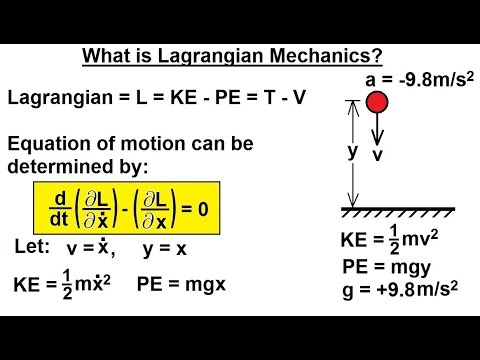
A Lagrangian is just like the sum of all energies.
Arvin AshHOST
Remember that Einstein's equation E equals mc squared says that mass and energy are equivalent.
Arvin AshHOST
I just want you to see the equation so you can see conceptually what happens to the math when we do these transformations.
Arvin AshHOST
L is the Lagrangian.
Arvin AshHOST
A Lagrangian is just the difference between kinetic and potential energy of a particle.
Arvin AshHOST
Psi is the wave function of a matter particle.
Arvin AshHOST
And psi-bar is the wave function of the equivalent antimatter particle.
Arvin AshHOST
You might say, okay, so what? I don't see any forces here.
Arvin AshHOST
This is where group theory comes in.
Arvin AshHOST
If U1 symmetry exists, it would mean that if we applied our transformation to this equation, like so, where n is negative 1 for matter particles and 1 for antimatter particles, the Lagrangian would not change.

Adam FrankGUEST
And in particular, it was Newton and Newton's laws that really gave us a view like, oh, we have these mathematical formulations, these laws that operate independent of us.
Adam FrankGUEST
And as Newton's laws became more formalized, became more abstracted, say what's called the Lagrangian formulation, which was even more abstract.
Adam FrankGUEST
And then the Hamiltonian formulation was even more abstract after that.
Adam FrankGUEST
There was this ascending spiral of abstraction, very powerful.
Arvin AshHOST
Here's what they came up with.
Arvin AshHOST
This represents the Lagrangian or the main equation for QED.
Arvin AshHOST
The Lagrangian contains all the energy terms of the theory.
Arvin AshHOST
In other words, it contains all information relevant for the theory.
Arvin AshHOST
And from this Lagrangian, you can obtain the behavior of the electromagnetic forces.
Arvin AshHOST
Now, don't let this formulation intimidate you.
Arvin AshHOST
I will explain intuitively what it means.
Arvin AshHOST
First, we can identify psi that represents the wave function of the spin one-half field, like the electron or positron field.

Jörg SchumacherGUEST
So how can machine learning techniques help us to understand the large scale dynamics, the evolution of the convection flow at the largest scales, and the contributions to the turbulent transport? And we have approached this topic from different directions, applying unsupervised or supervised machine learning techniques.
Jörg SchumacherGUEST
And the unsupervised part, for instance, was done in the Lagrangian frame of reference by looking at trajectory clusters which we have obtained from the Lagrangian description of these convection flows or by applying a Koopman eigenfunction analysis on the basis of diffusion maps.
Jörg SchumacherGUEST
I'm going to spend the rest of my talk with these two approaches of supervised machine learning.
Jörg SchumacherGUEST
The first is basically that we are applying these methods to learn the structures as they evolve in the turbulent flow.
Shivam PandeyGUEST
So if you give it the matter density field in the simulation, can you extract off the gas? And before I show you the comparison, the second approach that members of the collaboration has worked on, as is given again in Henry's paper, is to use this hybrid effective field theory approach.
Shivam PandeyGUEST
And the way this approach works is that you say that whatever bias tracer that you are interested in, you will write down its bias expansion in the very high redshift Lagrangian field.
Shivam PandeyGUEST
And then instead of in the traditional perturbation theory approach using the loop expansions to solve for any statistics in the Eulerian field, you're going to use the n-body simulation to give you this evolution exactly.
Shivam PandeyGUEST
So basically what this comes down to in practice is that you will take all your different distribution of the particles in the Eulerian field, but then you will weigh them by effectively this weight function that you extract off in the Lagrangian field.
Shivam PandeyGUEST
And the upshot is that this thing has been shown to work at remarkably smaller scales compared to doing the traditional loop expansions.
Shivam PandeyGUEST
So for example in here you can see how both of these methods are working.
8 more episodes mention Lagrangian.
Create an account to see the whole feed, search across every transcript, and follow the entities you care about.