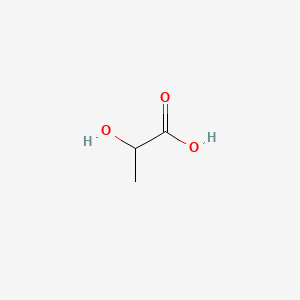
Lactic acid
Chemical compoundWikipedia
40
MENTIONS
11
EPISODES
11
PODCASTS
Search complete. 40 mentions across 11 episodes found for "Lactic acid".
Nov 4, 2026

Justin MihalyHOST
The issue is, majority of people find white rice to be more... enjoyable or palatable to consume so we can simply get more carbohydrates out of that right now let's look at keto fat has almost no thymine butter has none so when you go low carb it does lower your demand at the pdh store but fat brings nothing to the table so a fat adapted athlete can run a deficient b1 tab once add carbs back in and feel terrible like wow carbs make you feel like no you're just low you depleted the enzyme that those carbohydrates need in order to actually work in your body they think that means carbon tolerant but all it really means is you're restricting your body of things that it needs to actually perform at an elite level So, since we used the traffic and the door analogy, what happens when the traffic beats the door? Okay, so we don't have the key to get in, we got a lot of traffic.
Justin MihalyHOST
Pyruvate backs up, the cell cannot let glycolysis slip, so it turns the extra pyruvate into lactate.
Justin MihalyHOST
That keeps the fast split going, so you still make a movement of ATP.
Justin MihalyHOST
But you leave most of the meal's energy on the table.
Justin MihalyHOST
That is the issue with any blood work.
Justin MihalyHOST
And that's why with our coaching, biometrics are more important as symptomatology is also important.
Justin MihalyHOST
So the question to ask if you're looking to achieve unique health performance is, am I giving my body what it needs to hit this at 100% to use fuel 100%? Am I giving the enzymes that it needs to fully saturate my body with ATP as easily as possible, walk through all those doors and allow the traffic to come through without things getting backed up and by really getting turned into lactate? Most people are not.
Justin MihalyHOST
And again, this goes back to magnesium status, thyroid status, and ATP status.

Bailey HablerGUEST
So it's just really hard to do in the pool.
Bill EvansHOST
So tell me about the way that you guys use Lactate at Villanova and what numbers that you shoot for.
Bill EvansHOST
For context, Matt Valrani and Marcus Sullivan are the coaches there, and they have a ton of experience.
Bill EvansHOST
And Matt's been one of the people leading the forefront in this double threshold space.

Eric BergHOST
So when you're burning fuel in your body, you need oxygen.
Eric BergHOST
And to increase your VO2 max, you also need to look at a couple other things like your your CO2, your carbon dioxide, as well as your lactic acid, which is generated as a byproduct because CO2 allows the oxygen to actually go in deep into the tissues.
Eric BergHOST
So it's not just about oxygen.
Eric BergHOST
And then also the lactic acid, if that builds up too much, it's not cleared.
Eric BergHOST
That can prevent you from exercising and breathing because of the pH and what it does to your muscles.
Eric BergHOST
So top athletes that have developed their mitochondria and made their mitochondria really, really efficient and have increased and stretched the capacity for using, absorbing oxygen and getting rid of lactic acid, kind of bulletproof themselves against disease.
Eric BergHOST
And so it's a good measurement to see where you are in evaluating your overall health.
Eric BergHOST
When you go to a doctor, You don't go to your doctor to get healthy.

Cindy WestHOST
And so in the process, they release another type of acid, and this acid is called lactic acid.
Cindy WestHOST
Yep, let's spell it.
Cindy WestHOST
Lactic is spelled L-A-C-T-I-C.
Cindy WestHOST
And acid, you tell me how to spell it.
Cindy WestHOST
Right, A-C-I-D.

Ross TuckerHOST
So the counter argument to that is that the carbs, and they said it in that marketing speak that you read there, is that The carbohydrate supply is at some point constrained at the level of the gut and this provides a third way other than glucose and fructose.
Ross TuckerHOST
Lactate will now move from the gut into the blood independent of the carbs so that the carbs might be stuck in a major traffic jam but the lactate takes the back roads if I can use that analogy.
Ross TuckerHOST
So we've got to think about whether that is true or not as well.
Ross TuckerHOST
And that's something else that we'll get into in a little bit more detail.
Ross TuckerHOST
So let's talk about that very briefly.
Ross TuckerHOST
In that piece that you just read, they say humans can take anything between 5 and 25 grams an hour.
Ross TuckerHOST
There is a study actually that was published two years ago in McCarthy from Canada called Oral Sodium Lactate Ingestion Does Not Increase Blood Lactate Concentrations and is Accompanied by Moderate to Severe Gastrointestinal Effects.
Ross TuckerHOST
So it's not an encouraging headline.

Vanita RattanGUEST
So they will take that top layer of skin away.
Vanita RattanGUEST
Things to look out for, there would be like glycolic acid, mandelic acid or lactic acid.
Vanita RattanGUEST
So you'll see those quite a lot.
Vanita RattanGUEST
For us, I tend to recommend mandelic and lactic acid.
Vanita RattanGUEST
Glycolic acid can be a little bit irritating.
Vanita RattanGUEST
It's the smallest molecular weight.
Vanita RattanGUEST
So for us, if you've got pigmentation, we go for the AHA.
Vanita RattanGUEST
And you know how Cleopatra would like bathe in milk? In milk, yeah.

Marc HumbertHOST
Anyway, you're welcome for that.
Marc HumbertHOST
So why was it called anaerobic threshold? Well, when they were first studying the things they were looking at, Lactate, which they called lactic acid back then.
Cameron GarberHOST
Yep.
Cameron GarberHOST
So we're talking like early, early literature.

Arnar LárussonGUEST
So you have to start to get this imbalance.
Arnar LárussonGUEST
More CO2 starts to get created, more lactate starts to get created and shuttled into the blood.
Arnar LárussonGUEST
Lactate gets consumed and shuttled around the body and so forth.
Arnar LárussonGUEST
CO2 is basically a poison for the body because it disturbs the pH level, just like with the oceans.
Arnar LárussonGUEST
We don't want too much CO2 in the oceans because it acidifies them.
20 MINS LATER
Arnar LárussonGUEST
So lactate and ventilation during exercise come from glycolysis.
Arnar LárussonGUEST
So as we break down carbohydrates, we're producing that CO2 that needs to get exhaled out, and we're producing the lactate that accumulates in the blood if it's in excess.
Arnar LárussonGUEST
And the main difference, practically the main difference, from a practical standpoint, the main difference is that Lactate has a longer time course and it's also a significant source of fuel.

Brian HalliganHOST
You need to have that willpower, so to speak, to learn what you're capable of.
Brian HalliganHOST
But he was like basically talking about how he would back off a little bit and, and realize that an L4 session is for him, it's how fast can you go while staying in control and, And he's not trying to push the 10 millimoles of lactic acid.
Brian HalliganHOST
He's trying to push the, you know, the, the four to six millimoles just above that threshold.
Brian HalliganHOST
And I thought that was really, uh, it was just really interesting to hear him say that.
14 MINS LATER
Andy NewellHOST
And so they can easily do like a, What a hard start or over-under interval might look for a cyclist would be, okay, if I'm doing a four-minute interval, what I'm going to do is the first four minutes, I'm going to be at 110% of my FTP, so functional threshold power.
Andy NewellHOST
The first minute, I'm going to go really powerful, really hard, and then I'm going to settle at my FTP, so at my threshold basically for another two minutes, and then I might finish the last 30 seconds or interval hard.
Andy NewellHOST
as well and so i think the reason why athletes do this is not so different to what some of the benefits that we just mentioned like i do think it is a intensity control thing where the whole entirety of the l4 interval is not at a max effort there is some some intensity control so the middle of the interval is is kept more at threshold but you're starting it quite hard and you might be finishing it quite hard and i think what the adaptations that are happening there are just like we mentioned earlier kind of dancing but dancing between that that that lt2 or like kind of your your more aerobic pace into a more anaerobic pace and like how your body can transition between those two, potentially shuttling lactic acid and improves lactic acid shuttling.
Andy NewellHOST
It can improve VO2 kinetics.

JT TurnerGUEST
There are a lot of biodegradable polyesters.
JT TurnerGUEST
Polylactic acid is made from lactic acid from corn.
JT TurnerGUEST
Um, and even some of them right now, Kelly, are made from some petrochemical origins, but they have really good, um, they have really good compost or biodegradation, um, properties or kinetics, and you know, that, that's a good stepping stone along the way as well, right? I think, I think the part that's most important is, is the polymers being earth digestible, right? It's something, something that n- naturally exists that can digest it.
Kelly WilliamsHOST
I love the steak analogy.
Kelly WilliamsHOST
I have one for PLA that, that I think is useful.
Kelly WilliamsHOST
I'll share it real quick.
Kelly WilliamsHOST
If you think about polylactic acid, okay, lactic acid is part of so many cycles in our bodies, in, in the, in the-
JT TurnerGUEST
Mm-hmm
1 more episode mentions Lactic acid.
Create an account to see the whole feed, search across every transcript, and follow the entities you care about.