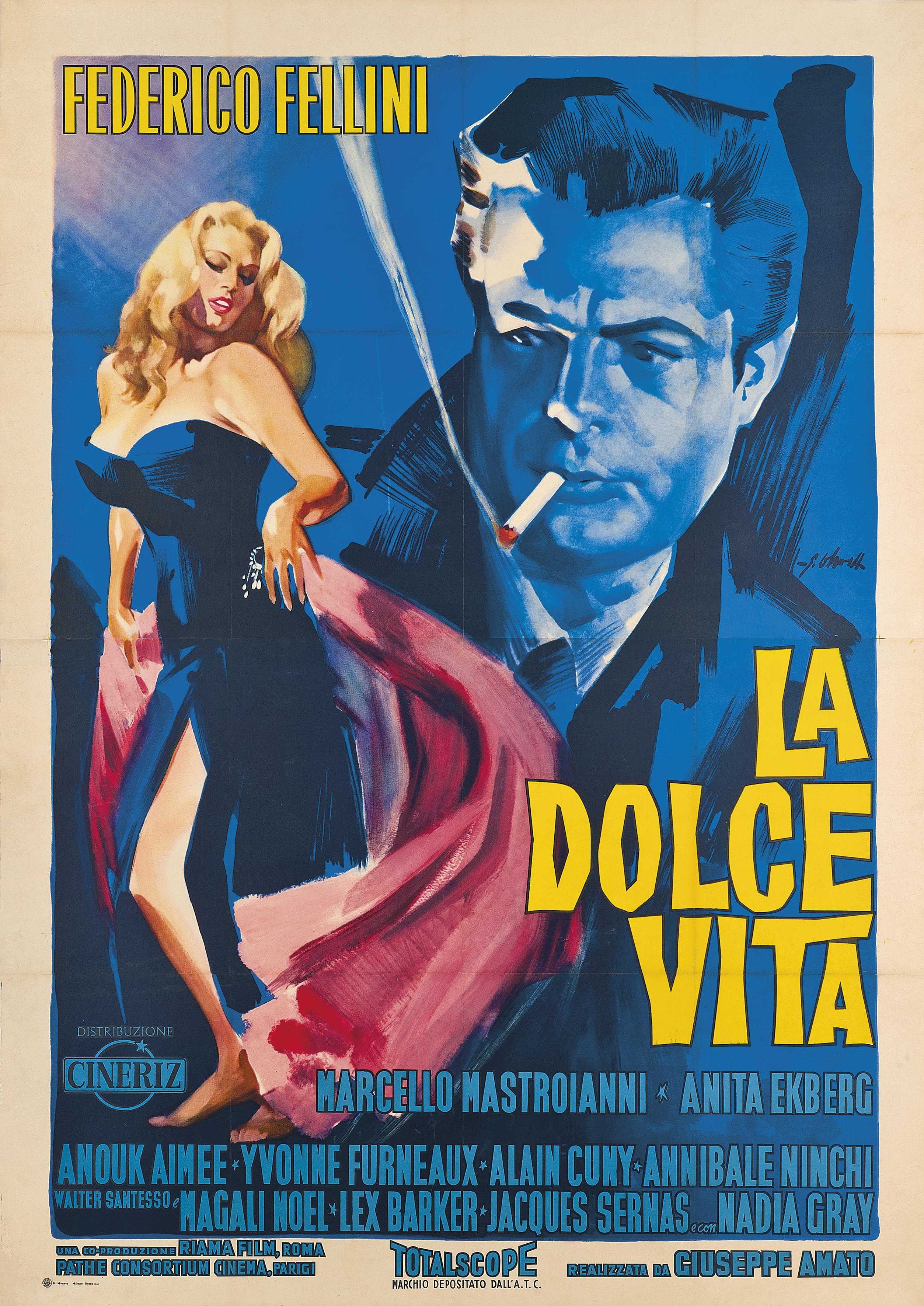
La Dolce Vita
1960 filmWikipedia
25
MENTIONS
12
EPISODES
11
PODCASTS
Search complete. 25 mentions across 12 episodes found for "La Dolce Vita".
Sep 14, 2026

speaker_0NARRATOR
All right, Steve and Ann will be right back, but first, another stop on the Hollywood tour.
speaker_0NARRATOR
Pretty much everyone has seen director Federico Fellini's La Dolce Vita.
speaker_0NARRATOR
It's the 1960 film with Anita Ekberg and Marcello Mastroianni.
speaker_0NARRATOR
Now, is there another more famous and memorable scene from Italian cinema than that Trevi Fountain midnight romp? I mean, who can visit or even think about this iconic Roman fountain without conjuring up that scene, even if you haven't seen the full three-hour movie? While the fountain scene lasts only about two minutes in the film, it took a week of filming in early March of 1959 under chilly Roman skies.
speaker_0NARRATOR
Well, that added color to the water, and it satisfied Fellini.
speaker_0NARRATOR
And since the movie's presented in black and white, that's a detail we can only imagine.
speaker_0NARRATOR
This is in the perfect keeping with one storyline of La Dolce Vita itself, the work that launched the phrase paparazzi for the first time.
speaker_0NARRATOR
That describes the intrusive photographers that surrounded celebrities in the newly post-war, sparkling, and chic city of Rome in the late 1950s and early '60s.

Craig JohnsonHOST
As Kim Newman points out in his book Nightmare Movies, quote, He creates a style-obsessed, emotionally frigid modern world that provides the perfect context for his callous stories and shatteringly staged violence.
Craig JohnsonHOST
Whereas before the war, Italian filmgoers aspired to, or at worst envied, La Dolce Vita, Argento's audience insists the haute bourgeoisie should suffer for their privilege by dying in elaborate agony.
Craig JohnsonHOST
End quote.
Craig JohnsonHOST
And modern and style-obsessed is certainly one way to describe Tenebrae, which, unlike the director's earlier films, avoids the depiction of anything that might be remotely described as classical or historic.

Federico FelliniGUEST
Every character returns in a different form.
Federico FelliniGUEST
La Dolce Vita ends with a girl on a beach calling to Marcelo across the water, and he cannot hear her.
Federico FelliniGUEST
Eight and a Half ends with a circle of hands.
Federico FelliniGUEST
Amarcord ends with a ship passing in the fog, the same fog it began with.

Adam LundyHOST
But also, funnily enough, it's it's very prescient of other kind of tabloid journalism films that wouldn't come out for a few more years.
Adam LundyHOST
You think of Sweet Smell of Success in the US and La Dolce Vita, you know, and that was 57 in 1960, you know, respectively.
Adam LundyHOST
So it's kind of a little bit ahead of its time in a way as well in terms of like really pushing back on showing the dirty side of this kind of journalism.
Chris HaskellHOST
Yeah.
Russell HowardHOST
Then a great episode with the film director, Joe Maggio, whose tales about growing up in working class Buffalo could have come straight out of a screenplay.
Joe MaggioGUEST
What is your next brilliant thing? My next brilliant thing is the film, La Dolce Vita, which- I
Russell HowardHOST
know
Joe MaggioGUEST
nothing
Joe MaggioGUEST
And like everything is there, the great themes that they're gonna be wrestling with.
Joe MaggioGUEST
You can divine them right from the beginning.
Joe MaggioGUEST
And in La Dolce Vita, La Dolce Vita opens with a helicopter carrying a giant statue of Jesus over Rome.
Joe MaggioGUEST
And it's this enormous thing and everyone's looking up and it's casting these long shadows on the ground and the children are running and chasing the helicopter.

E. Michael JonesGUEST
So i- in many ways, you could take this as a veiled, uh, the, a veiled reference to the threat of America, which is the Jews and their, their ide- their, uh, ideology.
E. Michael JonesGUEST
But it's, uh, I, I've always said the, if you want a cultural reference point to understand th- the times, the zeitgeist, the spirit of the times, I think you should, uh, watch Federico Fellini's film, uh, La Dolce Vita.
Mike PajakisHOST
Okay.
E. Michael JonesGUEST
Uh, because Totaviani and, Pr- Ottaviani's preliminary documents and were written at the same time as Fellini's movie, La Dolce Vita, came out.
E. Michael JonesGUEST
It was a big scandalous movie, uh, about...
E. Michael JonesGUEST
What's it about? It's basically about the Americanization of Italy.
E. Michael JonesGUEST
They love being over here, and so on and so forth, uh, but they're destroying our culture.
Mike PajakisHOST
Yeah.

E. Michael JonesGUEST
So i- in many ways you could take this as a veiled, uh, the, a veiled reference to the threat of America, which is the Jews and their, their ide- their, uh, ideology.
E. Michael JonesGUEST
But it's, uh, I, I've always said that if you want a cultural reference point to understand th- the times, the zeitgeist, the spirit of the times, I think you should, uh, watch Federico Fellini's film, uh, La Dolce Vita.
speaker_0HOST
Okay.
E. Michael JonesGUEST
Uh, because Ottaviani and, Ottaviani's preliminary documents and were written at the same time as Fellini's movie, La Dolce Vita, came out.
E. Michael JonesGUEST
It was a big scandalous movie, uh, about...
E. Michael JonesGUEST
What's it about? It's basically about the Americanization of Italy.
E. Michael JonesGUEST
They love being over here, and so on and so forth, uh, but they're destroying our culture.
speaker_0HOST
Yeah.

Big HassHOST
The term comes from paparazzo, a persistent news photographer character in, um...
Big HassHOST
I think it was in a film, La Dolce Vita, right? It came from that.
Big HassHOST
Using long-term range, uh, telephoto lenses, hiding, chasing subjects in vehicles.
Big HassHOST
You know, it's, it's, it's also very controversial in my opinion.

Richie UnterbergerGUEST
I'm giving away trivia question here of Serge Gonsberg's film music.
Richie UnterbergerGUEST
Nico had appeared in La Dolce Vita, a notable supporting role, a very famous film by Federico Fellini.
Richie UnterbergerGUEST
Her only lead role in a commercial film was two or three years later.
Richie UnterbergerGUEST
It's a film called Striptease, made in France.

Russell HowardHOST
[upbeat music] What is your next brilliant thing?
Joe MaggioGUEST
Uh, my next brilliant thing is the film La Dolce Vita, which-
Russell HowardHOST
Right, I know nothing about this film
Joe MaggioGUEST
...
Russell HowardHOST
Right.
Joe MaggioGUEST
You c- you can divine them right from the beginning.
Joe MaggioGUEST
And in La Dolce Vi- uh, La Dolce Vita opens with a helicopter carrying a giant statue of Jesus over Rome, and it's just, it's this enormous thing, and everyone's looking up, and it's casting these long shadows on the ground, and the children are running and chasing the helicopter.
Joe MaggioGUEST
And then there's this follow helicopter of this journalist, uh, played by, um, Marcello Mastroianni.
2 more episodes mention La Dolce Vita.
Create an account to see the whole feed, search across every transcript, and follow the entities you care about.