Kurukshetra
City in IndiaWikipedia
83
MENTIONS
33
EPISODES
25
PODCASTS
Search complete. 83 mentions across 33 episodes found for "Kurukshetra".
Sep 11, 2026

Alok PandeyHOST
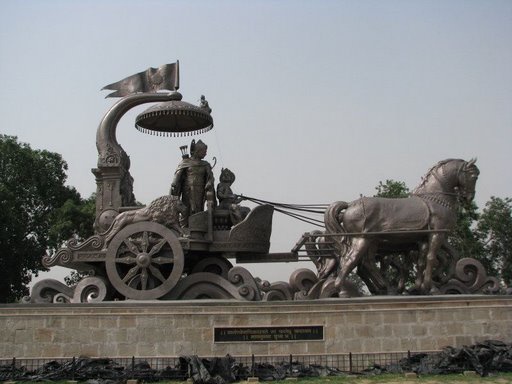
It was the image of Sri Krishna and Arjuna on the chariot.
Alok PandeyHOST
And when Sri Aurobindo was asked which aspect of Sri Krishna you were in contact with, he said Sri Krishna of Kurukshetra.
Alok PandeyHOST
So whenever there is a great upheaval, a great change.
Alok PandeyHOST
But this is one part of it.

speaker_4NARRATOR
Dhritarashtra.
speaker_4NARRATOR
Ranged thus for battle on the sacred plain, on Kurukshetra, say Sanjaya, say, what wrought my people and the Pandavas? Sanjaya.
speaker_4NARRATOR
When he beheld the host of Pandavas, Raja Duryodhana to Drona drew, and spake these words.
speaker_4NARRATOR
Ah Guru, see this line, how vast it is of Pandu fighting men, embattled by the son of Drupada, thy scholar in the war.

Dhanurdhara SwamiHOST
He had that kind of duality when you're faced with the person whom you love, but not in the atmosphere where you can love him.
Dhanurdhara SwamiHOST
Like Radharani, Srimati Radharani in Kurukshetra is really the classic, classic example.
Dhanurdhara SwamiHOST
And Gop Kumar, first in Vaikuntha, then in Yoja, and so intimate, more intimate with Ramachandra and Hanuman and all the associates, and there's something personal going on, but at the same sense, it's not the full manifestation of that person whom he loves.
Dhanurdhara SwamiHOST
And Ramachandra being compassionate, This is our faith.

Sacinandana SwamiHOST
and he needed to also not just destroy the evil doers, he needed to establish what? Dharma.
Sacinandana SwamiHOST
How did he do this? He spoke at the battlefield of Kurukshetra, the book about all dharmas.
Sacinandana SwamiHOST
Loka dharmas, what is it? Loka dharma, sva dharma, and...
Sacinandana SwamiHOST
Sanatana Dharma.
8 MINS LATER
Sacinandana SwamiHOST
The message read, You have tried so many times to come and see me and also I have wanted to come to you but I have not been able.
speaker_1UNKNOWN
Now there's an opportunity
Sacinandana SwamiHOST
All the kings, all the saintly personalities and yogis will assemble for the sun eclipse at the holy place of Kurukshetra.
Sacinandana SwamiHOST
And I will also come.
Sacinandana SwamiHOST
This is a very, very inauspicious event, but when it is celebrated at a holy place, it is very, very, very auspicious.
Sacinandana SwamiHOST
So all the citizens of Dvaraka, including Krishna, went to the holy place of Kurukshetra to observe the sun eclipse.
Sacinandana SwamiHOST
And Krishna had written earlier a letter.
Sacinandana SwamiHOST
To whom did he write the letter?
Sacinandana SwamiHOST
It's getting into the spirit of Rathayatra.
Sacinandana SwamiHOST
He had written a letter to the Vajravasis in Vrindavan.
Sacinandana SwamiHOST
Come, see me at Kurukshetra.
Sacinandana SwamiHOST
There we will meet again and our hearts will be satisfied.

Artificially AwareHOST
But this wasn't just any battlefield.
Artificially AwareHOST
This was Kurukshetra, a wasteland of scorched earth and shattered nerves, where the great warrior Arjuna slumped in his chariot, too riddled with moral angst to even lift his bow.
Artificially AwareHOST
This wasn't a story about physical war.
Artificially AwareHOST
It was the war inside.
18 MINS LATER
speaker_1ADVERTISER
What propels you? Propel with Gatorade Electrolytes.
Artificially AwareHOST
It's a guide for living in the chaos of modern life.
Artificially AwareHOST
The constant struggle between what you want, what you're supposed to do, and what's actually right is the battle of Kurukshetra being played out over and over right there in your head So what's the takeaway? Arjuna's victory wasn't just about lifting his bow.
Artificially AwareHOST
It was about lifting the weight of doubt off his shoulders.
Alok PandeyHOST
He can not only foresee, steer you through everything.
Alok PandeyHOST
And that's where the whole Kurukshetra battle is reminded.
Alok PandeyHOST
So, you just call the Divine.
Alok PandeyHOST
It doesn't matter.

Alan MapstoneNARRATOR
To imitate Socrates would be a miserable affectation; to imitate the religious hero is regarded as a common duty.
Alan MapstoneNARRATOR
It may seem impossible to dower the heroes and heroines of literature with this projective energy of the lives of saints but in India—as to some extent in Iceland—the feat has been accomplished For India is also one of the saga lands At every lull in her history we may hear the chanting of her bards And the joy of her people in the story of their past The long twilight of the North Is no better adapted to the growth Of such a literature than the deep And early night of the South In verandas and courtyards With the women concealed behind screens at the back it has been the Indian fashion for hundreds of years through the winter months to gather at dusk round the seat of the wandering teller and listen hour after hour to his stirring theme Surrounded by lights and flowers Gay carpets and burning incense There is in this performance A mixture of reading song and story It is something of opera Sermon and literature All in one Ever since the commencement of our era The Hindu people Have possessed in their present forms Two great poems: the Mahabharata and the Ramayana The first of these is Their Wars of Troy Their Heimskringla Their Morte D'Arthur That is to say It is the books of The deeds and the wars of the heroes Thanks to a Long-established culture of the race And the prestige which all Literature enjoys As sacred The Mahabharata is to This day the strongest influence In the shaping of the Lives and ambitions of Hindu boys The battle Which it describes took place If at all Very nearly fifteen hundred Years before the birth of Christ It lasted many days And the field of combat Was called Kurukshetra Being situated On that great plain near Delhi Where critical moments in the History of India Have Been so often decided For many a century After Kurukshetra The Wandering Bards all Over India sang of the Great Battle And when any new Theme claimed their creative powers It had to be recounted As if originally told By one of the Heroes to another At Some particular point In the course of the Main narrative In this way the heart's Heart of the whole poem The Bhagavad Gita--a title Translated by some scholars As Gospel of the Bhagavats Brings an interesting Instance of double drama with it The Gita consists in itself Of a dialogue between A young chieftain and Krishna The divine personage Who is acting as His charioteer At the moment of The opening of the Eighteen days' Combat But the device Which enables the Conversation to Be given in Detail Is the picture Of an old blind king Head of One of the rival houses Seated some miles away And attended in his Anxiety by a man of What is called Yogic Or hyperesthetic (that is Psychic) sense Who utters to him Every word that is spoken The exquisite Story of Savitri Similarly is Told by a rishi or Great sage Yudhisthira At the close of Day During the banishment Of the five Pandavas To the forest On this plan More than half of the Countryside tales of Northern India Could be woven into The Mahabharata When it was First thrown Into form by some Unknown hand Three or four Centuries Before Christ It underwent Its final recension Not more Than two or three Hundred years later A possible Fifteen hundred years After the occurrence Of the events which Are its central theme It is easy to see That this Saga fulfills thus All the conditions Of great epic poetry The stories that it tells Have been worked over By the imagination Of singers and People for Hundreds of years They have become Simple direct inevitable They are Spoken out of The innermost heart Of a nation not Yet dreaming of Self consciousness They are nothing If not absolutely sincere Comparing the Mahabharata With the Iliad and Odyssey We find it less Formed Less highly wrought More amorphous But also More brilliant And intense "To quote a great indian Writer" on Indian thought Outline is entirely Lost in color These characteristics Do not hold good To the same Extent of The second Indian Epic the Ramayana Which Has a closely Worked motive Running throughout This Poem the tale Of the exile of Sita And Rama Received Its Present form Not long after The mahabharata Early In the Buddhist Period It is supposed That under buddhist Influence The monastic Life Had come to Be So honored That the flower Of the Nation were Drawn to it Rather than to The mingled Responsibilities And joys of The home The romantic Reaction in Ideals Which was Inevitable Gathered itself About the ancient Theme of a Princely couple Of the house Of Oith In whom all That was precious In Monasticism Was found blended With all that was Desirable In sovereignty And love The strong And quiet story spoke Straight to the Heart Of the People And to this Day there are No characters so Beloved by the Masses as those Of the ramayana No one force That goes so far Towards The molding of Indian womanhood As the everliving Touch of the Little Hand of that Sita Who is Held to have been Queen of Ayodhya Thousands of years ago The Ramayana then Is a Love story Which grew up And came to Its flowering In the beginning Of the Christian Era But it is unlike all other romances of that early epoch in the subtlety and distinctiveness of its various characters, and in the complexity of its interpretation of life.
Alan MapstoneNARRATOR
For though humanity itself may differ little from age to age, we have become accustomed to look for a definite growth in its literary self-reflection.
Alan MapstoneNARRATOR
We expect primitive poetry to be preoccupied with events, portraying men and women only in bold outline as they move with simple grandeur through their fate.
17 MINS LATER
Alan MapstoneNARRATOR
In order therefore that he may display all the greatness of character that is possible to a man in these relations, Bhishma is made as heir to the throne to renounce all rights of succession (and even of marriage) at the beginning of his life by way of setting his father free to marry a fisher girl whom he loves and make her son his heir.
Alan MapstoneNARRATOR
From this point having set aside the privileges of Parent and Sovereign, Bhishma is made to bear to the full the responsibilities of both; and finally, in the energy and faithfulness of his military service, life itself can only be taken from him when he with his own lips hath given instructions for his defeat.
Alan MapstoneNARRATOR
In Bhishma therefore we have the creation of a People who have already learnt to regard detachment as a necessary element of moral grandeur It is strange to us, but perfectly consistent with this point of view that as long as Bhishma remains a militant figure in the Battle of Kurukshetra, he is acting as generalissimo for what he regards as the worst cause of the two.
Alan MapstoneNARRATOR
He has done his best to prevent the war, but when it is determined on, he sets himself to obey his sovereign in the place that is his own.

speaker_0HOST
And from here on, Krishna's life would begin to change again.
speaker_0HOST
New kingdoms, new battles, new friends and eventually war at Kurukshetra.
speaker_0HOST
But those Kathas are for another day.
speaker_0HOST
If you've enjoyed the Katha project so far, it would be amazing if you could share it with your friends and family.
Dhanurdhara SwamiHOST
So after a while of bathing in the fragrance of Ram, it's just...
Dhanurdhara SwamiHOST
It's Radharani and Kurukshetra.
Dhanurdhara SwamiHOST
It's the same person, but it's not like before.
Dhanurdhara SwamiHOST
It's not what I need.
23 more episodes mention Kurukshetra.
Create an account to see the whole feed, search across every transcript, and follow the entities you care about.