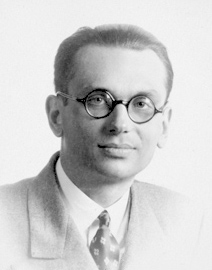
Kurt Gödel
Logician and mathematicianWikipedia
72
MENTIONS
27
EPISODES
24
PODCASTS
Search complete. 72 mentions across 27 episodes found for "Kurt Gödel".
Sep 23, 2026

Peter WolfendaleGUEST
So in a given situation, right, I have a certain set of concepts, types with their definitions, right? And I've got a certain number of theorems, right? And I might, you know, and
Peter WolfendaleGUEST
the question is, what can I deduce from that? But as Gödel showed, there are going to be some things that I can't prove with that set of things when you pack them down into axioms.
Peter WolfendaleGUEST
And the way I read this is, again, in terms of questions versus judgments, what intuitionistic
Peter WolfendaleGUEST
logic gives you is the structure of questions.
4 HRS 8 MINS LATER
Peter WolfendaleGUEST
Another person here who's really useful on this is Awadi.
Peter WolfendaleGUEST
Awadi's paper on bracket types is... basically shows that the double negation construction
Peter WolfendaleGUEST
that Gödel came
Peter WolfendaleGUEST
up with for translating

Justin SledgeHOST
The argumentative power which had been a mainstay, a philosophical mainstay, for 700 years It just evaporated.
Justin SledgeHOST
And then, some centuries later, Kurt Gödel adopted a modal version of that same argument such that by theological necromancy, the argument, the ontological argument, might live again, valid if not sound and risking modal collapse all the while.
Justin SledgeHOST
The Renaissance also saw the meteoric rise of a renewed ancient philosophy, Hermeticism.
Justin SledgeHOST
This Greco-Egyptian philosophy of salvation was heralded by luminaries of the time as a source of primeval wisdom, which would ultimately renovate all of philosophy and spirituality.

Tyrell JamesHOST
I'm not sure where it was in the movie.
Tyrell JamesHOST
Kurt Godel, an Austrian logician and mathematician, is played.
Tyrell JamesHOST
I don't know where he popped up in the movie, but that was James Urbaniak, dude.
Tyrell JamesHOST
That was Doc Venture.

JacobHOST
we can go in one of two directions.
JacobHOST
We can talk about Anselm's ontological proof and Gödel's kind of like furtherance of it.
JacobHOST
He's a mathematician, logician, later on, more contemporary.
JacobHOST
Or we can talk about today's readings with the wicked servant and the forgiveness of God and the many, many talents that he owed in debt.

Jeevan MatharuHOST
There is a more in-depth version of this that goes into statements like this law applies to all laws, but it's not something we're going to talk about here.
Jeevan MatharuHOST
And then in 1931, Kurt Gödel proved that any consistent formal system, powerful enough to express basic arithmetic, contains statements that are true but cannot be proven within that system.
Jeevan MatharuHOST
He illustrated this by creating a statement, much like Pinocchio's one.
Jeevan MatharuHOST
This statement cannot be proven within the system.
Jeevan MatharuHOST
When John von Neumann grasped the significance of the proof, his phrase was, it's all over.
Jeevan MatharuHOST
For a moment, imagine a perfect calculator that could answer every mathematical question.
Jeevan MatharuHOST
Gödel essentially showed that such a machine is impossible in principle.
Jeevan MatharuHOST
Any sufficiently powerful formal system will inevitably generate some questions it cannot answer from within its own rules.

Anna DeanHOST
He says it's categorically false, and he uses mathematics to argue his point.
Anna DeanHOST
He draws on Kurt Gödel's incompleteness theorem and Turing machines.
HallowayGUEST
How does an equation from the 1930s show my brain isn't a computer?
Anna DeanHOST
Let's look at the core concept.

speaker_0NARRATOR
You might get to Ellie J. Brower, intuitionism, constructivism, and bulbaki.
speaker_0NARRATOR
But at some point, you'll probably hit Gödel and Turing, and then you'll likely start thinking about computation.
speaker_0NARRATOR
Computation is the abstraction of computation.
speaker_0NARRATOR
Its avatars include the P versus NP problem, Gödel's incompletions theorems, Turing's imitation game, and many descendants.
speaker_0NARRATOR
As a field, computation leads to some deep, thought-provoking questions, and to some that, once upon a time, I thought held no interest at all.
speaker_0NARRATOR
In particular, I remember learning about computer programs called proof assistants, such as Coq, now Rock.
8 MINS LATER
speaker_0NARRATOR
This will further devastate universities and continue to eat away at the soft money edifice they rely on.
speaker_0NARRATOR
The resulting not-quite-academic findings will be leased back to us at profit, or held closely, developed in secret, and revealed as barely comprehensible jewels of arcana that, like Renaissance mathematicians at court, lend a bit of stature, a dash of rivalry, some injections of cash, and the imprimatur of legitimacy to the shady or primary activities of the companies.

speaker_7HOST
And we can push this mathematical logic to its extreme limits.
speaker_7HOST
This brings us to Kurt Gödel, one of the greatest logicians in human history.
speaker_6HOST
Oh, this part is fascinating.
speaker_7HOST
He is most famous for his incompleteness theorems in mathematics.
speaker_7HOST
But in 1949, Gödel was at the Institute for Advanced Study in Princeton, working right alongside Albert Einstein.
speaker_7HOST
They used to walk home together every day.
speaker_7HOST
What a
speaker_6HOST
duo.

Alejandro DolinaHOST
No sé, no sé.
Alejandro DolinaHOST
En 1931, el lógico austríaco Gödel, Kurt Gödel, publicó sus, este, famosos teoremas de la incompletitud y demostró algo que hizo temblar a la ciencia y que acá siempre decimos de un modo u otro.
Alejandro DolinaHOST
Cualquier sistema matemático lo suficientemente complejo siempre con-contendrá verdades que son imposibles de demostrar.
Alejandro DolinaHOST
Y son imposibles de demostrar utilizando las propias reglas de ese mismo sistema.
Alejandro DolinaHOST
Si asumimos que el universo está regido por leyes físicas y matemáticas, la conclusión de Gödel nos dice que al estar nosotros atrapados dentro del universo, siempre existirán verdades fundamentales que jamás podremos probar.
Alejandro DolinaHOST
Lo que decimos el otro día acerca de los lenguajes.
Alejandro DolinaHOST
Cuando está uno dentro de un lenguaje, eh, está preso de ese mismo lenguaje, tiene que salirse para afuera para demostrar cosas de adentro.

Jimmy AkinHOST
The ontological argument holds that you can demonstrate the existence of God just from properly understanding the concept of God.
Jimmy AkinHOST
A version of this argument was made famous by St. Anselm of Canterbury back in the 1100s, and there have been other versions of it, such as one by the 20th century mathematician Kurt Gödel.
Jimmy AkinHOST
who is one of the most famous mathematicians ever and a really sharp thinker.
Jimmy AkinHOST
So I have an intuition that even if some versions of the ontological argument, like Anselm's, need refinement, that I think a version of the ontological argument can succeed.
Jimmy AkinHOST
More than the ontological argument, though, I'm a fan of the contingency argument.
17 more episodes mention Kurt Gödel.
Create an account to see the whole feed, search across every transcript, and follow the entities you care about.