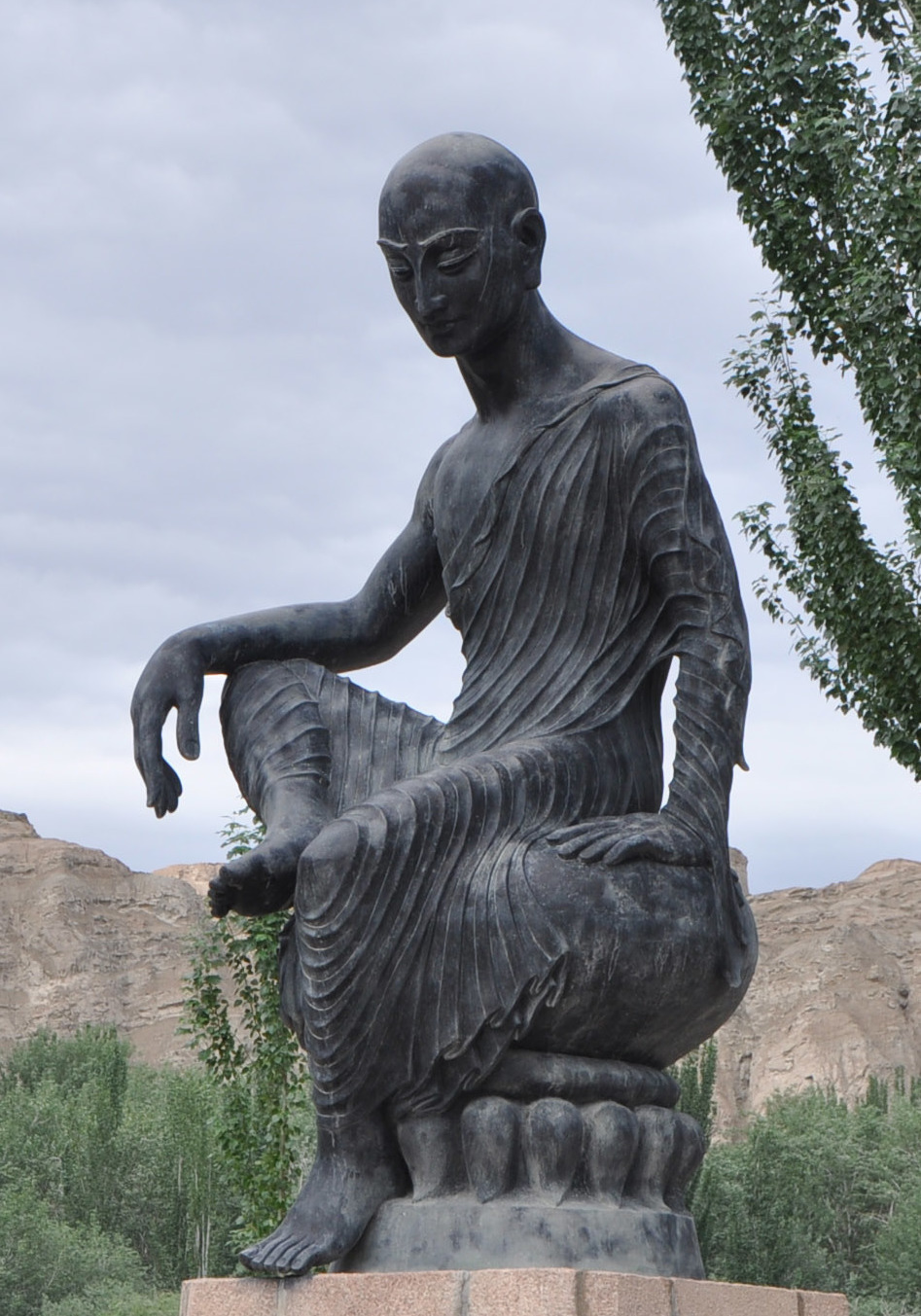
Kumārajīva
MonkWikipedia
54
MENTIONS
21
EPISODES
19
PODCASTS
Search complete. 54 mentions across 21 episodes found for "Kumārajīva".
Oct 14, 2026

Laszlo MontgomeryHOST
Or have we? Well, you can be the judge of that.
Laszlo MontgomeryHOST
We finished off last time with a quick sidebar looking at the life of the Buddhist monk Shenzang.
Laszlo MontgomeryHOST
And we ended in the milestone year of 630, four years into Taizong's reign.
Laszlo MontgomeryHOST
After the defeat of the Eastern Turks and subsequent conquest of Inner Asia, things were shaping up to be a golden age for China.
5 MINS LATER
Laszlo MontgomeryHOST
During the late Ming Dynasty, sixteen twenty-five or thereabouts, a nine-foot tall, two-ton black limestone stele or monument was dug out of the ground not too distant from Xi'an.
Laszlo MontgomeryHOST
This stele told us the exact date of Christianity's first arrival in China.
Laszlo MontgomeryHOST
The eighteen hundred, nineteen hundred Chinese characters and Syriac writing carved into this Nestorian Stele as it became known, told the story of the monk Alopen or Aòlèpěn in Mandarin, who came to China in the year six thirty-five.
Laszlo MontgomeryHOST
Alopen is generally agreed by most everyone to have been the first Christian missionary to come to China.

John GreenmanNARRATOR
Preface.
John GreenmanNARRATOR
This English version of The Diamond Sutra, translated from the Chinese text of Kumarajiva, owes its inception to successive conversations with a friend profoundly interested in the interpretation of Oriental systems of philosophy.
John GreenmanNARRATOR
During those conversations, renderings into English were made of numerous passages from the works of Confucius, Mencius, and Lao Tzu.
John GreenmanNARRATOR
Having surveyed briefly those fertile fields of thought, we passed by a natural transition into the delectable Buddhist realm.
5 MINS LATER
speaker_5ADVERTISER
Because a great trip starts with peace of mind, and maybe a good playlist.
speaker_5ADVERTISER
But we've got the peace of mind part covered.
John GreenmanNARRATOR
To Kumarajiva, a native of Kashmir, who gained distinction as a monk of the later Qin Dynasty, AD three eighty-four to four seventeen, is conceded the honor of having first translated the Diamond Sutra into the Chinese language.
John GreenmanNARRATOR
Of subsequent Chinese translations, perhaps the most noteworthy is the text ascribed to the scholarly Hiun Tsang and completed about the middle of the seventh century.

John GreenmanNARRATOR
Preface.
John GreenmanNARRATOR
This English version of the Diamond Sutra, translated from the Chinese text of Kumarajiva, owes its inception to successive conversations with a friend profoundly interested in the interpretation of Oriental systems of philosophy.
John GreenmanNARRATOR
During those conversations, renderings into English were made of numerous passages from the works of Confucius, Mencius, and Lao Tzu.
John GreenmanNARRATOR
Having surveyed briefly those fertile fields of thought, we passed by a natural transition into the delectable Buddhist realm.
5 MINS LATER
speaker_6ADVERTISER
With Vrbo care, help is always ready before, during, and after your stay.
speaker_6ADVERTISER
We've planned for the plot twists, so support is always available because a great trip starts with peace of mind.
John GreenmanNARRATOR
To Kumarajiva, a native of Kashmir who gained distinction as a monk of the later Qin dynasty, AD three eighty-four to four seventeen, is conceded the honor of having first translated the Diamond Sutra into the Chinese language.
John GreenmanNARRATOR
Of subsequent Chinese translations, perhaps the most noteworthy is the text ascribed to the scholarly Hiran Tsang and completed about the middle of the seventh century.

Mark HerrickHOST
In the first chapter of the Lotus, the Sanskrit text says the Buddha taught a great instruction before entering Samadhi, a state of deep meditative absorption, and it gives that teaching no content at all.
Mark HerrickHOST
When Kumarajiva translated the Lotus into Chinese in 406, he rendered the phrase as a Mahayana Sutra named Immeasurable Meanings.
Mark HerrickHOST
Within a few generations, a text with exactly that title was circulating in China, attributed to a translator credited with nothing else.
Mark HerrickHOST
No Sanskrit original has ever been found.

John GreenmanNARRATOR
Reis Davids, in his useful volume Buddhism, indicated that, quote, Dharma, palidama, is not law, but that which underlies and includes the law.
John GreenmanNARRATOR
a word often most difficult to translate, but best rendered here by truth and righteousness." Perhaps it may be opportune to remark that, had Kumarajiva regarded form, truth, or righteousness as expressing adequately the Sanskrit Dharma, these familiar terms being obviously at his command, might have been utilized at pleasure.
John GreenmanNARRATOR
Like the cultured Asvagocha, Kumarajiva may have regarded the nature of the law as coextensive with the illimitable ocean of being, and within that ample compass, perhaps he thought there might synthetically be included those beautifully defined concepts form, truth, and righteousness.
John GreenmanNARRATOR
chinese annotators of the diamond sutra seldom criticize adversely its classic terminology or suggest many inapplicable alternative renderings they appear to have surveyed the realm of spiritual wisdom enunciated by sakyamuni buddha and thereafter to have become greatly impressed by the thought that in its essence it might possibly be inexhaustible this may in part explain their motive for incorporating in the commentary a familiar passage from lao tzu infinite truth is inexpressible which in a measure illustrates the appreciable difficulty of stating in exact terms of philosophy the equivalent of the buddhic law in our intercourse with buddhist monks we heard the rather engaging suggestion that the familiar christian phrase the law of the spirit of life contains a spiritual concept which appears to approximate closely to the idea of the law of buddha those monks seem to believe that the law enters quietly and operates imperceptibly within every natural and spiritual sphere and that they have at least a semblance of reason for their belief the following exquisite lines clearly indicate this is its touch upon the blossomed rose the fashion of its hand shaped lotus leaves that is its painting on the glorious clouds and these its emeralds on the peacock's train out of the dark it wrought the heart of man out of dull shells the pheasant's pencilled neck it spreadeth forth for flight the eagle's wings what time she beareth home her prey this is its work upon the things ye see the unseen things are more men's hearts and minds the thoughts of peoples and their ways and wills those too the great law binds as we consider the manifold operations of this law which moves to righteousness perhaps we may gradually appreciate the dignified mind of sakyamuni when he addressed subhuti saying what is usually referred to as the law of buddha is not in reality a law attributive to buddha it is merely termed the law of buddha the sanskrit term samna usually rendered into chinese by ming and into english by name seems to deserve our further attention like the term dharma a clear knowledge of sangma is indispensable for a correct understanding of our text in one of the opening passages of the diamond sutra we find that sakyamuni buddha in reply to an inquiry by sabuti suggests that by means of this wisdom enlightened disciples shall be enabled to bring into subjection every inordinate desire every species of life whether hatched in the egg formed in the womb evolved from spawn produced by metamorphosis with or without form or intelligence possessing or devoid of natural instinct from these changeable conditions of being i command you to seek deliverance in the transcendental concept of nirvana thus you shall obtain deliverance from the idea of an immeasurable innumerable and illimitable world of sentient life but in reality there is no idea of a world of sentient life from which to obtain deliverance and why because in the mind of an enlightened disciple there have ceased to exist such arbitrary ideas of phenomena as an entity a being a living being or a personality a similar process of reasoning appears to permeate the whole of the diamond sutra and whether appertaining to a living being a virtue a condition of mind a buddhist kingdom or a personal buddha there is implied in each concept a spiritual essence only imperfectly described if not entirely overlooked in the ordinary use of each particular name shakespeare inquired what's in a name and in a thought inspired by the rose and its delicious fragrance suggested with buddha that there is little or nothing in a name which explains the real nature of an object even a particle of dust seems to the buddhist mind to embody in its composition a subtle spiritual element entirely inscrutable and quite incomprehensible According to the Mahayana school of Buddhist thought, objects and their respective names are alike unreal and illusory.
John GreenmanNARRATOR
Objects and names, in the abstract, represent merely the products of untutored and unenlightened minds.
Laszlo MontgomeryHOST
And just as his predecessor, the Taizong Emperor, did, the Gaozong Emperor made sure there was always enough money to support all the endeavors of Xuanzang.
Laszlo MontgomeryHOST
Along with Kumarajiva, translator of the Lotus and Diamond Sutras, known as Jomoloshir, who lived 344 to 413, Xuanzang's impact on Buddhism and Buddhist thought knew no rivals.
Laszlo MontgomeryHOST
No one translated more books of Buddhism than Xuanzang.
Laszlo MontgomeryHOST
In total, he's credited with 72 works that were printed on more than a thousand scrolls.

John GreenmanNARRATOR
Preface.
John GreenmanNARRATOR
This English version of The Diamond Sutra, translated from the Chinese text of Kumarajiva, owes its inception to successive conversations with a friend profoundly interested in the interpretation of Oriental systems of philosophy.
John GreenmanNARRATOR
During those conversations, renderings into English were made of numerous passages from the works of Confucius, Mencius, and Lao Tzu.
John GreenmanNARRATOR
Having surveyed briefly those fertile fields of thought, we passed by a natural transition into the delectable Buddhist realm.
John GreenmanNARRATOR
In the year eighteen thirty-six, Tsomo Khorosi published an account of the Tibetan translation, which interesting document may be consulted in volume twenty of the Asiatic researches.
John GreenmanNARRATOR
The Diamond Sutra is therein designated the Sutra of Wonderful Effects, a treatise by means of which Sakyamuni Buddha instructs Subhuti, one of his conspicuous disciples, in the Prajna-paramita of Transcendent Wisdom.
John GreenmanNARRATOR
To Kumarajiva, a native of Kashmir, who gained distinction as a monk of the later Qin Dynasty, AD three eighty-four to four seventeen, is conceded the honor of having first translated The Diamond Sutra into the Chinese language.
John GreenmanNARRATOR
Of subsequent Chinese translations, perhaps the most noteworthy is the text ascribed to the scholarly Hiuen Tsang and completed about the middle of the seventh century.

John GreenmanNARRATOR
Preface.
John GreenmanNARRATOR
This English version of The Diamond Sutra, translated from the Chinese text of Kumarajiva, owes its inception to successive conversations with a friend profoundly interested in the interpretation of Oriental systems of philosophy.
John GreenmanNARRATOR
During those conversations, renderings into English were made of numerous passages from the works of Confucius, Mencius, and Lao-tzu.
John GreenmanNARRATOR
Having surveyed briefly those fertile fields of thought, we passed, by a natural transition, into the delectable Buddhist realm.
John GreenmanNARRATOR
In the year eighteen thirty-six, Tsomo Khorosi published an account of the Tibetan translation, which interesting document may be consulted in volume twenty of the Asiatic Researches.
John GreenmanNARRATOR
The Diamond Sutra is therein designated the Sutra of Wonderful Effects, a treatise by means of which Sakyamuni Buddha instructs Subhuti, one of his conspicuous disciples, in the Prajna-paramita of Transcendent Wisdom.
John GreenmanNARRATOR
To Kumarajiva, a native of Kashmir, who gained distinction as a monk of the Later Ch'in Dynasty, AD three eighty-four to four seventeen, is conceded the honor of having first translated The Diamond Sutra into the Chinese language.
John GreenmanNARRATOR
Of subsequent Chinese translations, perhaps the most noteworthy is the text ascribed to the scholarly Hiuen Tsang and completed about the middle of the seventh century.

speaker_6ADVERTISER
true
Jeffrey EdwardsNARRATOR
and real not vain therefore we repeat the prajna paramita dharani then also say jyedi jyedi bholo jyedi bholo sungyedi bhuti sapaha gati gati paragati parasangati bodhisvaha The Diamond Sutra, Ching Kang Ching, or Prajna Paramita, translated from Sanskrit to Chinese by Kumarajiva, translated from Chinese to English by William Gimel.
Jeffrey EdwardsNARRATOR
This LibriVox recording is in the public domain.
Jeffrey EdwardsNARRATOR
1.

John GreenmanNARRATOR
The Diamond Sutra, by Unknown, translated from the Chinese with an introduction and notes by William Gemmell.
John GreenmanNARRATOR
Preface and Introduction Preface This English version of the Diamond Sutra, translated from the Chinese text of Kumara Jiva, owes its inception to successive conversations with a friend profoundly interested in the interpretation of Oriental systems of philosophy.
John GreenmanNARRATOR
During those conversations, renderings into English were made of numerous passages from the works of Confucius, Mencius, and Lao Tzu.
John GreenmanNARRATOR
Having surveyed briefly those fertile fields of thought, we passed, by a natural transition, into the delectable Buddhist realm.
11 more episodes mention Kumārajīva.
Create an account to see the whole feed, search across every transcript, and follow the entities you care about.