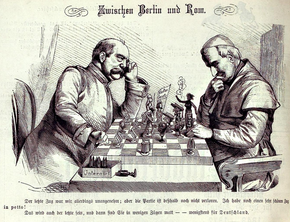
Kulturkampf
13
MENTIONS
10
EPISODES
4
PODCASTS
Search complete. 13 mentions across 10 episodes found for "Kulturkampf".
Oct 15, 2026

Thomas777GUEST
Now, granted, and yes, Germany's About one-third Roman Catholic.
Thomas777GUEST
But, uh, Bismarck's Kulturkampf was tremendously effective in basically rendering, um, the German state and the civil service that constituted that state at, um, level of executive enforcement, the same thing of decision-making, [coughs] had become very Protestant by design.
Thomas777GUEST
And also sectarian challenges aside, and I, I don't minimize those.
Thomas777GUEST
I mean, Germany was literally ground zero of the Thirty Years' War.

ThomasGUEST
Now, granted, and yes, Germany's about one-third Roman Catholic, but...
ThomasGUEST
Bismarck's Kulturkampf was tremendously effective in basically rendering the German state and the civil service that constituted that state at a level of executive enforcement, the same thing as decision-making, and become very protestant by design and also sectarian challenges aside and i i don't minimize those i mean germany was literally ground zero of the 30 years war this was not like a minor thing but there it was despite the regional attachments to germans and despite you know the kind of several populations who are um possessed of discrete cultural forms, you know, like a Swabian is not a Prussian is not a Bavarian, but there is like a German identity, like a Deutsch, like racial identity, if you will, that is not a British race.
ThomasGUEST
Okay.
ThomasGUEST
There's constituent elements of great Britain, but I, nobody would argue to the contrary.

Noah SmithGUEST
And decades before that, German immigration had essentially drawn to a close because Germany got rich and no one wanted to come anymore.
Noah SmithGUEST
And all the Catholic Germans fleeing Bismarck's Kulturkampf had already come here.
Noah SmithGUEST
And so there was never a German pause or an Irish pause.
Noah SmithGUEST
Sure.
ThomasGUEST
Um, Petain I think was eighty-four, eighty-five.
ThomasGUEST
Um, so I mean, uh, Adenauer was a remarkable guy, and he-- A-Adenauer was born in the Catholic Rhineland, okay? Um, and he was born, uh, literally, you know, at the kinda zenith of Bismarck's Kulturkampf.
ThomasGUEST
And for those that don't know, you know, Bismarck, the, the kinda arch Prussian Protestant, he did not trust Catholics.
ThomasGUEST
He, he purged Catholics from the kinda civil apparatus which, uh, had by that point was quite robust.
Pete QuiñonesHOST
In centuries subsequent, the city of Nuremberg endured all the traumatic upheavals wrought by the Protestant Reformation, the Thirty Years' War, and the conflict's long aftermath, ultimately becoming a late-blooming hub of Baroque aesthetic tendencies and high culture.
Pete QuiñonesHOST
The peculiar irony of Nuremberg having been the cultural symbolic, if not truly sovereign, seat of the Holy Roman Empire, subsequently becoming synonymous with Protestant resistance to the Catholic League, and ultimately attempting to enter into the formal union with the Kingdom of Prussia, progenitor of Kulturkampf, was not lost on Adolf Hitler.
Pete QuiñonesHOST
We've discussed this before.
Pete QuiñonesHOST
This was the fight to be...

speaker_0NARRATOR
But the whole program, for all its democratic clang, is tainted through and through by the Lasallian sect's servile belief in the state, or, what is no better, by a democratic belief in miracles, or rather it is a compromise between these two kinds of belief in miracles, both equally remote from socialism.
speaker_0NARRATOR
If one desired, at this time of the Kulturkampf, to remind liberalism of its old catchwords, it surely could have been done only in the following form.
speaker_0NARRATOR
everyone should be able to attend his religious as well as his bodily needs without the police sticking their noses in.
speaker_0NARRATOR
But the Workers' Party ought, at any rate in this connection, to have expressed its awareness of the fact that bourgeois freedom of conscience is nothing but the toleration of all possible kinds of religious freedom of conscience, and that for its part, it endeavours rather to liberate the conscience from the witchery of religion.
Pete QuiñonesHOST
In centuries subsequent, the city of Nuremberg endured all the traumatic upheavals wrought by the Protestant Reformation, the Thirty Years' War, and the conflict's long aftermath, ultimately becoming a late-blooming hub of Baroque aesthetic tendencies and high culture.
Pete QuiñonesHOST
The peculiar irony of Nuremberg having been the cultural symbolic, if not truly sovereign seat of the Holy Roman Empire, subsequently becoming synonymous with Protestant resistance to the Catholic League, and ultimately attempting to enter into the formal union with the Kingdom of Prussia, a progenitor of Kulturkampf, was not lost on Adolf Hitler.
Pete QuiñonesHOST
We've discussed this before.
Pete QuiñonesHOST
This was the fight.
ThomasGUEST
And the Second Reich, the Kaiserreich That was viewed as the ongoing process of realizing the destiny of the German Volk after the destruction of the empire.
ThomasGUEST
And that's one of the reasons, and I'm not saying this is a positive thing, because sectarianism is always ugly, but the Kulturkampf, which originally described the Hohenzollern effort to purge Catholic influence from public life, this endured until the end of the Kaiserreich in some sense.
ThomasGUEST
Supposedly Wilhelm II's wife wouldn't let Catholics in her house.
ThomasGUEST
But Prussia viewing itself not just as the master element of the German people and the first among the Volk, but they also, they're committed to never again allowing a supranational imperative or authority or power to set the Volk against itself.
ThomasGUEST
You know, and confidence in the state and confidence in the national narrative that, I mean, don't get me wrong, there was very bad blood owing to excesses of the Kulturkampf and a lot of Catholics were treated very badly.
ThomasGUEST
But that didn't deteriorate, that never deteriorated or unraveled into the kind of sectarian hatred that happened in the UK, which is interesting.
ThomasGUEST
But Germany also, the Kaiserreich was also far more of a united polity than the UK and even England, you know, within that structure.
1 HR 1 MIN LATER
ThomasGUEST
You know, so this idea of this sort of pious commitment, this congregationalism, you know, a pious commitment to the inner witness and a sort of shared understanding of the source of, you know, moral learning being that inner witness among a, a community of, uh, you know, confessional agreement deriving from those aforementioned principles.
Thomas777GUEST
I mean, that's part of it, but I posit that that only became a feature of the Prussian cultural mind on grounds of the basic homogeneity that was accomplished.
Thomas777GUEST
Now, granted, and yes, Germany's about one-third Roman Catholic, but Bismarck's Kulturkampf was tremendously effective in basically rendering the German state and the civil service that constituted that state at a level of executive enforcement, the same thing as decision-making, had become very Protestant by design and also sectarian challenges aside.
Thomas777GUEST
And I, I don't minimize those.
Thomas777GUEST
I mean, Germany was literally ground zero of the 30 years war.
ThomasGUEST
Now, granted, and yes, Germany's about one-third Roman Catholic, but...
ThomasGUEST
Bismarck's Kulturkampf was tremendously effective in basically rendering the German state and the civil service that constituted that state at a level of executive enforcement, the same thing as decision-making, and become very protestant by design and also sectarian challenges aside and i i don't minimize those i mean germany was literally ground zero of the 30 years war okay this was not like a minor thing but there it was despite the regional attachments of germans and despite you know the kind of several populations who are um possessed of discrete cultural forms, you know, like a Swabian is not a Prussian is not a Bavarian, but there is like a German identity, like a Deutsch, like racial identity, if you will, that is not a British race.
ThomasGUEST
Okay.
ThomasGUEST
There's constituent elements of great Britain, but I, nobody would argue to the contrary.