Knossos
City in Crete, GreeceWikipedia
90
MENTIONS
31
EPISODES
26
PODCASTS
Search complete. 90 mentions across 31 episodes found for "Knossos".
Nov 23, 2026

Rory SmithGUEST
Was he really? Yeah, I think so.
Rory SmithGUEST
Knossos was on Creek.
Rory SmithGUEST
So they say.
Rory SmithGUEST
So they say, Dodd knows where he is now.

speaker_0NARRATOR
The Minoans were the forerunners of modern Greeks, the ancient Greeks of the ancient Greeks.
speaker_0NARRATOR
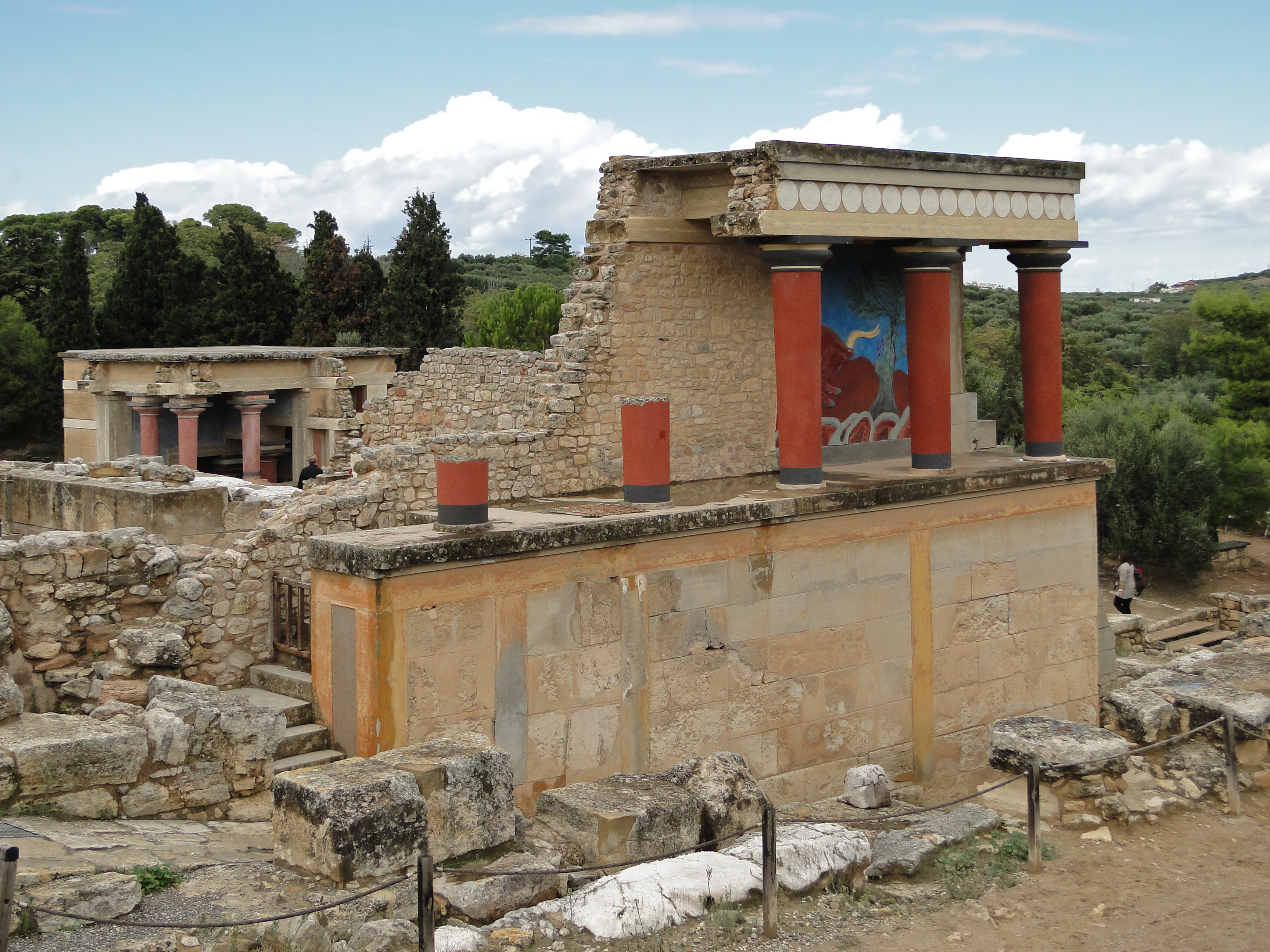
This is the Palace of Knossos, the remains of a Minoan city only found and restored in the 20th century.
speaker_0NARRATOR
Knossos hints of a sophisticated civilization.
speaker_0NARRATOR
Astonishingly, they built aqueducts, and yes, had even figured out indoor plumbing.
speaker_0NARRATOR
These are things we take for granted, but were unknown to Bronze Age man until the Minoans.
speaker_3SOUNDBITE_SPEAKER
They introduced, for example, in palace in Knossos and Crete system of sewage, and the fresh water was brought into the houses.
speaker_1SOUNDBITE_SPEAKER
The Minoan civilization had indoor plumbing, including flush toilets.
speaker_1SOUNDBITE_SPEAKER
And that was continued throughout the ancient world, even up through ancient Rome.

ScottHOST
At the same time, another group of Anatolian farmers island-hopped their way down to Crete.
ScottHOST
Per L. Vance Watrous, their earliest sites were along the north coast, in caves near Hania and Rethymno, and at a third site a mile and a half inland, called Knossos.
ScottHOST
Figurines recovered from this early period of clay, stone, and marble are predominantly female and may represent the earliest depictions of a largely female pantheon.
ScottHOST
Around 3100 BC, a huge new wave of immigrants arrived, from coastal Anatolia and the nearby islands.
ScottHOST
By 2500, Crete, the Cyclades, and the Hellatic mainland were sharing a growing prosperity.
ScottHOST
reflected by a proliferation of elite tombs and an artisan middle class of metalworkers, potters, masons, and seal and stone carvers.
ScottHOST
The sites of Knossos, Phaistos, and Malia grew to the size of small towns, each with a population well over a thousand.
ScottHOST
Per the author, this was the era when potent symbols of Cretan culture first began to emerge.

Ken HudnallHOST
Well, there's the catastrophism argument that a once great civilization vanished virtually overnight.
Ken HudnallHOST
Marie Chatelaine, who made a detailed mathematical study of ancient sites and legends, wrote, Personally, I'm convinced that the story of Atlantis, as someone heard it from Sanchez, and as Plato has given it to us, is true from beginning to end, that someday the ruins of Atlantis will be found just as One after another, we found the once legendary Troy and Mycenae and Tyrians and Knossos.
Ken HudnallHOST
While Antarctica added to the list of places suggested as the source of the Atlantis legend, the debate continues.
Ken HudnallHOST
It appears clear, though, that regardless of where it was located, the evidence indicates that a widespread advanced civilization did in fact exist in prehistory.

Emma LaramyHOST
He was always optimistic about getting away together.
Emma LaramyHOST
So in 1965, he planned a romantic journey to Athens on the Orient Express, followed by a visit to Crete and Knossos.
Emma LaramyHOST
Then, he invited his good friend and photographer of his source photographs, John Deacon, to come because, as Bacon put it, quote, George alone was too much George, end quote.
Emma LaramyHOST
According to Deacon, the men argued through much of the trip, especially when they were drinking.

Jorrit KelderGUEST
We have no clear attestation for him from the Bronze Age itself.
Jorrit KelderGUEST
But of course, in later legends, he is the mostly just ruler of Crete, residing at Knossos, which is the major palace on Crete, in central Crete.
Jorrit KelderGUEST
And allegedly a son of Zeus.
Jorrit KelderGUEST
But he is credited with sending his fleet to suppress piracy and to make the seas safe.

speaker_0NARRATOR
And there, among the Minoans of Crete, it took on a new and gentler character.
speaker_0NARRATOR
The Minoans, named by the archaeologist Arthur Evans after the legendary King Minos, built a brilliant civilization on Crete in the second millennium before the Common Era, with great palaces at Knossos and Phaistos and Malia and elsewhere, and a lively colourful art full of plants and animals and the sea.
speaker_0NARRATOR
And the griffin was one of their favourite creatures.
speaker_0NARRATOR
The most famous Minoan griffins are in the so-called throne room at Knossos.
speaker_0NARRATOR
a small dark room in the palace with a stone seat against one wall, and stone benches along the sides, on the walls on either side of the throne, painted in plaster or griffins, reconstructed from fragments of the original paintings.
speaker_0NARRATOR
They are wingless, lying peacefully among stylized lilies and papyrus plants, with long, graceful necks and crested heads, and their bodies decorated with rosettes and spirals.
speaker_0NARRATOR
They are not frightening.
speaker_0NARRATOR
They are calm and elegant, and almost tender.

Dan SnowNARRATOR
And he told Evans something else.
Dan SnowNARRATOR
The prime spot to find the stones was a place called Knossos.
Dan SnowNARRATOR
The site was rumored to hide the lost palace of the mythical King Minos, who built a labyrinth to contain the raging Minotaur.
Dan SnowNARRATOR
Evans was intrigued.
Dan SnowNARRATOR
It was dawning on him that the origin of the earliest European writing could be entwined with the Minotaur myth.
Dan SnowNARRATOR
And both mysteries might unravel at Knossos in Crete.
Dan SnowNARRATOR
But before he could even think about a dig, he wanted to decode the seal stone secrets.
Dan SnowNARRATOR
And to prove the symbols were from a pre-Greek civilization, he needed more of them.
speaker_8NARRATOR
As there have been no finds of either bones or artifacts from this level, it has been suggested that these chambers here may have been designed as storage for water or grain.
speaker_8NARRATOR
Water storage has also been put forward as the possible function of the hypogeum at Knossos on Crete, dated between 2150 and 2000 BC.
speaker_8NARRATOR
The primary function of the Hypogeum site was certainly as a cemetery, as around 7,000 skeletons have been found in the chambers, ranging in date from 3600 to 2500 BC.
speaker_8NARRATOR
In other words, spanning the life of the site itself.

Gary MannersHOST
How far does any of this reflect the real Bronze Age? The Linear B tablets, clay records written in an early form of Greek, use two titles that match Homer's words, and the first is Wanaka, or Wanaks.
Gary MannersHOST
Dartmouth College's Aegean Prehistoric Archaeology course notes that at Pylos and Knossos only one Wanaks appears to have existed at either place, and Thomas G. Palima, in his 1995 study of the title, writes, the Wanaks is the central figure of authority in Mycenaean society.
Gary MannersHOST
The second title is QAC Ryu, the ancestor of Basileus, the ordinary Homeric word for a king.
Gary MannersHOST
On the tablets, the Dartmouth course explains, this man was some kind of chief or leader of a small group, in one case a group of bronze smiths.
21 more episodes mention Knossos.
Create an account to see the whole feed, search across every transcript, and follow the entities you care about.