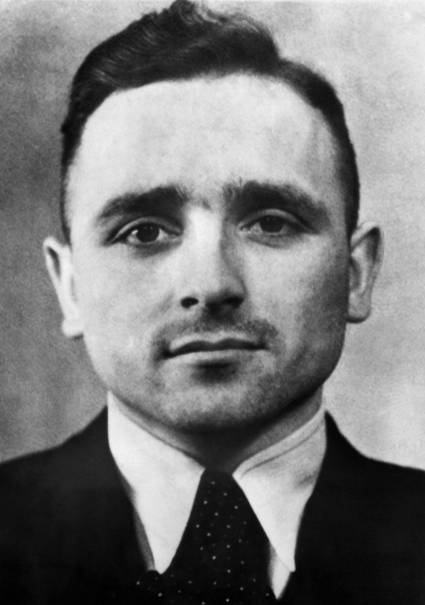
Klaus Barbie
German police officerWikipedia
16
MENTIONS
13
EPISODES
12
PODCASTS
Search complete. 16 mentions across 13 episodes found for "Klaus Barbie".
Oct 21, 2026

Jake TapperGUEST
It's the story of...
Jake TapperGUEST
Do you remember the Nazi Klaus Barbie who was found in Bolivia, found in the 70s, extradited to France in the 80s? So it is the story.
Jake TapperGUEST
It is his story.
Jake TapperGUEST
And I'm telling that in a graphic novel form.

Simon WhistlerHOST
Toward this end, the CIC collaborated closely with General Reinhard Gehlen, former head of the Foreign Army's East, founded in 1938 and responsible for collecting intelligence on the Soviet Union.
Simon WhistlerHOST
But the Corps also recruited personnel whose resumes erred on the criminal side, such as SS officer Klaus Barbie, charmingly known as the Butcher of Lyon.
Simon WhistlerHOST
Barbie the Butcher and other war criminals were eventually protected from prosecution and smuggled out of Europe with the complicity of the CIC, OSS, and other Allied services.
Simon WhistlerHOST
many many more former nazi and ss officials would escape via rat lines set up by argentinian intelligence and even the vatican the us joint chief of staffs however were not interested in simply knowing more about the soviets they were interested in gaining a technological edge over them As early as July 1945, they explicitly authorized a program to exploit chosen rare mines whose continuing intellectual productivity we wish to use.

Jules MasseyGUEST
Because it was up in a... high rise building, uh, W NYU was.
Jules MasseyGUEST
And I remember we're signing in where these knucklehead kids signing in the book, you know, for security and, and Alex, Alex is signing Klaus Barbie.
Jules MasseyGUEST
And then like someone like we all just like, no one checked, no one checked our IDs or anything like that.
Jules MasseyGUEST
We're just signing stupid names.

Taylor NoakesGUEST
Rat line is the term that's used to describe efforts by the Allies, notably the United States, to get Nazi officials, their collaborators, and other people sort of in that milieu to North America or to South America after the war, where they were retained as intelligence assets or were otherwise employed.
Taylor NoakesGUEST
Probably the most famous person to come through the rat line is a Gestapo officer by the name of Klaus Barbie.
Taylor NoakesGUEST
He's a horrible, horrible man who murdered and tortured many people.
Taylor NoakesGUEST
He was responsible for the Holocaust, a key figure in the Holocaust in France.

Manon KerjeanPANELIST
He was sent by de Gaulle to unite the different resistance movements fighting against the Nazi occupation.
Manon KerjeanPANELIST
And in June '43, he was arrested near Lyon and interrogated by Klaus Barbie, the head of the local Gestapo.
Manon KerjeanPANELIST
And the film focuses on Moulin's final days in captivity, turning this confrontation into a psychological battle between the two men.
Manon KerjeanPANELIST
And Niemes had already explored the horrors of the Holocaust in Son of Saul, and here he approaches history through a very intimate and suffocating perspective once again.

speaker_2VOICE_ACTOR
Jumping into France to resist Nazi Germany.
speaker_2VOICE_ACTOR
Dining with the Klaus Barbie, gaining knowledge for your friends.
speaker_2VOICE_ACTOR
Betrayed the second time in country, the Gestapo promising unconscionable.
speaker_3VOICE_ACTOR
We'll be right back.

Steve StoopsGUEST
Um, and then shortly thereafter I got selected for, uh, the Marine Security Guard Battalion, which is, uh, known as embassy duty, and I served in US embassies in Bucharest, Romania, uh, Guatemala City, Guatemala, La Paz, Bolivia, and Lisbon, Portugal.
Steve StoopsGUEST
Um, my claim to fame on embassy duty was the Nazi war criminal Klaus Barbie, better known as the Butcher of Lyon, came to the embassy in La Paz while I was working the front, uh, desk, better known as Post One, and he came up and asked for political asylum.
Steve StoopsGUEST
Um, it was denied, uh, and off he went out of the embassy sh- uh, only to be picked up shortly thereafter by French intelligence, flown back to France where he was put on trial, convicted, and he dro- he died an unrepentant Nazi in prison.
Steve StoopsGUEST
Uh, I think he passed away of leukemia.

MadiganHOST
So let's just get into it right away.
MadiganHOST
Where we left off, Klaus Barbie, who worked for the Nazis, was trying incredibly hard to track down Virginia Hall, screaming, I'd give anything to get my hands on that limping Canadian bitch, even though she was not, in fact, Canadian.
MadiganHOST
Wanted posters went up of Virginia with the caption below her depiction, the enemy's most dangerous spy.
MadiganHOST
We must find and destroy her.
19 MINS LATER
MadiganHOST
In the winter of 1942 to 1943, Alesh's double identity would finally be found out.
MadiganHOST
But I'll talk more on Alesh as we go.
MadiganHOST
Do you remember Klaus Barbie? Let's talk about him a little bit more.
MadiganHOST
In late February 1943, Barbie had arrived in Lyon.

speaker_0HOST
The IMT subsequently convicted three of the groups, the Nazi leadership cause, the SS, including the SD, and the Gestapo.
speaker_0HOST
In the years following the Second World War, US counterintelligence cause implored the former Leon Gestapo chief, Klaus Barbie, for his anti-communist efforts, and also helped him to escape to Bolivia.
speaker_0HOST
In 1997, Cologne transformed the former regional Gestapo headquarters in Cologne, the ELDE House, into a museum to document the actions of the Gestapo.
speaker_0HOST
We live in a world where dictatorships are still very much in operation.

Victor Davis HansonGUEST
So in other words, you admit that maybe there's no substantia- substantial f- proof that you have.
Victor Davis HansonGUEST
There's no corroboration." And then he said, "Well, you know, Klaus Barbie, Klaus Barbie, uh, did it in the Nazi period." Well, now we're down to just one person, and he only has one example, and when you look at all of the information about Klaus Barbie, you don't find anything.
Victor Davis HansonGUEST
Biologically, everyone, the issue that many people brought up, and many people with vast experience in dog training and dog physiology, canine physiology, have concluded that if you take Fido and you say, "Fido," and I'll be very careful 'cause we have a family audience, but if you say, "Fido, see that human being over there? I want you to approach that human being and to physiol- physiologically be able to commit violent coitus with that, on that person on command." And that's not the way that dogs work.
Victor Davis HansonGUEST
They're not like humans.
3 more episodes mention Klaus Barbie.
Create an account to see the whole feed, search across every transcript, and follow the entities you care about.