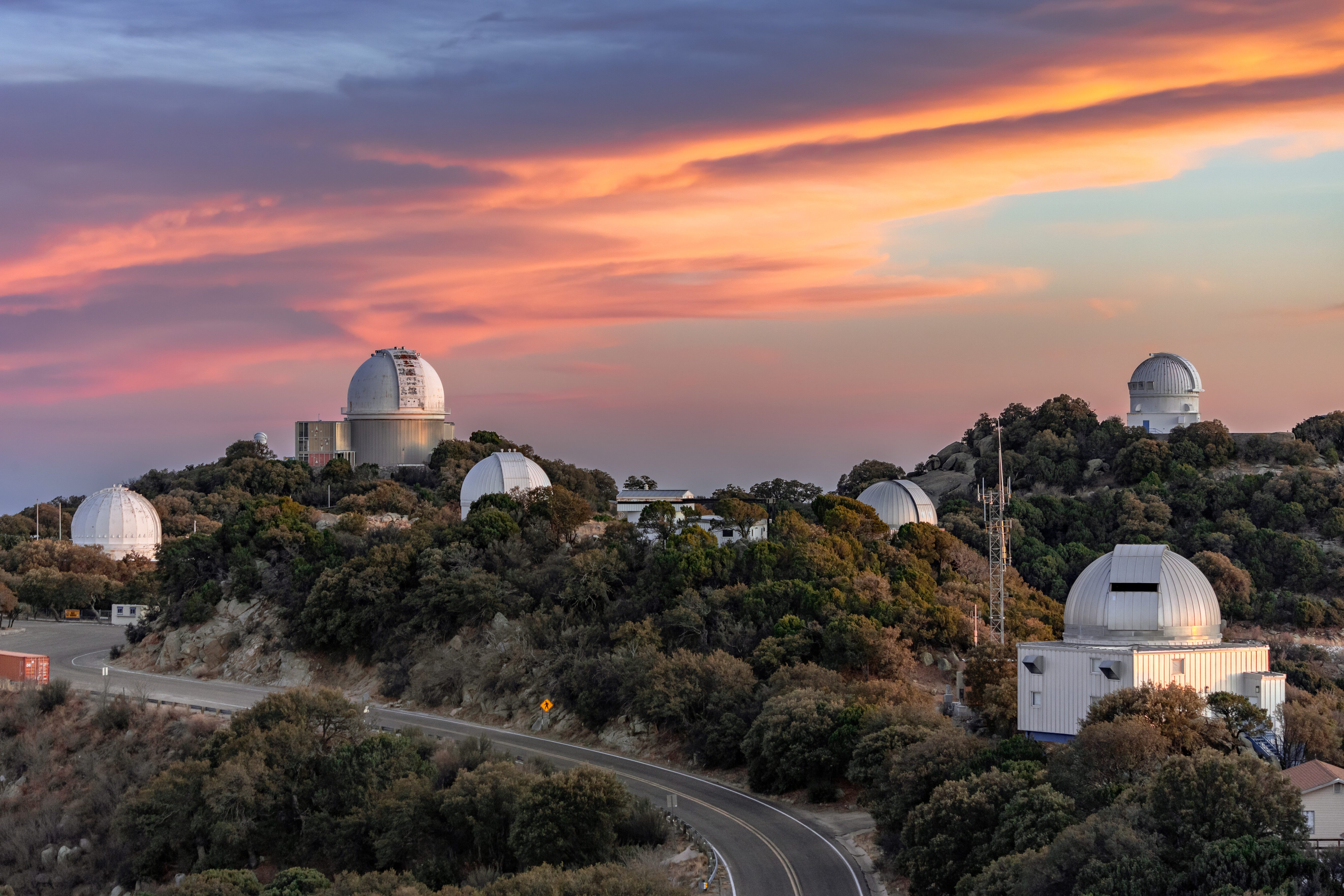
Kitt Peak National Observatory
Observatory in Pima County, ArizonaWikipedia
9
MENTIONS
5
EPISODES
5
PODCASTS
Search complete. 9 mentions across 5 episodes found for "Kitt Peak National Observatory".
Oct 9, 2026

Catherine Davis-YoungCORRESPONDENT
Catherine Davis-Young, KJZZ News, Phoenix.
Phil LatzmanHOST
On Saturday, the Kitt Peak National Observatory is hosting a special family night for the Tohono O'odham Nation, whose tribe views the sacred mountain that hosts over two dozen research telescopes.
Phil LatzmanHOST
Gabriel Pietrarazio reports on the renaming of a science center there.
Gabriel PietrasioCORRESPONDENT
[gentle music] Long before the National Science Foundation looked to the starry sky, O'odhams like Giselle Ramon-Soberon stood atop I'tki Jugan Du-ag, or Manzanita Shrub Mountain.
Gabriel PietrasioCORRESPONDENT
So the legend goes, the creator, I'itoi, would come from his home in a nearby cave and pluck food from this mountain's bountiful slopes.
Giselle Ramon-SoberonSOUNDBITE_SPEAKER
You know, whether we were farming, wild harvesting, or hunting, we used the night sky as a resource.
Gabriel PietrasioCORRESPONDENT
She's the education liaison for Kitt Peak National Observatory.
Gabriel PietrasioCORRESPONDENT
The tribal council signed a lease in 1958 allowing astronomers to use this summit.

Daniel SonHOST
Let's jump in to talk about Apophis so I can spoil this for you.
Daniel SonHOST
So on June 19th, 2004, three astronomers were using the Kitt Peak National Observatory in Arizona when they spotted this object moving through space, and they gave this object the name of 2004 MN4.
Daniel SonHOST
So shortly after that, scientists began calculating this asteroid's orbit, and that is when the people, uh, the astronomers were like, "Whoa, what the fuck?"
AaronHOST
Yeah, they're like, "This bitch might hit us."

Jessica DowellGUEST
So the, um...
Jessica DowellGUEST
So I told you we went to, uh, Indiana University Bloomington for grad school, and they are part of the WYNN Consortium that has a 3.5 meter telescope on, um, Kitt Peak in Tucson.
Jessica DowellGUEST
And so we never got to do it, but we heard, or they would have these nights where they'd get the big donors to come in and they would put an eyepiece on the 3.5 meter and let them look at it.
Jessica DowellGUEST
So if you donated enough money-

Preston DennettHOST
He's a published author with 28 books in print.
Preston DennettHOST
He's a former docent at Kitt Peak National Observatory, former associate curator at Pearl Harbor Aviation Museum, former restoration manager on the MOF's de Havilland Comet MK4C at the Museum of Flight, and a former master sergeant at the U.S. Air Force.
Preston DennettHOST
He studied business marketing at University of Minnesota and is a recognized authority both on low-observable aircraft such as the F-117, the B-2A, the Lockheed Twins, F-22 and F-35, and the Lockheed Skunk Works family of Blackbirds in the U.S. Navy's fleet of modern-day fast attack and ballistic missile submarines.
Preston DennettHOST
been photographing and writing about spooky military aircraft naval ships and submarines for the past 35 years and his latest book just out 75 years of the lockheed martin skunk works published by osprey oh no that's actually not his latest book that was in 2021 his newest book i'm sorry is ohio class submarines the u.s navy's ssbn and ssgn boats here i'll just flash you a quick picture of it right here.

John MoustakasGUEST
Uh, this is a, a survey that started about, uh, five years ago.
John MoustakasGUEST
Uh, it's an instrument located at the Mayall four-meter telescope at Kitt Peak near Tucson, uh, where you are.
John MoustakasGUEST
Um, and it's a full-time machine that is trying to understand the energy content of the universe, specifically dark energy.
John MoustakasGUEST
Uh, so there's this-- Uh, most people or many people may be familiar with the idea that the, the universe had a beginning that we call a Big Bang, and it's been expanding ever since.
John MoustakasGUEST
Uh, and it really just has to do with what part of the sky you can observe.
John MoustakasGUEST
So if I look up at the sky, I'm seeing half the sky at any one time, right? The other half is below the horizon.
John MoustakasGUEST
And so in the north, we used a couple cameras, uh, at, uh, also located at Kitt Peak, uh, in Tucson.
John MoustakasGUEST
Um, so we used the ninety-prime instrument on the two and a half-meter Bok telescope.