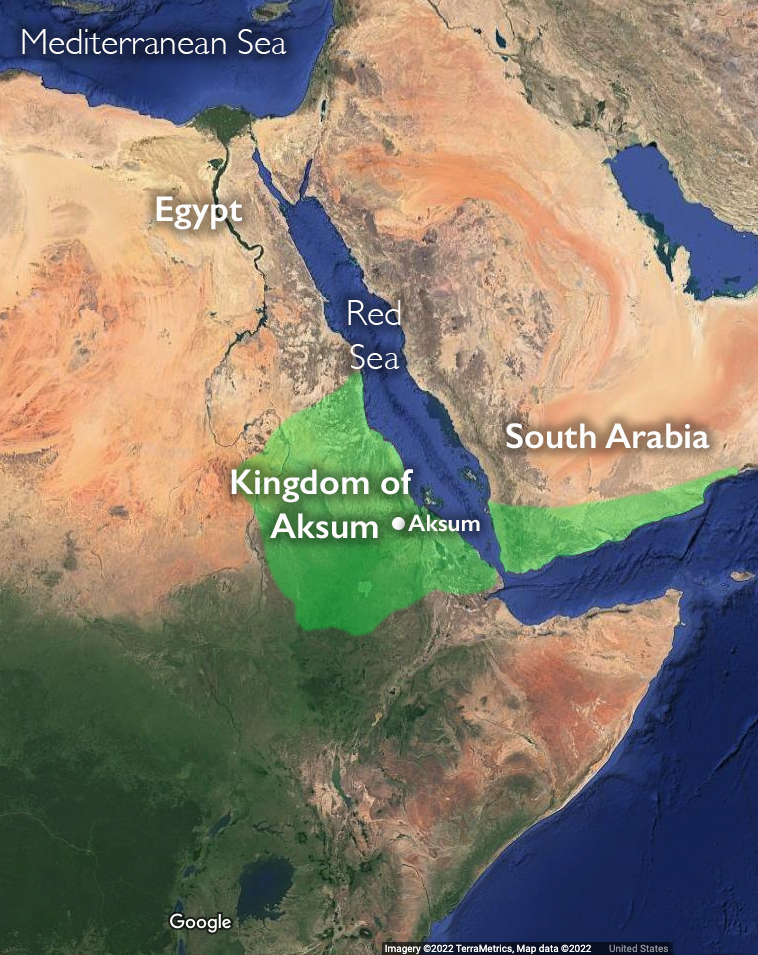
Kingdom of Aksum
TerritoryWikipedia
18
MENTIONS
9
EPISODES
8
PODCASTS
Search complete. 18 mentions across 9 episodes found for "Kingdom of Aksum".
Nov 5, 2026

Felege-Selam Solomon YirgaGUEST
I don't find this compelling because the evidence kind of hinges on like a Greek inscription.
Felege-Selam Solomon YirgaGUEST
So Greek Aksumite inscriptions where the Aksumite king will list a bunch of subject peoples.
Felege-Selam Solomon YirgaGUEST
Like I'm, I don't know, Nugus Izana or Basileus, I guess in Greece, Basileus Izana or Basileus Kaleb.
Felege-Selam Solomon YirgaGUEST
And I am the king of Himyar and Duraidan and Saba and also Ethiopians.
Anthony KaldellisHOST
Can you tell us a little bit about those other groups?
Felege-Selam Solomon YirgaGUEST
Yeah.
Felege-Selam Solomon YirgaGUEST
So I guess if I were to restrict myself to the time of Abba Moses, just around that fourth century, I would say the groups that the Romans identify as Ethiopians or as Ethiopians beyond the Aksumites.
Felege-Selam Solomon YirgaGUEST
It's also tricky.

Robert McTeigueHOST
These include the Kingdom of Prussia, the Republic of Ragusa, the...
Robert McTeigueHOST
The Sasanian Empire, the Abbasid Caliphate, the Mongol Empire, the Khmer Empire, the Mughal Empire, the Kingdom of Joseon, the Qing Dynasty, the Ottoman Empire, the Kingdom of Aksum, the great empires of the Sahel, the Mali Empire, the Sangha Empire, the Kingdom of Congo, and the Zulu Kingdom.
Robert McTeigueHOST
Why am I looking at that map and not the American electoral map? Stay with me.
Robert McTeigueHOST
I've got a story to tell.

HassanGUEST
In the mid-19th century, you have what is effectively a kind of fragmented and decentralized array of various kingdoms and principalities.
HassanGUEST
with various leaders kind of claiming the legacy of a kind of ancient Abyssinian or Aksumite civilization as being the kind of core of their identity.
HassanGUEST
And in particular, you have a figure who is kind of credited for being the first person to really place on the agenda the idea that Ethiopia should become this reunified entity under a centralized imperial authority.
HassanGUEST
And that's Tirodros II, who is emperor of Ethiopia from the 1850s up through the late 1860s, who kind of begins this gambit to sort of reclaim or claim various regions and consolidate the various noble families under one kind of political imperial dynasty.
HassanGUEST
Then you have a figure like Johannes IV, who is kind of coming, you know, from this Aksumite Basin that is present-day Eritrea and present-day Tigray, who is kind of advancing these policies a little bit further, right? There's the British, there's the French, and there's the Italians in particular.
HassanGUEST
He's quite nixed about the Italians.
HassanGUEST
And also effectively trying to kind of promote something like a kind of fusion between the Christian Orthodox Church and this emerging imperial state of Ethiopia.
HassanGUEST
Then you have Menelik II and he is really the kind of figure who's either credited or accused of effectively causing all of the glories or ills of the Ethiopian state.

Jose MiguelGUEST
The great irony is back then during this time of the sixth century, you have the Roman Empire trying to get around Persia's lock on the Straits of Hormuz the same way.
Jose MiguelGUEST
now that iran is you know throwing their weight around they put their lock back on the straight of her moves which the british broke a couple hundred years ago um and um great irony today is so the um maxim and the roman the christian romans worked together to make sure the red sea lanes would still be open and that's part of why um the ethiopians had uh such an interest in uh the you know well having uh himyar as part of their as part of their empire And in fact, even before St. Caleb, the fact was the Himyar was part of the Aksumite Empire for centuries.
Jose MiguelGUEST
And by keeping that lane open, that's how the Roman Empire could essentially establish trade with the Far East as well as India for spices to get around Persia.
Jose MiguelGUEST
So I'm also going to be covering the geopolitics of the time, and it's amazing how much of that geopolitics parallels to today as well.
13 MINS LATER
Jose MiguelGUEST
So it was their conversion that happened in the 4th century under King Azana.
Jose MiguelGUEST
So you had two Syrian Christian youths, Frumentius and Adisaeus.
Jose MiguelGUEST
They were brought to the Aksumite court after they were either shipwrecked or kidnapped.
Jose MiguelGUEST
We're not sure.

KennedyAUDIENCE
Yes, because according to tradition, they thought the Jews said that they left Egypt, towards Kenai.
KennedyAUDIENCE
But according to archaeology, it's not possible because back then, the new Axum Empire or the Egyptian Empire had already conquered their land.
KennedyAUDIENCE
So it won't make any sense for the Jews to leave Egypt to Kenai because their land was already under the Egyptian rule.
KennedyAUDIENCE
So we all know that Jews were known for making up

Mike DHOST
William Bernstein notes that this chain of events has echoes that last to this present day.
Mike DHOST
An Aksumite general named Abraha later ruled Yemen and, according to Islamic tradition, marched on Mecca with war elephants and failed.
Mike DHOST
The year became known as the Year of the Elephant.
Mike DHOST
traditionally dated sometime around 570.

EnochNARRATOR
One of the most intriguing points to Ethiopia, where, according to some legends, the Ark was carried by a son of King Solomon and the Queen of Sheba.
EnochNARRATOR
In the city of Aksum, a temple claims to house the Ark, but no one has ever been allowed to confirm it, keeping the mystery completely intact.
EnochNARRATOR
Others believe the Ark was taken to Egypt, or even to the interior of Mount Nebo, where Moses died.
EnochNARRATOR
Some bolder speculations suggest it was hidden in the Qumran caves, where the Dead Sea Scrolls were found, or even taken by celestial forces.
speaker_0HOST
While Ethiopian Jews have a strong Jewish heritage, this is due to their lineage from Cush, meaning their ancestry is closer to the Hamitic peoples rather than the Semitic ones.
speaker_0HOST
The history of Ethiopian Jews is complex and involves a long tradition of migration and isolation, with many studies suggesting that the Kingdom of Aksum in Ethiopia was an important center for Jews of ancient origin, who may have settled in the region over two thousand years ago.
speaker_0HOST
Ethiopian Jews are often described as having Cushitic origins, a direct reference to the ancient kingdom of Cush, which was a power in the Nubian region, now located in Sudan.
speaker_0HOST
The connection between these Jews and Africa is undeniable, but this does not imply that they are direct descendants of the lost tribes of Israel, as some more simplistic interpretations suggest.