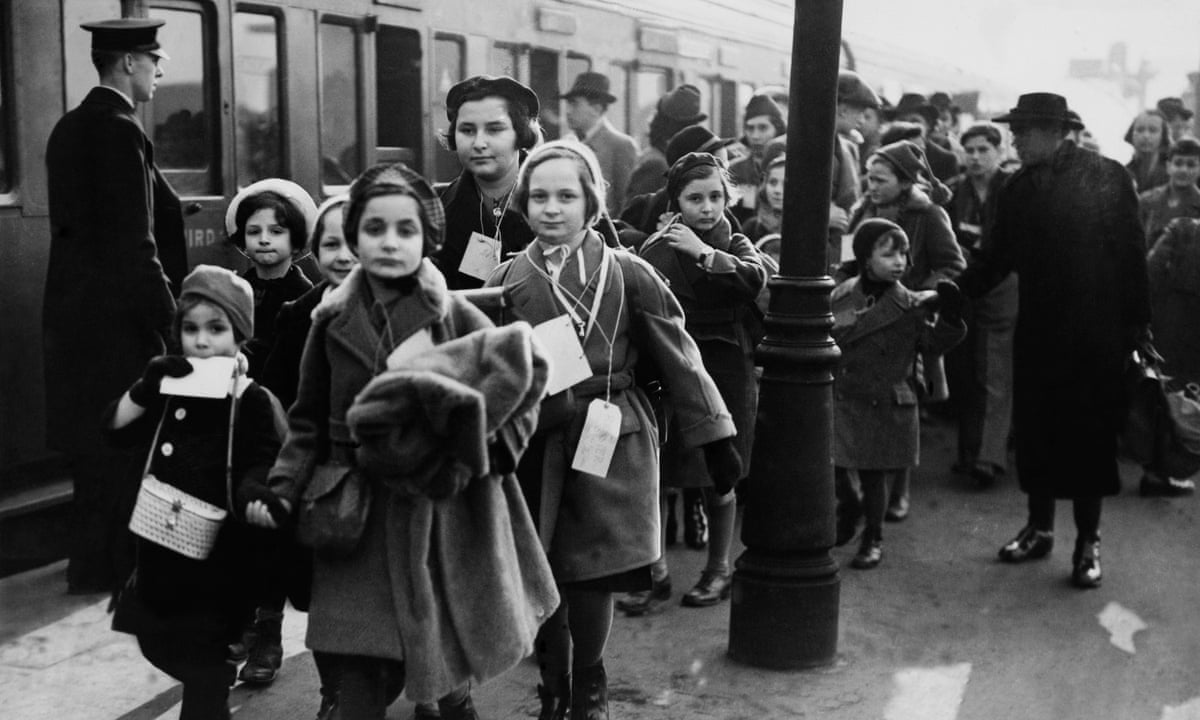
Kindertransport
36
MENTIONS
25
EPISODES
25
PODCASTS
Search complete. 36 mentions across 25 episodes found for "Kindertransport".
Sep 14, 2026

Nadav ZysblatGUEST
and decided to move to Germany, where they became Süssblatt, which is sweet leaf, if I'm correct in German, or at least that's what I was told by my nana.
Nadav ZysblatGUEST
And my grandparents grew up in Germany, and my grandmother actually was on the last Kindertransport that arrived in September 1939 to London.
Nadav ZysblatGUEST
And she built her life there.
Nadav ZysblatGUEST
My grandfather and grandmother built their life in the UK, which was very kind to them.

Andy CoulsonHOST
She spent much of the next 86 years trying to justify being on it.
Andy CoulsonHOST
Steve arrived in Britain in July 1939 on the Kindertransport, fleeing Nazi Germany with her older sister, Renate.
Andy CoulsonHOST
She went on to build one of Britain's most successful software companies at a time when women were barely expected to run businesses at all.
Andy CoulsonHOST
She called herself Steve because when building the business, any letter she signed Stephanie went unanswered.

Vincent McAvinnyGUEST
Uh, but, you know, th-this statement as well that, you know, it was, um, Jew hate, it has kind of gone down badly given that the UK has been a, a decades-long supporter, uh, of the State of Israel.
Vincent McAvinnyGUEST
It also, of course, goes back to its war record, the Kindertransport taking in many Jewish refugees from, you know, the, the continent when, uh, there was r-more resistance to that in America, for instance.
Vincent McAvinnyGUEST
So, uh, you know, these statements are sort of being disputed by the government, but some in the Jewish community feel that, uh, others w- uh, because they're not able to distinguish between Jewish people a-and the State of Israel, that this might further, uh, in some people's minds who are antisemitic, sort of give them a bit of sort of approval or government backing in their own minds.
Shane ColemanHOST
Okay.

Moshe LevinHOST
Rabbi Yitzhak Tovia Weiss was the leader of the Jewish court of the Eid al-Haridah in Jerusalem for many years.
Moshe LevinHOST
And he was one of the thousand children that was brought in a Kindertransport to England, and the king of England, King George VI, came to see the thousand children that he had rescued among the total of about 10,000 children that were rescued altogether.
Moshe LevinHOST
And when the king came, the children were standing in formation, 500 on each side, and the king was walking through.
Moshe LevinHOST
And one boy left the formation, and the guards tried to stop him, but he ran over to the king and the king beckoned him to come closer what would you like your majesty you've done so much but really i can't be happy here because i don't have my parents i don't have my siblings please your majesty please rescue my family king looked at him and he asked him for his name and two weeks later this boy's family arrived in england as well Today is a day when God created the world, and God created the world, as the Talmud said, in order to have a home in this lowest of all worlds for Moshiach to come.

KobyUNKNOWN
[laughs] Censor yourself now.
Moshe LevinHOST
During World War II, there was a Kindertransport.
KobyUNKNOWN
The what one?
Moshe LevinHOST
Kindertransport.
Moshe LevinHOST
They, they allowed 1,000 children to leave Czechoslovakia to, to England.
Moshe LevinHOST
And Moshe Tuvi Weisz was-- who was the head of the Beis Din of the Edah HaChareidis many years, he was living in Czechoslovakia, and the head of the community asked him to walk in the middle of the night to Pressburg, to Pressburg, and to find out if the head of the community there, is there any way to escape the Nazis? Is there a way? So it was very dangerous, but he went.

Pinchas AlloucheGUEST
But instead, he said to his friend, I'm coming.
Pinchas AlloucheGUEST
He went to Czechoslovakia, and he organized what's called Kindertransports, transports of children to Great Britain.
Pinchas AlloucheGUEST
These children were abandoned, found their home thanks to Nicholas Winton in Great Britain on top of the families, and he had saved altogether 660 children.
Pinchas AlloucheGUEST
When the Second World War began on September 1st, 1939, and then he had to stop, there was no way for him to let the children to Great Britain.

Katie MeadHOST
Cause I also work in, I do all the fun jobs.
Katie MeadHOST
I also work in Holocaust education and survivor also has different means meanings in that world too, because we have survivors who survived at the camps versus survivors who, who did Kindertransport and that's how they got away.
Katie MeadHOST
So I think I would love to start by simply saying, you know, this definition of survivor is a little bit malleable when it comes to the story.
Katie MeadHOST
And so I think with yours, while you were not in residence down there, frankly, as far as I'm concerned, when you go to school somewhere, you're basically living there for half of your life anyway.

Paul HenleyHOST
I'm Paul Henley.
Paul HenleyHOST
Coming up a bit later on in the program, how a statue on a station platform unlocked memories of the Kindertransport.
Gabrielle KeehnenSOUNDBITE_SPEAKER
It was a monument of a little boy sitting on a, on a case, actually, and he looked a little bit glum, and it all flooded back to me because I could feel what he was showing.
Paul HenleyHOST
That's coming up later on.
32 MINS LATER
Paul HenleyHOST
[gentle music] I'm Paul Henley with News Hour from the BBC World Service.
Paul HenleyHOST
Gabrielle Keenaghan is a British woman who was 12 when she escaped Nazi Austria as a Jewish refugee in 1939.
Paul HenleyHOST
She still remembers the day that April when she said goodbye to her grandmother at a railway station in Vienna to become part of the so-called Kindertransport to Britain.
Paul HenleyHOST
Mrs. Keenaghan is now a retired headteacher living in the northeast of England.

Moshe LevinHOST
However, because you came in the middle of the night, and you had the sacrifice to come, it was dangerous, I'll give you a present.
Moshe LevinHOST
What did he give him? There's something called Kindertransport.
Moshe LevinHOST
Anyone heard of Kindertransport? The Nazis made a deal with England, right? It was England, England, to allow 1,000 children to leave from Czechoslovakia.
Moshe LevinHOST
And so he said, I'm giving you a ticket.
Moshe LevinHOST
There was only 1,000 tickets.

Louise PerryGUEST
The problem is that the situation we're facing now, it's really nothing like the 1930s.
Louise PerryGUEST
The nature of immigration now, and refugees in particular now, we're not talking about the Kindertransport.
Louise PerryGUEST
We're talking about young, able-bodied men who are coming here to improve their economic prospects.
Louise PerryGUEST
It's completely different.
15 more episodes mention Kindertransport.
Create an account to see the whole feed, search across every transcript, and follow the entities you care about.