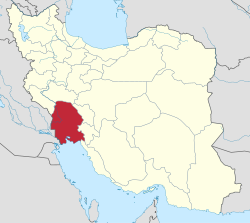
Khuzestan Province
32
MENTIONS
17
EPISODES
10
PODCASTS
Search complete. 32 mentions across 17 episodes found for "Khuzestan Province".
Nov 3, 2026

Mario NawfalHOST
So Iran is still striking those ships through the Strait of Hormuz.
Mario NawfalHOST
And there was just now an Iranian ballistic missile launch detected from Ahvaz, Khuzestan province, which is always, you know, we've seen this on a daily basis as Iran targets the ships in the Strait of Hormuz.
Mario NawfalHOST
Ben, look, good luck tomorrow.
Mario NawfalHOST
Get your alcohol ready.

speaker_0HOST
Yet wherever water finds a path through narrow river valleys, mountain springs, or the ancient underground channels later called kanats, human settlement has clung stubbornly for thousands of years.
speaker_0HOST
Around 3000 BCE, in the southwestern lowlands near the modern province of Khuzestan, one of the region's earliest urban societies took shape.
speaker_0HOST
We know it as Elam.
speaker_0HOST
Its principal city, Susa, sat on the fertile plain between the Karun River and the first foothills of the Zagros.
45 MINS LATER
speaker_0HOST
Nobles retained their estates and influence, but their power was now more carefully channeled through royal service.
speaker_0HOST
Yet Khosrow's most enduring legacy may lie in the realm of learning rather than taxation or social order.
speaker_0HOST
In the southwestern province of Khuzestan, the Academy of Gondishapur became, under his active patronage, the most important centre of scholarship in the late antique world.
speaker_0HOST
When the Byzantine Emperor Justinian closed the philosophical schools of Athens in 529 CE, many displaced Greek scholars travelled east.

ShirvanHOST
Previous interbasin transfers have only fueled ethnic tensions and pitted communities against one another.
ShirvanHOST
The fallout has been most visible in regions like Khuzestan and Chaharmahal Bakhtiari, where government-led transfers and industrial priorities have devastated local livelihoods.
ShirvanHOST
In Khuzestan, for instance, water has been diverted to sustain sugarcane plantations and steel factories, while in Chaharmahal Bakhtiari, farmers have watched their rivers rerouted to feed cities like Isfahan and Yazd.
ShirvanHOST
Both these provinces have seen protests over these very issues.
ShirvanHOST
Still worse, Khuzestan and Chaharmahal Bakhtiari are home to ethnic minorities such as Arabs, Lurs and others.
ShirvanHOST
So, by diverting water from minority regions to Persian majority provinces, Tehran fuels mistrust among its multi-ethnic communities.
ShirvanHOST
Water scarcity, therefore, could quickly turn into a divisive force and deepen resentment between minority and majority groups.
ShirvanHOST
In the long run, this dynamic risks fraying the social fabric of Iran, even if unintended.
ShirvanHOST
One option recently floated by US military officials is to capture strategic locations and turn them into a new pressure point.
ShirvanHOST
Five such places stand out, Karg Island, the Strait of Hormuz, the islands of Abu Musa, Greater Tumb and Lesser Tumb, the port city of Chabahar, and finally the oil-rich Khuzestan region.
ShirvanHOST
Each of these sites offers access into the country, but interestingly, none offers a path to strategic victory.
ShirvanHOST
The first option, Karg Island, is the clearest example of how leverage can turn into liability.
7 MINS LATER
ShirvanHOST
However, at the same time, Chabahar is so far removed from Iran's heartland that any US force landing there would still need to advance deeper into Iranian territory to gain more meaningful leverage.
ShirvanHOST
So, what begins as a limited operation to seize a deep-water port could quickly pull American forces into a broader ground war, with all the complications that follow.
ShirvanHOST
The fifth option, and arguably the most plausible route for a ground invasion, is Khuzestan.
ShirvanHOST
This one offers the most direct and most obvious path from the Gulf into one of Iran's most strategically valuable regions.
ShirvanHOST
Early in the war, Israeli warplanes struck well beyond nuclear installations.
ShirvanHOST
They hit places like Khuzestan, Mahabad and Tabriz, not just for military targets, but because these are Iran's fault lines.
ShirvanHOST
Regions where national cohesion and unity are weakest.
ShirvanHOST
and where unrest can spread fastest.
ShirvanHOST
Even though these movements were crushed, they revealed just how fragile Iran's ethnic unity really is.
ShirvanHOST
Israel is playing into that vulnerability.
ShirvanHOST
In addition to the Kerman Shah and Kurdistan provinces, Israeli jets have targeted Khuzestan, which is predominantly ethnic Arab.
ShirvanHOST
Missiles landed near Awaz, Mashahar, and key roads, hammering military staging points and security compounds.
Shirvan NeftchiNARRATOR
That is exactly why this formed the historical border between Mesopotamia and Persia.
Shirvan NeftchiNARRATOR
The only exception to this is to the south, where we have the province of Khuzestan.
Shirvan NeftchiNARRATOR
This region is flat, but it's partly a swamp.
Shirvan NeftchiNARRATOR
This is where the Tigris and Eupratis rivers join and form the Shet-el-Arab waterway.
Shirvan NeftchiNARRATOR
So despite being lowland, the swampy nature makes Khuzestan a defensible region.
Shirvan NeftchiNARRATOR
But this region is populated by ethnic Arabs, not Persians, and therefore this area is vulnerable to separatism and covert operations.
Shirvan NeftchiNARRATOR
And Iran's intelligence service is always on its high alert in this region.
ShirvanHOST
Assuming that obstacles such as funding, mobilization, popular support, and regional logistics were overcome, Washington could then begin assembling the forces required for a full-scale invasion.
ShirvanHOST
This would likely involve a buildup of hundreds of thousands of troops with the initial phase focusing on amphibious landings along Iran's southern coast and a push toward major cities and the oil-rich province of Khuzestan.
ShirvanHOST
American forces could then attempt to weaken the Iranian military while supporting local opposition groups, similar to the strategy used in Afghanistan in 2001.
ShirvanHOST
Or they might attempt a direct advance toward Tehran, as they did with Baghdad two years later.

AshleyHOST
And what followed were a few weeks of rush training, most of which involved desensitizing us to the sights and sounds of combat.
AshleyHOST
Then, once we graduated, they wrapped a headband around each of our heads, daubed with a verse from the Quran, and were sent south to Khuzestan to fight the Battle of the Marshes.
AshleyHOST
We had to cross shallow, muddy waters in small boats and on foot, which in turn made us easy prey for Iraqi helicopters and artillery.
AshleyHOST
I watched friends I'd shared bread with that same morning disappear in the explosions, or they'd fall down choking in the clouds of gas that sometimes drifted over us.
AshleyHOST
And what followed were a few weeks of rush training, most of which involved desensitizing us to the sights and sounds of combat.
AshleyHOST
Then, once we graduated, they wrapped a headband around each of our heads, daubed with a verse from the Quran, and were sent south to Khuzestan to fight the Battle of the Marshes.
AshleyHOST
We had to cross shallow, muddy waters in small boats and on foot, which in turn made us easy prey for Iraqi helicopters and artillery.
AshleyHOST
I watched friends I'd shared bread with that same morning disappear in the explosions, or they'd fall down choking in the clouds of gas that sometimes drifted over us.

Mike MendenhallHOST
I know, Marshall and Sharon, you both mentioned the terrain there in Iran isn't always the easiest to operate in.
Mike MendenhallHOST
And I was reading somewhere that the guys involved in this, when they were in the south around Khuzestan, the province in southwestern Iran, up at the northern part of the Persian Gulf, in the summertime there in the desert, you would get temperatures of 120 Fahrenheit outdoors and 130 indoors, which if you're a Celsius person, that would be like 49 to 55 degrees Celsius.
Mike MendenhallHOST
And then at other times of the year, you're going through mountains in snow, harsh, cold winter weather and things along these routes on the trucks, on the trains and everything.
Mike MendenhallHOST
So it was quite an effort.
7 more episodes mention Khuzestan Province.
Create an account to see the whole feed, search across every transcript, and follow the entities you care about.