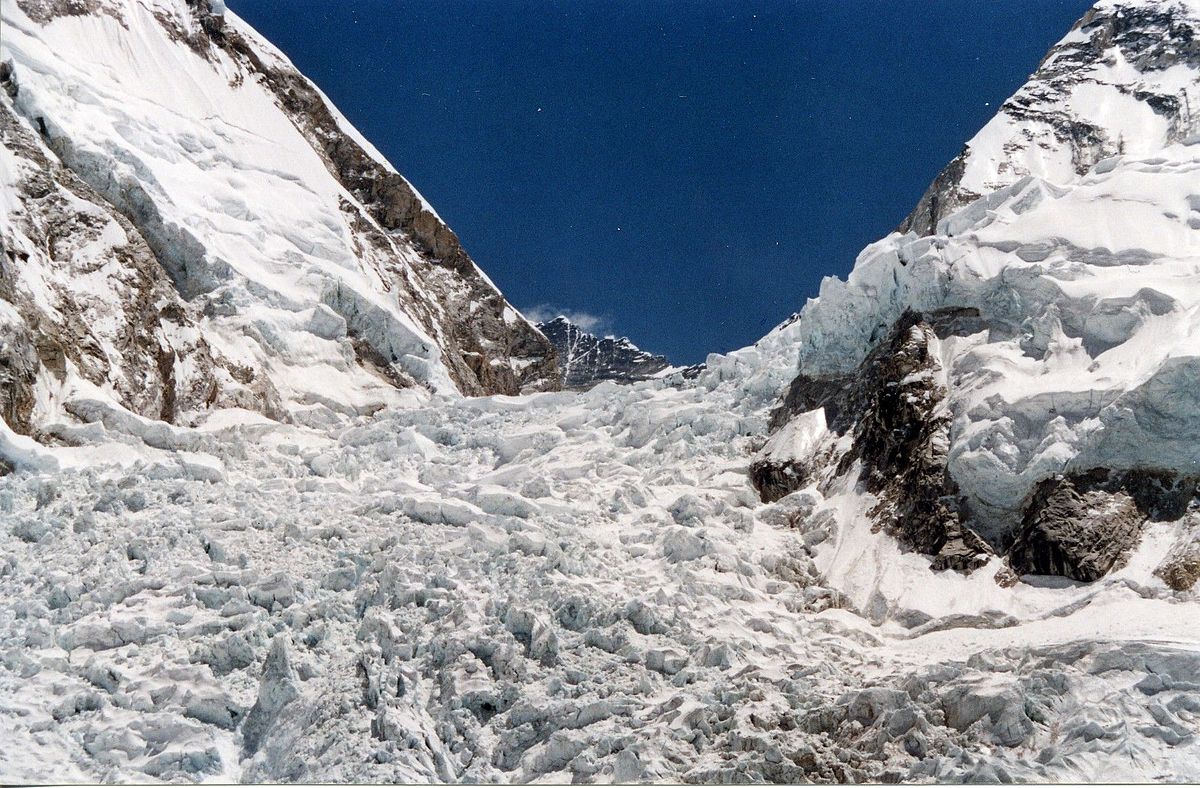
Khumbu Icefall
Glacier in NepalWikipedia
33
MENTIONS
10
EPISODES
10
PODCASTS
Search complete. 33 mentions across 10 episodes found for "Khumbu Icefall".
Sep 11, 2026

Josh HorowitzHOST
To get, yeah
Tom HiddlestonGUEST
... through the valley, over base camp, and we clapped eyes on, on Everest, and looked up through the ice fall, the Khumbu Icefall, the Western Cwm, the South Summit, the neighboring faces of Lhotse and Nuptse.
Tom HiddlestonGUEST
And what was extraordinary was my first sight of Everest was with you.
Josh HorowitzHOST
Mm-hmm.
33 MINS LATER
Tom HiddlestonGUEST
Can I say, you just should have seen how hard this guy worked.
Tom HiddlestonGUEST
There's a scene in the film where, um, and I could, I could- honestly, I, I, you know I could go on all day, but the most difficult, Pu Batashi and all the, all the great summiters of Everest will tell you, the most dangerous part of Everest is not the summit.
Tom HiddlestonGUEST
It's the Khumbu Icefall.
Josh HorowitzHOST
Yeah.

Ryan MitchellGUEST
'Cause it is just, it's a little bit of walking up a hill sometimes.
Ryan MitchellGUEST
Especially this year, I know the Khumbu Icefall wasn't that technical.
Ryan MitchellGUEST
So I wanted to learn more.
Ryan MitchellGUEST
I wanted to get more into the sport.

Scott ParazynskiGUEST
There are avalanches most every day, uh, in the Khumbu region of, uh, of Everest, around the cir- above base camp.
Scott ParazynskiGUEST
So what do you do? You get up early in the morning, at 3:00 in the morning, and you try to get through the Khumbu Icefall to camp one before the sun hits and, uh, it's more likely to have, uh, an avalanche.
Scott ParazynskiGUEST
But avalanches can happen, you know, through the middle of the night as well.
Scott ParazynskiGUEST
Um, so you're not 100% secure.

Oliver ForanGUEST
I was like, oh, I'd love to rest five days.
Oliver ForanGUEST
And then just how it all happened, the Kimball Icefall opened up the day after I got there and we went all the way around.
Ben SouthallHOST
It was a late open this year, wasn't it? They had problems.
Ben SouthallHOST
The ice doctors had a real problem trying to find a route up and switched it, I think, one side to the other.
Oliver ForanGUEST
But yeah, it was like I arrived at base camp.
Oliver ForanGUEST
I spent two days at base camp and then I was on rotation straight away.
Ben SouthallHOST
When we talk about a Serac, we're talking about a multi-storey block of solid ice that has spent hundreds of years winding its way down the Western Quim and it is about to teeter down the most dangerous part of the climb in a way of Everest, the Coomber Icefall.
Ben SouthallHOST
Going up there for the first time, there has to be a very tight butthole and a lot of apprehension going up there, doesn't it?

Iain MartinHOST
I mean, quite frankly, I was terrified watching you make your way back along the summit ridge.
Iain MartinHOST
But you mentioned that you reached Camp 2, which is at 6,500 metres, by I think about 8.30pm. You had to wait until morning to negotiate the Khumbu icefall.
speaker_2VOICE_ACTOR
Was the icefall
Andrzej BargielGUEST
more frightening than skiing the summit ridge?

Lisa ThompsonHOST
I don't have it here, but I also want to know where on the mountain those things happen.
Lisa ThompsonHOST
And in the case of Everest, most of these accidents happened in the Khumbu Icefall.
Lisa ThompsonHOST
Additionally, we see people, I think the next most common thing is acute mountain sickness or AMS, which is kind of a continuum of issues that increase in severity as we sort of move to the right.
Lisa ThompsonHOST
We see exhaustion, other illnesses that are not altitude related, and then just exposure, so some kind of cold injury.
Lisa ThompsonHOST
That's because about 14% of the reported issues in the Himalayan Database didn't have a cause or there were multiple causes.
Lisa ThompsonHOST
So if I'm thinking about going diverse, I'm thinking about like, what are the things that could happen to me that I need to be comfortable with and that I need to try to have a plan to mitigate? And those two things, of course, are avalanches and falls.
Lisa ThompsonHOST
So what can we do about those things? Avalanches, you know, they're mostly on Everest concentrated to the Khumbu Icefall, where there's, you know, this really pronounced shifting of ice and rock and snow.
Lisa ThompsonHOST
And obviously we've seen, you know, some very tragic collapses in the icefall in recent years.

Jon KrakauerGUEST
It's melting alarmingly fast, and it's making part, the most dangerous part of the climb from Nepal side really dangerous.
Jon KrakauerGUEST
The Khumbu Icefall is now disintegrating, and last year was closed for a long period of time 'cause huge towers of ice were in danger of collapsing.
Jon KrakauerGUEST
That's only gonna get worse, and there's serious thought, serious talk now of having to close that icefall altogether and find another route up the Nepal side of the mountain, which would be difficult.
Jon KrakauerGUEST
So yeah, i- i- it's

Jake FieldHOST
But the thing that we rarely stop and think about is how those ladders got there in the first place.
Jake FieldHOST
Who looked at a crevasse in the Khumbu Icefall and decided where it could be crossed, and then carried an aluminum ladder up the mountain to bridge it? Who installed the ropes? Who went through the icefall before the commercial teams arrived, working out which parts looked relatively stable and which parts needed to be avoided? And when the glacier moved, a ladder slipped or a crevasse became wider overnight, who went back in and fixed it? Now, that job belongs to a small team of highly experienced climbers known as the Icefall Doctors.
Jake FieldHOST
It's ...
Jake FieldHOST
Now, it's a brilliant name really because that is effectively what they do.
Jake FieldHOST
They spend their Everest climbing season examining the Khumbu Icefall, diagnosing its problems, and trying to keep a route alive through a piece of terrain that is constantly changing.
Jake FieldHOST
The difference is that this particular patient is a collapsing glacier filled with crevasses, avalanches, and towers of ice that can fall without warning.
Jake FieldHOST
So today's episode is all about the Icefall Doctors, who they are, what they actually do, and why almost every climber attempting Everest from the Nepalese side depends on their work.
Jake FieldHOST
And I think it is worth saying from the start that this is not just another slightly unusual job on Everest.

Jason WangGUEST
So we planned extremely well for our expedition, and again, it comes from the team that we hired and the expertise of our guide who's done this many, many times.
Matt BowlesHOST
So once you embarked from Base Camp on your way up, can you describe the Khumbu Icefall for people that have never heard of this? Explain why it's considered so dangerous, and then take us into that moment and what it was like for you to cross that.
Jason WangGUEST
So the most dangerous section of Everest is where you sleep at Base Camp.
Jason WangGUEST
It's right At the beginning of the Khumbu Icefall and then getting to camp one, 'cause you have to climb through this, it's like a valley of ice, but it's constantly shifting and moving, and that's where a lot of accidents happen, right? If you ever seen photos of Everest or a movie where there's ladders going across crevasses, it's at the Khumbu Icefall.
Jason WangGUEST
And literally, when we went up to Khumbu and when we got back down, even during rotations and after summit, it looked completely different 'cause it's constantly shifting around.
Jason WangGUEST
Like, one wrong step and you're falling into a crevasse.
Jason WangGUEST
That could be it, and you sometimes you just don't know.
Jason WangGUEST
So you have to be extra careful and fast getting through some parts of the Khumbu Icefall.

speaker_0HOST
OK, let's break down that exposure then.
speaker_0HOST
The most notorious bottleneck on the South Call route is the Khumbu Icefall, right? Right above base camp.
speaker_1HOST
Yes, the Khumbu Icefall.
speaker_1HOST
It is terrifying.
speaker_0HOST
From my understanding, it isn't just a steep glacier.
speaker_0HOST
The summit is just the final step of a massive process.
speaker_1HOST
Yes.
speaker_1HOST
Those 32 summits represent hundreds of trips through the Khumbu Icefall.