Khepri
GodWikipedia
15
MENTIONS
8
EPISODES
8
PODCASTS
Search complete. 15 mentions across 8 episodes found for "Khepri".
Nov 2, 2026

Heidi WongHOST
They didn't understand the full reproductive process, so it looked like new life appearing from nothing.
Heidi WongHOST
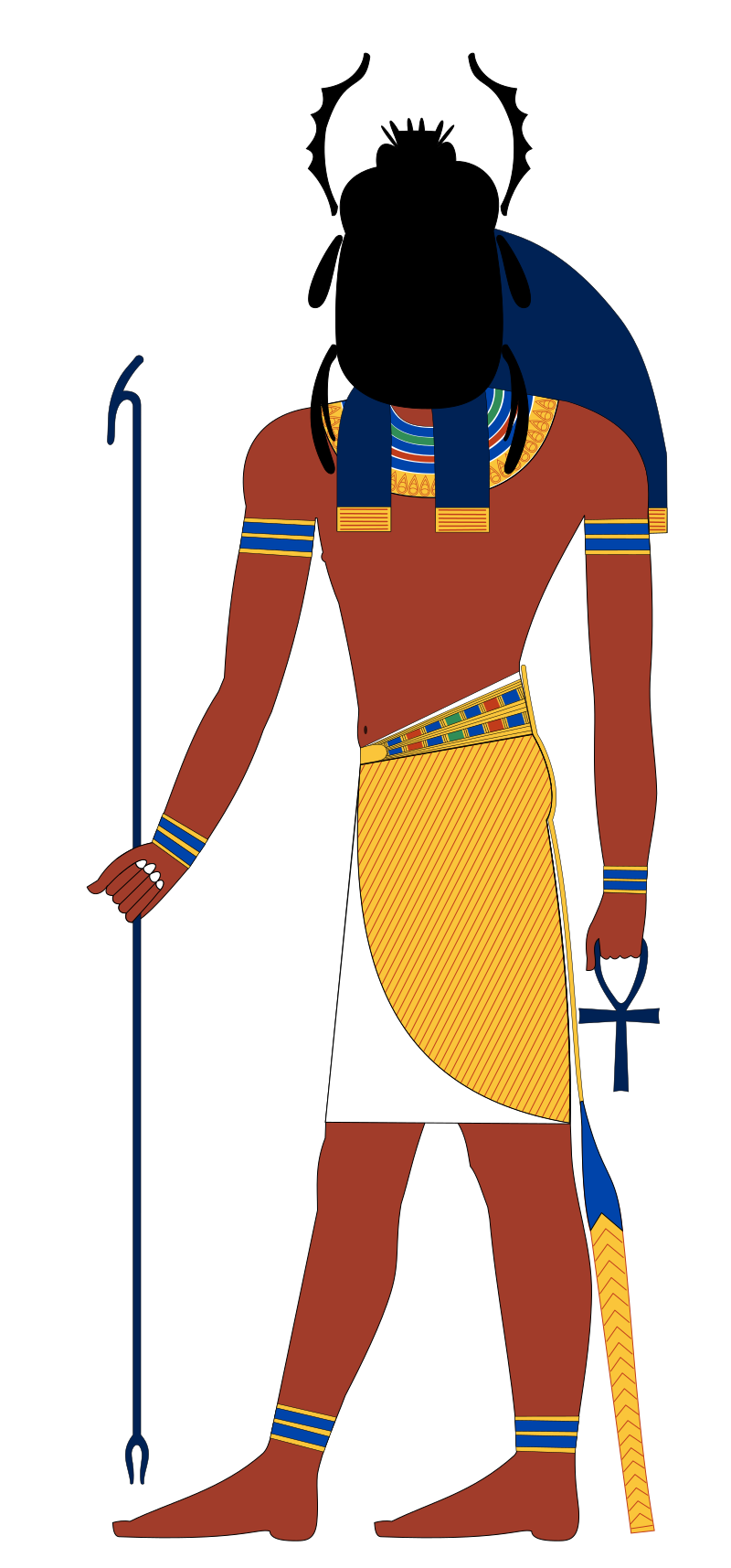
It reminded them of Khepri, a god associated with the rising sun.
Heidi WongHOST
Just like Khepri rolled the sun across the sky each day, scarabs rolled their little balls of dung across the ground.
Heidi WongHOST
So the Egyptians carved scarab amulets, placed them in tombs, and used them as symbols of eternal life and resurrection.
Heidi WongHOST
But eating people and crawling under their skin? That's made up from movies, not actual Egyptian beliefs.

Dan SnowNARRATOR
And so do the scarabs.
Dan SnowNARRATOR
More than 3,000 years old, these tiny carved stones are symbols of Khepri, the Egyptian sun god.
Dan SnowNARRATOR
Clearly, Heron Allen was desperate to contain the sapphire's curse.
Dan SnowNARRATOR
But still, it was not enough.

Lizzie PeabodyHOST
Dung beetles famously roll balls of dung across the earth and then bury them underground, lay their eggs, so the larvae hatch and pupate underground before the new beetles emerge.
Lizzie PeabodyHOST
So ancient Egyptians watching scarab beetles connected this cycle to Khepri, the god of the rising sun, who renewed the world each morning.
Lizzie PeabodyHOST
In fact, the Egyptians imagined Khepri as a giant scarab pushing the newborn sun across the sky.
Lizzie PeabodyHOST
There are about 8,000 different species of dung beetle in the world.
Lizzie PeabodyHOST
Most dung beetles live in couples in their cozy little dung homes.

Andrew M. HenryHOST
The huge number of different sun gods in the Egyptian pantheon demonstrates the sun's importance in Egyptian mythology.
Andrew M. HenryHOST
There is, of course, the famous Re, whose name is actually just the ancient Egyptian word for sun, along with his various relations, Re-Horakhty, Re-Atum, Amun-Re, and his alter egos, such as Khepri, the scarab-headed god who pushes the sun over the horizon every morning.
Andrew M. HenryHOST
Even Osiris, the dead and buried god-king of the underworld, is also the embodiment of Re at night, when the sun descends below the horizon and plunges the land into darkness.
Andrew M. HenryHOST
But what about the moon? The moon may not be as bright as the sun, but it occupies about the same amount of space in the sky.

Stephen MehlerGUEST
So the key to bringing the teachings out now is they're saying we're coming to the end of the cycle.
Stephen MehlerGUEST
We're coming to the new dawn, which is characterized by Khepri, the scarab beetle, which means the driller, which represents the dawn.
Stephen MehlerGUEST
The beetle pushes the sun in front of it, according to the Kemetians.
Stephen MehlerGUEST
And so we are coming to the end of darkness, and it's time that the indigenous traditions from peoples all around the world now be brought to the West because the West is key to the future of humanity, and to under- for people to have an understanding that we are going through a raising in consciousness now, and this is why the teachings are being brought out.

Julie BusuttilGUEST
And he learns about an Egyptian god called Kepri.
Julie BusuttilGUEST
And Kepri... brings Ra, which is the sun, from the day into the night, and it's like a cycle, right? And Kephri resembles, to me, is the common dung beetle of the day, the poo beetle, right? And so it's got a beautiful intersection between an Egyptian, I won't say it's a fairy tale, but an Egyptian story, an ancient Egyptian story, But it also draws in the common dung beetle of today and why it's so important of how the dung beetle wraps his children in poo for it to survive.
Julie BusuttilGUEST
And it's about life cycles.
Julie BusuttilGUEST
Yes, yes, yes.

Joseph W. PhippsHOST
But the ancient Egyptians took the mythic image a step further, creating an entire mythscape allegory for this little guy.
Joseph W. PhippsHOST
The itty beetle butt buddy is represented by Khepri, who generated the creative act of the physical world.
Joseph W. PhippsHOST
Khepri rolled primal matter along the river of the underworld at night so the sun could hatch from it each morning.
Joseph W. PhippsHOST
The hatchling sun would grow strong to its zenith, or noon position, and then grow weaker into old age as it descended into death once again.
Joseph W. PhippsHOST
The sphere rolls and the sun rotates, just as this cycle performs its routine of life from death.
Joseph W. PhippsHOST
Khepri, being not subject to corruption, was driven to repeatedly resurrect the world of temporality in this perpetuated cycle.
Joseph W. PhippsHOST
The parable is clear.
Joseph W. PhippsHOST
The divine tendency has always been to turn death into life, lead into gold, and chaos into order in the most creatively efficient way possible.