Khalsa
16
MENTIONS
5
EPISODES
5
PODCASTS
Search complete. 16 mentions across 5 episodes found for "Khalsa".
Sep 24, 2026

Simranjeet SinghGUEST
The ten Sikh gurus are credited with fostering and cultivating the Sikh community from its establishment in the fifteenth century to the death of Guru Gobind Singh, the tenth Sikh Guru, in 1708.
Simranjeet SinghGUEST
Before his death, Guru Gobind Singh passed on the title of guruship to two authorities for Sikhs to follow, the Guru Granth Sahib and the Guru Khalsa Panth, the community of formally initiated Sikhs.
Simranjeet SinghGUEST
The Guru Granth Sahib is a collection of hymns and poetry compiled by the Sikh gurus themselves.
Simranjeet SinghGUEST
The Sikh scripture is unique in that it doesn't contain narratives.
Andrew M. HenryHOST
You can find gurdwaras all over the world serving as centers for Sikh congregational worship and a variety of life cycle rituals, such as baby naming, marriage, and funeral ceremonies.
Simranjeet SinghGUEST
The initiation ceremony is one of the most important rituals in the Sikh tradition because undergoing this ritual means becoming Amritdhari.
Simranjeet SinghGUEST
Now, what does that mean? Well, remember that Guru Gobind Singh, before his death, instituted two authorities to help shepherd the community going forward, the Guru Granth Sahib, the collection of scriptures, and the Guru Khalsa Panth, the community of initiated Sikhs who have committed their lives to living the ideals of Sikhi.
Andrew M. HenryHOST
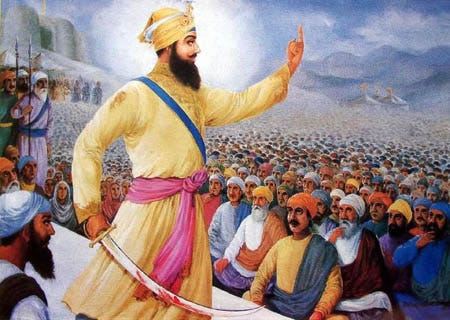
The tradition goes that in 1699, Guru Gobind Singh called his followers to his tent, drew his sword, and asked for volunteers to sacrifice his head.

John GreenHOST
Like, many of us perform rituals out of habit, but performing the ritual still serves a function regardless of the participant's level of engagement with the symbolic meaning, because participation in a ritual reinforces a shared community and identity, and it lets other people know you belong.
John GreenHOST
For example, people who want to join the Khalsa, a special order of Sikhs who follow specific codes of conduct, must undergo a ritual known as taking amrit.
John GreenHOST
Joining the Khalsa is a big step for a Sikh and represents complete devotion to the faith.
John GreenHOST
It requires that five existing members of the Khalsa stir an iron bowl of sugar water with a double-edged sword, and each member recites a special prayer while stirring that transforms the sugar water into amrit, or immortal nectar.
John GreenHOST
a process that can take hours.
John GreenHOST
Once the amrit is prepared, initiates are called forward one at a time to kneel and drink the amrit.
John GreenHOST
Then the nectar is sprinkled on their hair and eyes as they affirm their commitment to God.
John GreenHOST
They arise as members of the Khalsa and are then given new names.

Ranveer SinghHOST
Perhaps Vaheguru's mercy will fall upon one of them and they will have the courage to speak the truth about Bhai Jaswant Singh's last moments.
Ranveer SinghHOST
The Khalsa Panth is eagerly awaiting that auspicious day.
Ranveer SinghHOST
I will be a martyr, you will commit suicide.
Ranveer SinghHOST
The above unspoken words of Bhai Jaswant Singh Kalra came true when on 23rd of May 1997, Ajit Singh Sandhu jumped in front of a running train, the Himalayan Queen, near Deerabasi on the Ambala Chandigarh railway track in the wee hours of the morning and ended his sinful life.
9 MINS LATER
Ranveer SinghHOST
And that's maybe the lasting significance of this book.
Ranveer SinghHOST
Bhai Ajmer Singh restores for me the political, intellectual and spiritual dimensions of Bhai Jaswant Singh Kalra's life.
Ranveer SinghHOST
He was a human rights defender but he was not only a human rights defender, he was a Gursikh thinker, organiser and political activist whose work emerged from a much deeper commitment to the Khalistan Sangharsh and the future of the Khalsa Panth.
Ranveer SinghHOST
So thank you to everyone who has listened to these audio recordings, whether you've joined us from the beginning or discovered the series somewhere along the way.

Eleanor NesbittGUEST
In that sense, every turban-wearing Sikh is a sovereign, whatever his or these days her social rank.
Eleanor NesbittGUEST
But also, of course, it's inseparable from what people know as the five Ks, the five outward signs of being a committed Sikh, a member of the Khalsa.
Eleanor NesbittGUEST
And that goes back to traditionally stated 1699 and the 10th Guru, Guru Gobind Singh.
Eleanor NesbittGUEST
And although the turban is not one of the five Ks, it's inseparable because the keish, the uncut hair on the head, has to be covered in a respectful way.
Jalees KhanHOST
Amazing, amazing stuff.
Jalees KhanHOST
For a Sikh who wears a turban today, what does it represent beyond being an item of clothing?
Eleanor NesbittGUEST
Well, beyond being an item of clothing and beyond being a religious symbol, I think you'll find that Sikhs talk in terms of equality, because whatever your social status, your economic standing, and so on, members of the Khalsa, Sikhs, turban-wearing Sikhs, are equal.
Eleanor NesbittGUEST
In fact, Sikhs are taught to believe that all humans are equal.

EricHOST
Wrestling matches and musical and acrobatic performances are on full display as people dance to the beat of the Punjabi drum, called a dhol, with energetic music and noise.
EricHOST
The other event marked by this day is the establishment of the Khalsa Pant by the 10th Sikh Guru, Sri Guru Govind Singh Ji.
EricHOST
In Sikhism, the teachings of the ten gurus, which form the scriptures, are a means of passing on wisdom or...
EricHOST
Gyan? Pisaki is the occasion when Guru Gobind Singh...
EricHOST
established the Khalsa Punt of warrior saints in order to protect the people from the tyrant of Mughal kings and perpetrate the knowledge in the holy book.
EricHOST
In Hindi called Pavitra Kitab, every year on Bisakhi, Sikh devotees offer prayers and chants in their temples.
EricHOST
Neighborhood processions take place on this day and people celebrate by distributing sweets in the evening.