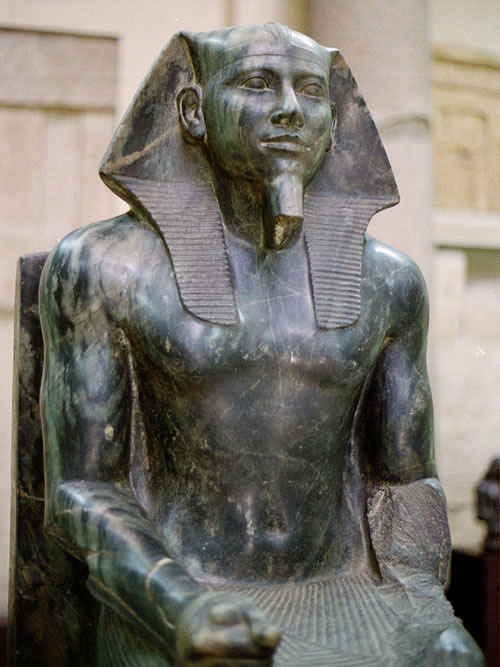
Khafre
PharaohWikipedia
128
MENTIONS
22
EPISODES
17
PODCASTS
Search complete. 128 mentions across 22 episodes found for "Khafre".
Sep 22, 2026

Dominic MontserratGUEST
who build at Giza and Abu Ruash, you see something really interesting.
Dominic MontserratGUEST
Because first of all, you've got Jedef-Rei at Abu Ruash, and then Kai-ef-Rei, Kefren.
Miriam CookGUEST
And Menkaure, who built the third pyramid at Giza.
Dominic MontserratGUEST
Menkaure, exactly.

Heather M. ByeNARRATOR
Abdadufri, his immediate successor, we can probably say that he reigned eight years.
Heather M. ByeNARRATOR
But Khephren, the next son who succeeded to the throne, erected temples and a gigantic pyramid like his father.
Heather M. ByeNARRATOR
He placed it some three hundred and ninety-four feet to the southwest of that of Cheops, and called it Iru the Great.
Heather M. ByeNARRATOR
It is, however, smaller than its neighbor, and attains a height of only four hundred and forty-three feet.
Heather M. ByeNARRATOR
Here the laborers employed on the works came every evening to huddle together, and the refuse of their occupation still encumbers the ruins of their dwellings, potsherds, chips of various kinds of hard stone which they had been cutting, granite, alabaster, diorite, fragments of statues broken in the process of sculpture, and blocks of smooth granite ready for use.
Heather M. ByeNARRATOR
The chapel commands a view of the eastern front of the pyramid, and communicated by a paved causeway with the temple of the Sphinx, to which it must have borne a striking resemblance.
Heather M. ByeNARRATOR
The plan of it can be still clearly traced on the ground, and the rubbish cannot be disturbed without bringing to light portions of statues, vases, and tables of offerings, some of them covered with hieroglyphs, like the mace head of white stone which belonged in its day to Khephren himself.
Heather M. ByeNARRATOR
The internal arrangements of the pyramid are of the simplest character.

Geoffrey DrummGUEST
Yeah, of course
Jesse MichelsHOST
... for this sort of thing, uh, podcast with, uh, Filippo Biondi, of course, of synthetic aperture radar, Doppler tomography fame, who, uh, has these, uh, scans which he claims show these 20-meter-wide hollow tubular structures, eight of them below the Khafre Pyramid.
Jesse MichelsHOST
Total proof of concept for the actual, like, technique.
Jesse MichelsHOST
That's very, very nice, you said.
5 MINS LATER
Geoffrey DrummGUEST
50% I don't believe it at all, 50% I see some potential in the technology to be utilized to discover hidden structures within the pyramids, which is really the impetus of their entire work, is to find things that have not been dar- documented by the conventional archeol- archeological process.
Geoffrey DrummGUEST
So I was about 50/50.
Geoffrey DrummGUEST
The more I looked into it after the Malta conference and after doing some digging and more videos on their second paper regarding the Khafre Pyramid, I was about 70/30.
Geoffrey DrummGUEST
70% I don't believe it, 30% thinking that there is some limited potential for the scanning technology to detect structures within the pyramids.

ClaraHOST
The drama brings us face to face with the pharaoh.
ClaraHOST
The transcript identifies him as Khafre, the god-king of Egypt from roughly 5,000 years ago.
AdrianHOST
And the pharaoh is speaking with all the arrogance of stone.
AdrianHOST
He's talking about his absolute power, how he raised massive protections, how his monuments make him eternal.
Dan SnowNARRATOR
And home to a mystery.
Dan SnowNARRATOR
In a temple connected to the pyramid of the pharaoh Kefren, archaeologists discovered a huge and perfectly preserved statue of the king carved in an exotic iridescent stone.
Dan SnowNARRATOR
But this sculpture is in no local rock.
Dan SnowNARRATOR
In fact, this striking material can only be found deep in the desert, hundreds of miles from Giza.
6 MINS LATER
Dan SnowNARRATOR
But Aswan is not home to the rare mice of the statue.
Dan SnowNARRATOR
In fact, this rock doesn't occur anywhere on the banks of the Nile.
Dan SnowNARRATOR
In 1999, an international team of scientists came together to see if they could solve the riddle of the location of Kefren's missing quarry and discover how the pharaoh's builders actually brought the stone to Giza.
speaker_6SOUNDBITE_SPEAKER
Many tools actually were found at our excavation.

speaker_0NARRATOR
The Sphinx doesn't exist in isolation out there in the sand.
speaker_0NARRATOR
It's part of a larger complex, physically and according to most Egyptologists, architecturally connected to the pyramid of Khafre.
speaker_0NARRATOR
There's a causeway, a long processional pathway that runs from Khafre's valley temple up toward his pyramid.
speaker_0NARRATOR
The Sphinx sits just off to the side of this causeway, practically guarding it.
speaker_0NARRATOR
Right next to the Sphinx itself is a structure called the Sphinx Temple, and just beyond that sits Khafre's Valley Temple.
speaker_0NARRATOR
Built using massive limestone blocks and granite facing, here's what makes this connection so important.
speaker_0NARRATOR
The blocks used to build both the Valley Temple and the Sphinx Temple appear, at least according to conventional analysis, to have been quarried directly from the enclosure around the Sphinx.
speaker_0NARRATOR
It's clean, it's logical, and it's exactly the kind of evidence that keeps the conventional dating locked in place for most researchers.

Heather M. ByeNARRATOR
Chapter 2.
Heather M. ByeNARRATOR
The Memphite Empire, Part 4 Of Chephren's sons, Menkari, Mykerinos, who was his successor, could scarcely dream of excelling his father and grandfather.
Heather M. ByeNARRATOR
His pyramid, the supreme huru, barely attained an elevation of 216 feet, and was exceeded in height by those which were built at a later date.
Heather M. ByeNARRATOR
Up to one-fourth of its height it was faced with cyanide, and the remainder up to the summit with limestone.
Heather M. ByeNARRATOR
It contained a sloping passage cut into the hill itself, and an oblong low-roofed cell devoid of ornament.
Heather M. ByeNARRATOR
The main bulk of the work had been already completed, and the casing not yet begun, when it was decided to alter the proportions of the whole.
Heather M. ByeNARRATOR
Mykerinos was not, it appears, the eldest son and appointed heir of Chephren.
Heather M. ByeNARRATOR
While still a mere prince he was preparing for himself a pyramid similar to those which lie near the horizon, when the deaths of his father and brother called him to the throne.

Ikraduya JambiNARRATOR
Pliny, the Roman writer of a later age, merely repeats some of the statements of Herodotus.
Ikraduya JambiNARRATOR
When Khufu died, Khafra, his son, succeeded him to the throne.
Ikraduya JambiNARRATOR
Following the example of his father, he built the somewhat smaller pyramid at the side of Khufu's tomb, and the rocky projection at the base of the great pyramid was shaped into a mighty sphinx whose head was a portrait of Khafra.
Ikraduya JambiNARRATOR
The next king, Menkaura, built another pyramid still smaller, and there the three massive piles have stood to astonish the travelers of every age.
Ikraduya JambiNARRATOR
Centuries, even millenniums passed.

Andrew CollinsGUEST
But what seems so important is that these shadow lines continue on and go all the way to beneath the second pyramid.
Andrew CollinsGUEST
Now this is not the Great Pyramid, but it's its neighbour, the Second Pyramid, which was constructed for the pharaoh Khafre, also known as Khefren in Greek, around 4,500 years ago.
Andrew CollinsGUEST
And what's interesting here is that this, in Arab and in the tradition of the Sabians, the peoples of southeast Turkey, would come to Giza on pilgrimages to venerate their gods, they believed that the second pyramid marked the whereabouts of the so-called tomb of Hermes.
Andrew CollinsGUEST
Now Hermes was the name that the Greeks gave to the Egyptian god Thoth or Toph.

Heather MbyeNARRATOR
It reappeared under the Ptolemies for the last time before becoming extinct forever.
Heather MbyeNARRATOR
Snofru was probably, therefore, one of the most popular kings of the good old times, but his fame, however great it may have been among the Egyptians, has been eclipsed in our eyes by that of the pharaohs who immediately followed him, Cheops, Chephren, and Mycerinos.
Heather MbyeNARRATOR
Not that we are really better acquainted with their history.
Heather MbyeNARRATOR
All we know of them is made up of two or three series of facts, always the same, which the contemporaneous monuments teach us concerning these rulers.
12 MINS LATER
Heather MbyeNARRATOR
Read for librivox.org into the public domain.
Heather MbyeNARRATOR
Chapter 2.
Heather MbyeNARRATOR
The Memphite Empire, Part 4 Of Chephren's sons, Menkari, Mykerinos, who was his successor, could scarcely dream of excelling his father and grandfather.
Heather MbyeNARRATOR
His pyramid, the supreme hieru, barely attained an elevation of 216 feet, and was exceeded in height by those which were built at a later date.
12 more episodes mention Khafre.
Create an account to see the whole feed, search across every transcript, and follow the entities you care about.