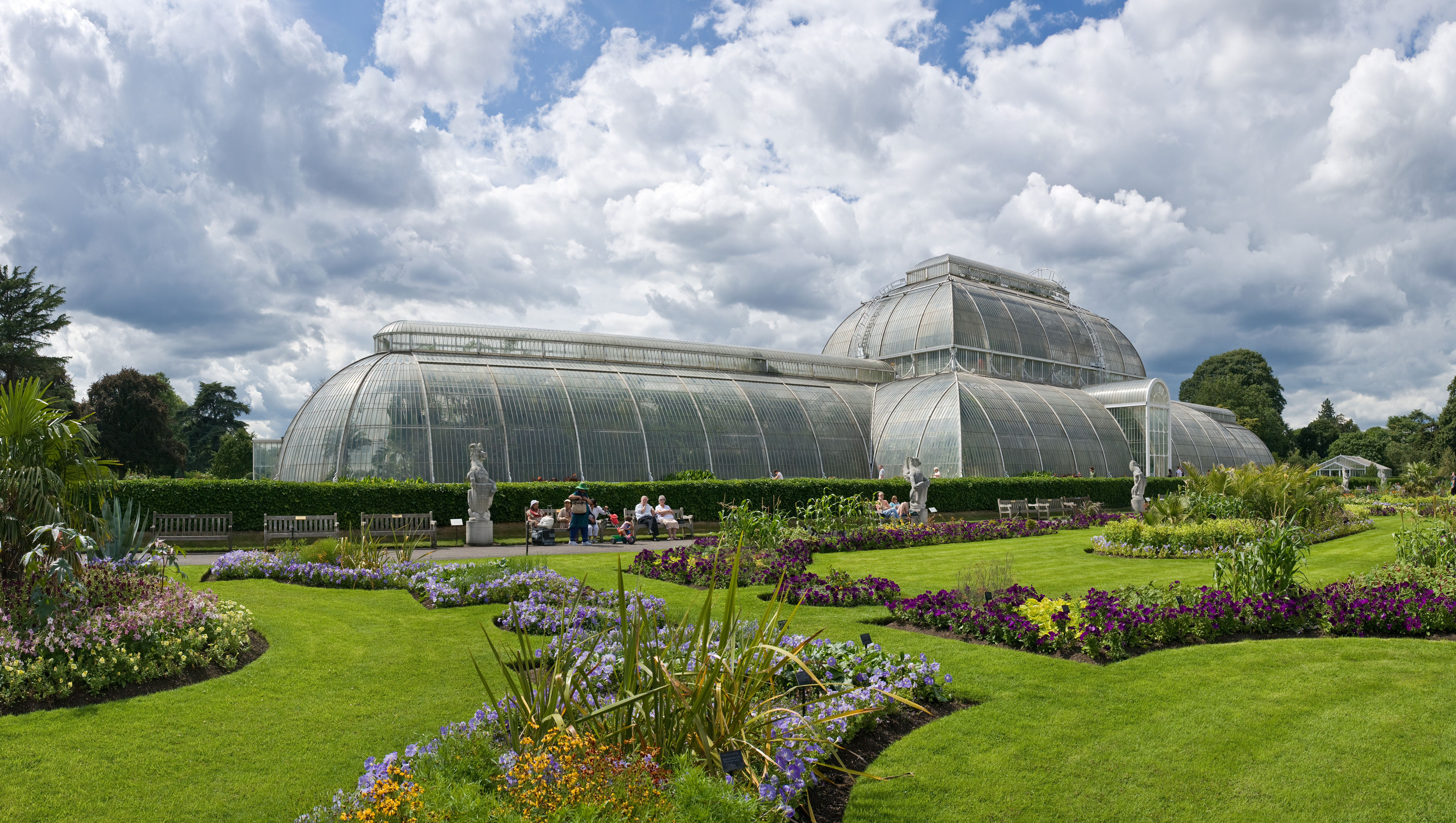
Kew Gardens
Park in Richmond, EnglandWikipedia
18
MENTIONS
9
EPISODES
9
PODCASTS
Search complete. 18 mentions across 9 episodes found for "Kew Gardens".
Oct 22, 2026

Andrew C. ScottHOST
He is a prominent botanist and ecologist who has worked at the New York Botanical Garden and spent much of his time undertaking fieldwork in the Amazon rainforest.
Andrew C. ScottHOST
has been the director of the Royal Botanic Gardens Kew and also involved in the Eden Project and in the Nature in Art Trust.
Andrew C. ScottHOST
Welcome Sir Gillian.
Ghillean PranceGUEST
Thank you.

Tom Hart-DykeGUEST
And a lot of them are now growing throughout the land.
Tom Hart-DykeGUEST
They're growing at Wisley, they're growing at Royal Botanic Gardens Kew for my collections, and they're growing at the World Garden.
Tom Hart-DykeGUEST
And so having a rough idea of where you want to go before you go always helps.
Tom Hart-DykeGUEST
Having a grant gives you real kudos.
12 MINS LATER
Tom Hart-DykeGUEST
And even online now, people still, still, it's so important for me to know the origins of where these plants are from.
Tom Hart-DykeGUEST
You can improve your husbandry by growing the plant if you know the conditions in the wild that it comes from, the soil, the heat, the cold.
Tom Hart-DykeGUEST
that the altitude the humidity the light the shade can really improve your husbandry back home for a plant that perhaps you'd otherwise kill all the time because you don't know where it's from and how it grows in the wild but it just expands your knowledge obviously you might say you can see a type of red hot poker you've got in the garden such as nifofia linarifolia it's in flower now with lovely linear narrow leaves in full flower you know he introduced that you know who brought that back in the 1750s the first professional plant hunter in 1770 was a chap called francis masson from aberdeen in scotland that Joseph Banks, founding Kew Gardens to the Botanical Institute that it is known today, sent abroad to South Africa to bring back these plants.
Tom Hart-DykeGUEST
As you say, risking life and limb, sometimes not coming back on these expeditions, often years in total.

Michelle WaycottGUEST
For example, the Cuddly Creek fires a couple of years ago, this is a fairly well documented, well written about example, but a species of little native pea had appeared to have gone extinct from the region where the fires had occurred.
Michelle WaycottGUEST
So the seed bank team, we were able to recall seeds from the Royal Botanic Gardens Kew seed bank where we had lodged a duplicate of our collection as a part of the Millennium Seed Bank Program and bring them back to Australia, back to our collection, grow them and then plant them out.
Michelle WaycottGUEST
And that helped that species recover in the wild.
Michelle WaycottGUEST
Otherwise, we might have had a very, very small population starting to recover and it probably wouldn't have recovered adequately to be viable for producing more seeds in the future.

Tracy CollinsHOST
Have a cup of tea, absolutely, absolutely.
Tracy CollinsHOST
So other places, obviously, that are going to be better when it's dry, it's like Kew Gardens.
Tracy CollinsHOST
Yeah.
Tracy CollinsHOST
Hampton Court for the gardens they're just you know if you're going to be out and about walking in gardens you really if it's pouring down with rain it's not the best place to go yeah and the Tower of London as well is probably going to it's probably a surprise if I'm going to say this that I would not head to the Tower of London if it's raining or very heavy rain because actually a lot of your visit is spent outside walking between the towers along the walls and now it's not going to be ruined if there's a shower but if it's a really heavy day with rain I wouldn't I would probably try and move it

speaker_0HOST
From the Australian Orchid Review, Volume 69, Number 4.
speaker_0HOST
From the Kew Royal Botanic Gardens.
speaker_0HOST
From the Missouri Botanical Garden.
speaker_0HOST
From the IUCN.

Peter GibbsHOST
Hello, and welcome to Gardeners' Question Time with me, Peter Gibbs.
Peter GibbsHOST
This week we're at the Royal Botanic Gardens, Kew, 32 hectares of the world's most extensive and diverse living plant and fungi collections on the banks of the Thames in southwest London.
Peter GibbsHOST
Kew's story dates back to 1759 when Princess Augusta established a botanic garden in the grounds of Kew Palace, and over the next two and a half centuries it grew into a garden of global scientific importance.
Peter GibbsHOST
At its heart stands the Palm House, Decimus Burton and Richard Turner's great curved glasshouse of iron and glass completed in 1848.

Katie RobinsonGUEST
We've been involved with, um, green prescriptions, um, with charities supporting, you know, adults with various challenges.
Katie RobinsonGUEST
And between us, we've, we've worked at, uh, National Trust locations, RSPB sites, um, Kew Gardens, even ran a session at RSH- um, RHS Wisley.
Katie RobinsonGUEST
And, uh, yeah, and I had the opportunity to be in a program with the Reverend Kate Bottley, um, briefly.
Katie RobinsonGUEST
So just as a, a guide, I wasn't the focus of it.
14 MINS LATER
Katie RobinsonGUEST
And that's, that's one of the wonderful things, um, about it.
Katie RobinsonGUEST
Um, yeah, that feeling of calm.
Katie RobinsonGUEST
I know when I did a few of the ones at Kew Gardens, so that was a very public session.
Katie RobinsonGUEST
Most people didn't come with somebody they knew, and I w- to be honest, I was a bit skeptical about how much they would get from it, i- in a botanical garden.

Phil AchlemanHOST
And here is a detail nobody had brought to my attention before.
Phil AchlemanHOST
Scion House stands directly across the Thames from Kew Gardens.
Phil AchlemanHOST
An 1840 history of the parish describes the view from Scion's windows.
Phil AchlemanHOST
The Thames, it says, seems to flow through the grounds of which Kew Gardens appear to form a part.
Phil AchlemanHOST
For 40 years, Thomas Hoy worked within sight of the greatest botanical garden in the world.
Phil AchlemanHOST
Joseph Banks, the most powerful man in British science, was just across the water, and the river was no barrier.