Kerner Commission
24
MENTIONS
10
EPISODES
10
PODCASTS
Search complete. 24 mentions across 10 episodes found for "Kerner Commission".
Nov 2, 2026

Joshua CitarellaHOST
I wanna touch on some of the key touchstones for that.
Joshua CitarellaHOST
There is the Kerner Report in 1968 and Robert L. Allen's Reluctant Reformers in 1974.
Joshua CitarellaHOST
What were the arguments in those texts and how did they inform some of our ideas about racial justice now?
Adolph Reed Jr.GUEST
Okay, yeah, and that's really important.
Adolph Reed Jr.GUEST
And it's funny because I'm doing another cut on that stuff now for the last chapter of the book.
Adolph Reed Jr.GUEST
So the Kerner Report is kind of an interesting study in how ideology works.
Adolph Reed Jr.GUEST
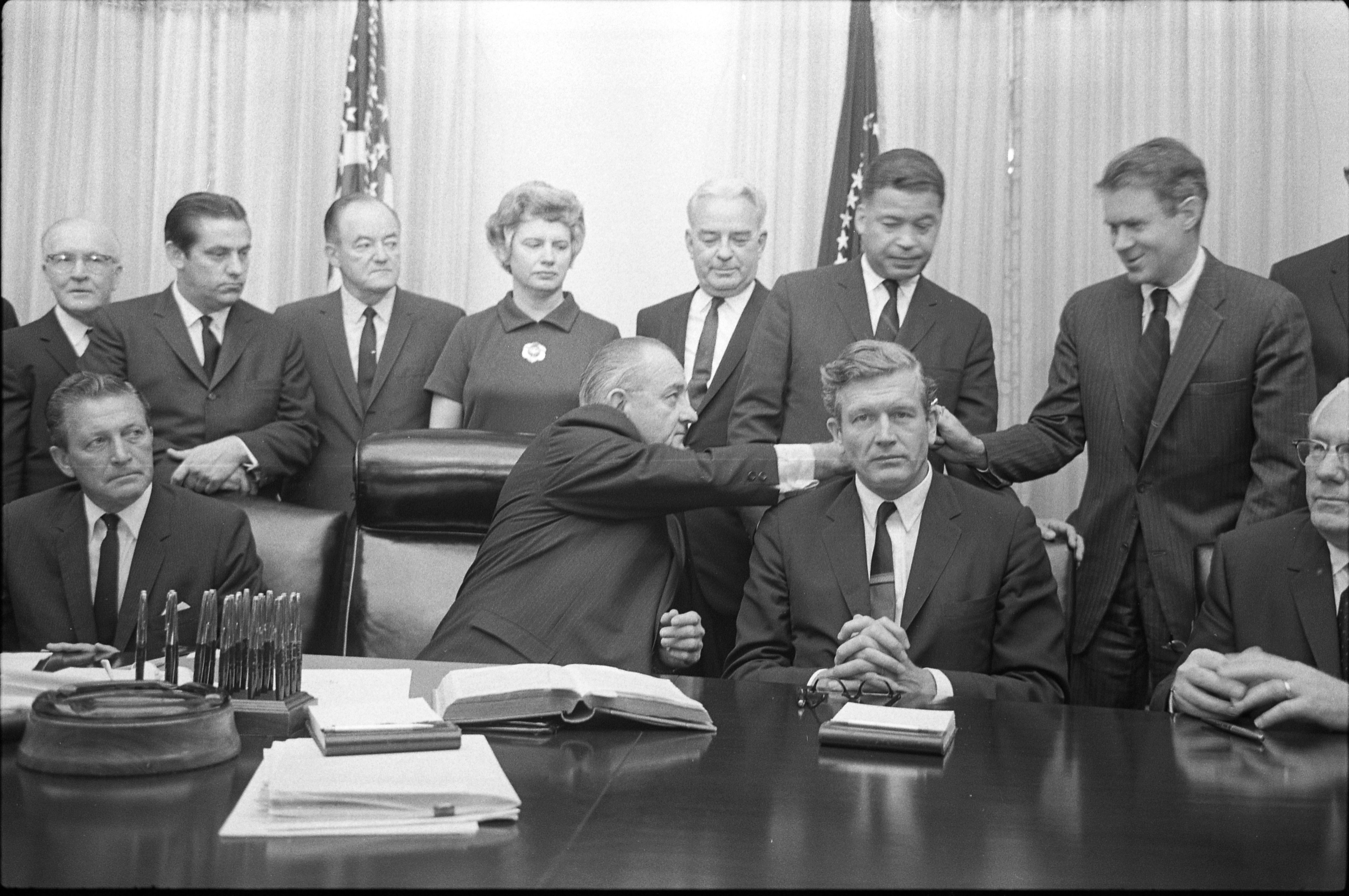
So President Johnson impaneled the National Advisory Commission on Civil Disorders.
Adolph Reed Jr.GUEST
And the committee took its name from its chair, who was then the governor of Illinois, Otto Kerner, who became the first of many new governors of Illinois to go to jail after his term was over.

Amy AlexanderGUEST
Yes.
Amy AlexanderGUEST
And so if you want to do a quick walkthrough, there was in the late 60s, something called a Kerner Commission Report, because there were all these riots after Martin King was assassinated and the Kennedys were assassinated.
Amy AlexanderGUEST
And there were urban riots all around the country.
Amy AlexanderGUEST
Watts, Chicago, Detroit blew up.
Amy AlexanderGUEST
And part of what the Kerner Commission looked at was, like, what are some of the core causes for all of this upheaval around the country? And among other things, like police brutality and lack of jobs for primarily Black and Latino communities, one of their findings was that the news industry writ large, coast to coast, had not been accurately and fairly covering these communities, right? That was a really signature finding.
Amy AlexanderGUEST
And it became, by the time I entered journalism school in the 80s in San Francisco, my hometown, you know, they put that in front of us.
Amy AlexanderGUEST
And our instructors walked us through that part of the Kerner Commission findings and said, this is why we take seriously.
Amy AlexanderGUEST
And at the time, they called it minority affairs coverage.

Isaac MadisonGUEST
So they created a commission that came up with some plans, but they never carried through those plans from 1964, even up until right now.
Isaac MadisonGUEST
So then there was another commission called the Kerner Commission.
Isaac MadisonGUEST
Now, this Kerner Commission in the United States, the study does the civil unrest.
Isaac MadisonGUEST
That probably, and I haven't seen one since that time, that's probably the most accurate and best study, at least done by the government, as far as to detail the effects of the racism, white racism, upon Black people.
Isaac MadisonGUEST
but, you know, people of color in general.
Isaac MadisonGUEST
And there were, you know, disturbances all over the United States because people were just tired of Jim Crow.
Isaac MadisonGUEST
And So President Johnson wanted to find out what was going on, how they could stop it.
Isaac MadisonGUEST
And the Kerner Commission came up with some ways to do that.

Brian MackeyHOST
We can talk a little about that.
Brian MackeyHOST
But there's also a strong connection to the Kerner Commission, which was led by a former Illinois or then Illinois governor, Otto Kerner.
Brian MackeyHOST
And this was the big Lyndon Johnson administration response to all the urban protests, riots, however you want to phrase it, in the late 1960s.
Brian MackeyHOST
So talk a little bit about the origins of 9-1-1 and how it really came to be.
Rebecca NeusteterGUEST
But there seemed to be, you know, sort of more to that story.
Rebecca NeusteterGUEST
And so as we started to dig in, what we learned was that there were two commissions that were happening at the same time.
Rebecca NeusteterGUEST
There was the Kerner Commission and then there was also the Cotton Botch Commission.
Rebecca NeusteterGUEST
And the Cotton Botch Commission was designed in order to sort of help understand the administration of justice.

Skip IntroGUEST
We don't think about, even though there's like reams of evidence, academic research.
Skip IntroGUEST
I mean, we knew this back in the 60s with the Kerner Commission, which was commissioned by the Johnson administration, which basically found that most of the racial turmoil of the civil rights era was due to material conditions.
Skip IntroGUEST
It was due to the fact that there are all of these like police riots and race riots and whatever else of the 60s come from the fact that there's a structural inequality and that the best way to address that is not by increasing spending for the police, which Nixon would do in 68 and going forward, but rather in addressing those kind of root causes and trying to create a more equitable and just society.
Skip IntroGUEST
But we don't want to do that because that's a lot harder and also because there are a lot of I think people also don't think of the police, I think we've kind of been getting around it in this part, but policing capital as a political entity who are putting their thumb on the scale and trying to tell their story.
Skip IntroGUEST
They're not going to just lay down and take it.
Skip IntroGUEST
If the Kerner Commission says we should be spending less money on the police and spending more money on social welfare, the police are not going to just be like, yeah, okay, take our money.
Skip IntroGUEST
I don't care.
Skip IntroGUEST
Like, They're going to fight for that in a very understandable way, even if I disagree with them.

Ilana FriedmanGUEST
However, in response to the criticism of that model, largely, I mean, this has been an ongoing debate and it was really brought to the fore following the death of George Floyd.
Ilana FriedmanGUEST
States have sort of layered on additional mechanisms of So beginning around the 1960s, particularly following some pretty prominent urban uprisings that prompted what was called the Kerner Commission, policymakers were increasingly recognizing that communities lacked confidence in police departments' ability to investigate their own officers.
Ilana FriedmanGUEST
And the Kerner Commission itself highlighted the tensions between police departments and minority communities.
Ilana FriedmanGUEST
And they called for a greater level of responsiveness and greater accountability.
Ilana FriedmanGUEST
So in the decades that followed, cities began experimenting with civilian review boards, with auditors, with inspectors general, with independent monitors, special prosecutors, attorney general investigations, and eventually the federal government actually got involved too with federal consent decrees and pattern or practice investigations through the civil rights unit at DOJ.

Pascal RobertHOST
Are you aware of the political climate upon which the film kind of arose? Between 1967 and 1972, there were over 300 urban rebellions across the country.
Pascal RobertHOST
So when you say the, when we say the film was pulled out of theaters, and the book had difficulty being published, do we understand the context in which, what was going on in America? I mean, literally, the Kerner Commission report was published in nine- I believe 1968 or '69.
Pascal RobertHOST
Lyndon Johnson thought that the Soviet Union was aiding Black America in trying to develop a covert revolution, so, so much so that he actually empaneled a federal commission, Senate Commission, to do an investigation on what was the cause of these urban rebellions.
Pascal RobertHOST
So in consideration of those realities- Can you see why a film like The Spook Who Sat by the Door, it not only would be not surprising why they pulled it, it's almost surprising as how it could've been made at that particular time.

Mitzi RapkinHOST
But it was also obviously deep, and there were a lot of layers there as Johnson continued to investigate what was going on within his department.
Mitzi RapkinHOST
And then we learn about the Kerner Commission.
Mitzi RapkinHOST
I'm wondering if you could, if you'd like to talk about these things.
T. Geronimo JohnsonGUEST
There, there's a lot to talk about there.

April RyanGUEST
I am America, and I'm so much so an American that the Founding Fathers put in place for all of us, the journalists, to be able to ask questions of the White House, of the government, for accountability.
April RyanGUEST
And then I wanna take you back to the Kerner Commission report when-- if we wanna talk about special groups, if we wanna consider someone a special group.
April RyanGUEST
The Kerner Commission report, at the back of the report, it talked about journalists.
April RyanGUEST
It talked about Black journalists being in spaces and places like the White House, City Hall, the State House, so that we could ask questions to get answers to quell any kind of upset.
April RyanGUEST
That was in 1968.

T. Geronimo JohnsonGUEST
But the history, history is real, but the history would be just kind of dry sawdust without the, the relationships, and these are the most important things, you know? Um, yeah.
Brett BennerHOST
And hey, like I, I will tell you, like I didn't know about the Kerner report, which then I immediately downloaded because-
T. Geronimo JohnsonGUEST
[laughs]
Brett BennerHOST
... you know, that's which comes up, and I thought, "All right." Again, something I love about books is when they teach you something else that you had no idea about.