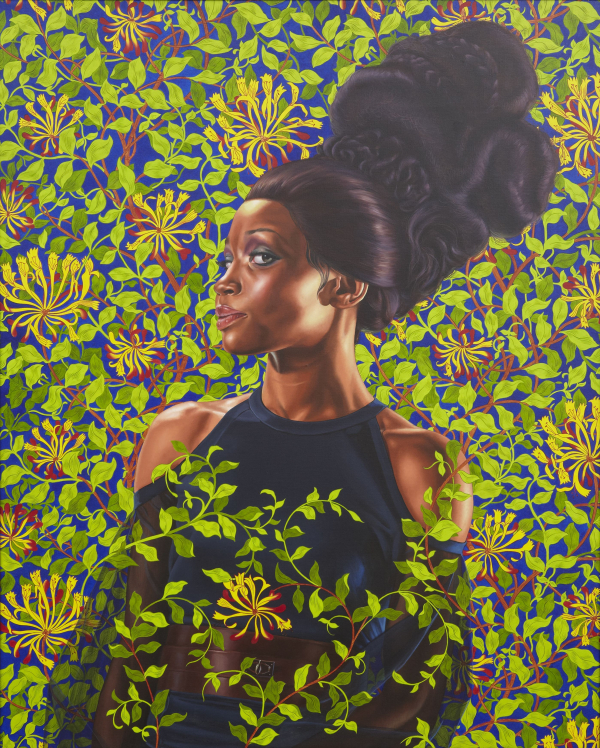
Kehinde Wiley
American painterWikipedia
24
MENTIONS
21
EPISODES
20
PODCASTS
Search complete. 24 mentions across 21 episodes found for "Kehinde Wiley".
Sep 23, 2026

Gina BeaversHOST
not, you know, we're talking sort of apples and oranges in terms of the way that we're talking about culture and how it's shifted.
Gina BeaversHOST
You know, like Amy Sherald, I mean, you know, Trump just... deaccessioned or got rid of the Kehinde Wiley painting at the one embassy.
Gina BeaversHOST
So it's completely unacceptable to a part of the culture that Amy Sherald is saying, here are people in my community, here are black Americans on a canvas.
Gina BeaversHOST
It's completely culturally unacceptable.

Michael MotiaHOST
Titus Kaphar gets some mention in this book, and there's a novelist, Frederick Weissman.
Michael MotiaHOST
But one of the main ones is this work called An Archaeology of Silence by Kehinde Wiley.
Michael MotiaHOST
Can you tell us about that work and how it helped you see Byzantine art?
Glenn PeersGUEST
Yeah, yeah.

Michael MotiaHOST
Titus Kefar gets some mention in this book, and there's a novelist, Frederick Weissman.
Michael MotiaHOST
But one of the main ones is this work called An Archaeology of Silence by Kehinde Wiley.
Michael MotiaHOST
Can you tell us about that work and how it helps you see Byzantine art?
Glenn PeersGUEST
Yeah, yeah.

Michael MotiaHOST
um and i mean then and that's i mean one just go go see the documentary um but also it's a way of doing art history too of this this process of you know you see a documentary um and the experience of something in the present helps us then kind of re-see the past um and and a lot of this book is is making that kind of of move um you know titus kafar gets a Some mentioned in this book, and there's a novelist, Frederick Weissman.
Michael MotiaHOST
But one of the main ones is this work called An Archaeology of Silence by Kehinde Wiley.
Michael MotiaHOST
Can you tell us about that work and how it helps you see Byzantine art?
Glenn PeersGUEST
Yeah, yeah.

Mike MontillaHOST
And there's a novelist, Frederick Weissman.
Mike MontillaHOST
But one of the main ones is this work called An Archaeology of Silence by Kehinde Wiley.
Mike MontillaHOST
Can you tell us about that work and how it helps you see Byzantine art?
Glenn PeersGUEST
Yeah, yeah.

Michael MotiaHOST
Titus Kefar gets some mention in this book, and there's a novelist, Frederick Weissman.
Michael MotiaHOST
But one of the main ones is this work called An Archaeology of Silence by Kehinde Wiley.
Michael MotiaHOST
Can you tell us about that work and how it helps you see Byzantine art?
Glenn PeersGUEST
Yeah, yeah.

Michael MotiaHOST
um and i mean then and that's i mean one just go go see the documentary um but also it's a way of doing art history too of this this process of you know you see a documentary um and the experience of something in the present helps us then kind of re-see the past um and and a lot of this book is is making that kind of of move um you know titus kafar gets a Some mentioned in this book, and there's a novelist, Frederick Weissman.
Michael MotiaHOST
But one of the main ones is this work called An Archaeology of Silence by Kehinde Wiley.
Michael MotiaHOST
Can you tell us about that work and how it helped you see Byzantine art?
Glenn PeersGUEST
Yeah, so another exhibition encounter that really captivated and changed.

Michael MotiaHOST
Some mentioned in this book, and there's a novelist, Frederick Weissman.
Michael MotiaHOST
But one of the main ones is this work called An Archaeology of Silence by Kehinde Wiley.
Michael MotiaHOST
Can you tell us about that work and how it helps you see Byzantine art?
Glenn PeersGUEST
Yeah, yeah.

Ellie AndersonHOST
But one artist is fighting statues with statues.
Ellie AndersonHOST
In 2019, Kehinde Wiley, the famed painter of Barack Obama's presidential portrait, crafted a 27-foot-tall sculpture of a man triumphantly poised upon a battle-ready steed.
Ellie AndersonHOST
He installed it at the Virginia Museum of Fine Arts, right near Richmond's infamous Monument Avenue.
Ellie AndersonHOST
It looks, in many ways, just like the monuments that once lined that street: huge, imposing, bronze.

Ana NavarroHOST
So if you don't see the racism at this point, I don't know what is clouding your judgment.
Ana NavarroHOST
What else is he doing? They're removing what they call woke artwork by artists of color from US embassies, including a painting by the artist, African American artist, Kehinde Wiley.
Ana NavarroHOST
He's the one that painted the official portrait of Obama that hangs in the Smithsonian.
Ana NavarroHOST
Oh, the Smithsonian.
11 more episodes mention Kehinde Wiley.
Create an account to see the whole feed, search across every transcript, and follow the entities you care about.