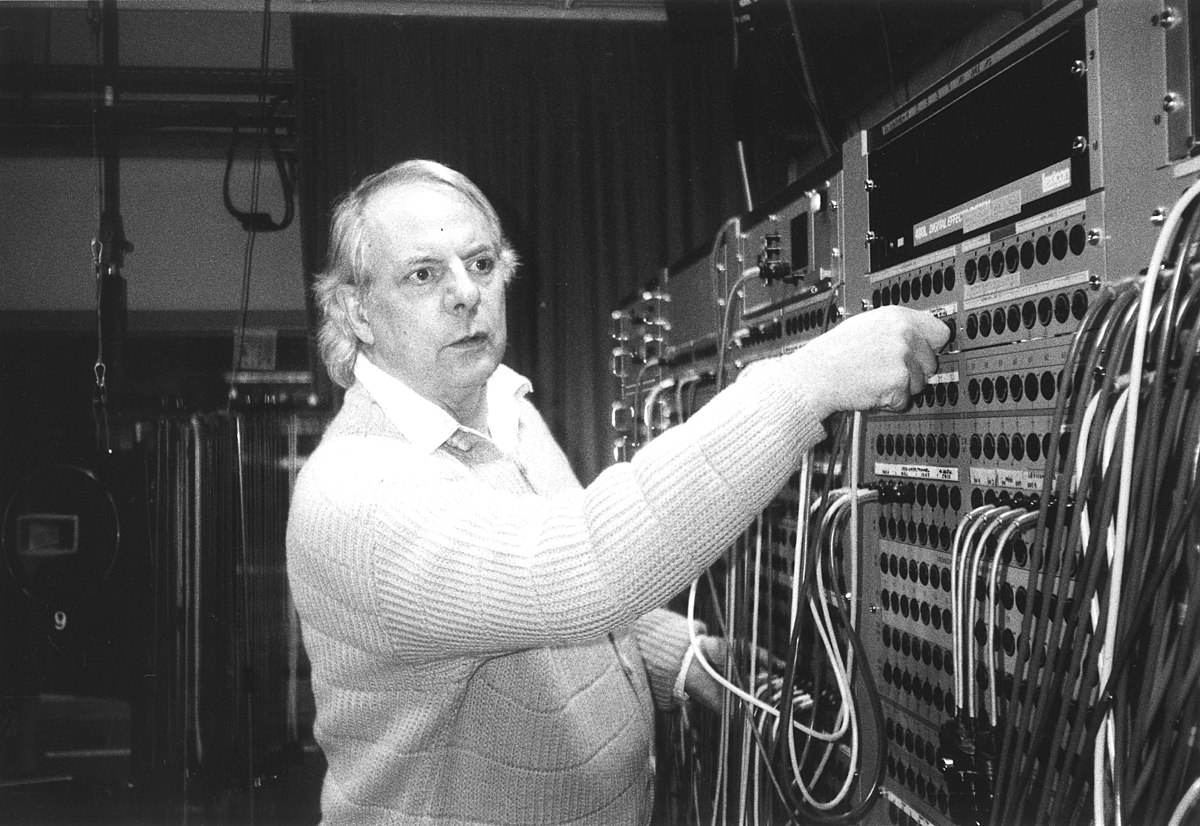
Karlheinz Stockhausen
German composerWikipedia
41
MENTIONS
28
EPISODES
27
PODCASTS
Search complete. 41 mentions across 28 episodes found for "Karlheinz Stockhausen".
Sep 15, 2026

ÓtalGUEST
And this is called Persian Love.
ÓtalGUEST
He was a student of Stockhausen, so he knew electronic music pretty well.
ÓtalGUEST
But he does this in this very light, very jolly and very happy kind of a mood.
ÓtalGUEST
Yeah, it's a very romantic.

Ron LessardGUEST
And from prog rock, I, you know, I, I, I started listening to the classical avant-garde people because it's like, well, these guys take it even farther than King Crimson.
Ron LessardGUEST
You know, I started listening to like John Cage and Stockhausen and all those kinds of guys, you know? And, um, It was always a quest to be more extreme, more far out than previous.
Ron LessardGUEST
And then one day I bought a record from a band called The Residents.
Ron LessardGUEST
Oh my God, I couldn't believe what I was hearing.

Nate BrownHOST
But she was influencing him down these kind of avant-garde paths, and so that's kind of where Revolution 9 comes from.
Nate BrownHOST
And The Beatles were aware of some avant-garde composers, particularly Stockhausen, and it was actually McCartney who got interested in Stockhausen.
Nate BrownHOST
sooner than Lennon did.
Nate BrownHOST
But Stockhausen is actually one of the pictures on the Sgt. Pepper cover.
Nate BrownHOST
But McDonald points out that Revolution 9 is similar to some electronic compositions by so-called serious composers.
Nate BrownHOST
However, since it was on a Beatles album, which sold millions of copies, even if those who bought the album only listened to this particular track once, that still makes it probably by far the most heard kind of avant-garde electronic collage piece ever produced.

Bob JamesGUEST
Yes, I was.
Bob JamesGUEST
Those two names I don't remember, but, but I was more, uh, influenced by the people in the classical avant-garde world like John Cage and, um, and- Stockhausen and those people that were...
Bob JamesGUEST
It was a different kind of experimentation.
QuestloveHOST
Okay.

speaker_3UNKNOWN
there.
Jah WobbleGUEST
I joined the local library and they had a really good electronic section, so I'm listening to Stockhausen.
Jah WobbleGUEST
I've driven everyone out to squat because I set fire to some furniture.
Jah WobbleGUEST
It was like the script from The Young Ones, apparently.

Michael Mark CohenGUEST
Susan Sontag was driven out of American journalism.
Michael Mark CohenGUEST
The German composer Stockhausen had his...
Michael Mark CohenGUEST
I mean, the Dixie Chicks.
Michael Mark CohenGUEST
The Dixie Chicks, KRS-One.

Charlemagne PalestineGUEST
I wanted to create my own universe.
Charlemagne PalestineGUEST
If they could create their universe and they didn't have to be a part of all that conservatory and all that, and even the Stockhausen, Berio, Yusachevsky, Davidovsky, and all those people that I knew about, who were part of the official sort of new musics and electronics, because I was already liking electronics and I was playing with like $50 recording machines and trying to break them so they would make weird sounds and things like that.
Charlemagne PalestineGUEST
But still, I liked the energy and the... imagination and it was all connected to ceremonies and to funerals and to births and to marriages and to indigenous people, I mean.
Liam ErbHOST
Yeah, so yeah.

Nick CoatesGUEST
I mean, I, I often do the thing of what are your desert island discs ones, and I, I usually try and come up with a, a bit of a cocktail of, you know, if I were on the desert island, what would, what would it be? And I mean, I Am The Walrus is definitely up there.
Nick CoatesGUEST
Um, Tomorrow Never Knows for the same reasons, like, the, the most revolutionary sound, and, uh, just how, how daring it is and, but also how it links through to, you know, Stockhausen and Berio.
Nick CoatesGUEST
And, like, th- bringing the cl- this of the serious side, the art world, I think that's something that's really interesting about The Beatles, how serious they were in lots of ways, as well as how, how playful.
Nick CoatesGUEST
But then, you know, there are, there, there are the other ones that are just beautiful songs.

SamHOST
But after the war, things went the other way.
SamHOST
In Europe, composers like Boulez and Stockhausen pushed total serialism to the extreme.
SophieHOST
Everything was controlled, mathematically determined.
SophieHOST
The result was often fiercely intellectual and alienating.

Charles C. W. CookeHOST
But there was something about it.
Charles C. W. CookeHOST
The, there's a compo- awful modernist composer, Stockhausen, who worked with this guy Cage in the '60s, Cage and Stockhausen.
Charles C. W. CookeHOST
And Stockhausen said after 9/11 that it was the greatest work of art in history, and it was a revolting thing to say, and he was correctly reviled for it.
Charles C. W. CookeHOST
But in a perverse way, there's actually something to what he was saying in the sense that it was maybe the most revolting visual [laughs] enterprise.
Noah RothmanGUEST
Well, there, there's a delusion-
18 more episodes mention Karlheinz Stockhausen.
Create an account to see the whole feed, search across every transcript, and follow the entities you care about.