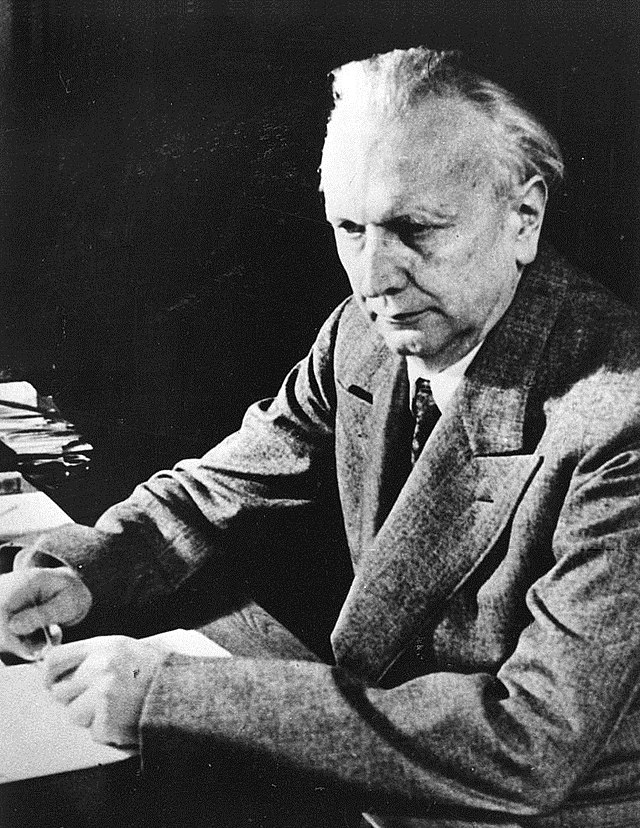
Karl Jaspers
German-Swiss psychiatrist and philosopherWikipedia
11
MENTIONS
8
EPISODES
8
PODCASTS
Search complete. 11 mentions across 8 episodes found for "Karl Jaspers".
Sep 26, 2026

Richard TarnasGUEST
Uh, it was really great.
Richard TarnasGUEST
So, um, His particular focus is on leading up to and understanding the Axial Era, when right across the world, particularly in China, India, Greece, and Israel, there was a sudden awakening of kind of disclosure to a higher transcendent dimension of reality that was unitive, that had a quality of infinity, of the eternal, of perfection, had both rational and mystical components, and it took different forms for each of those axial cultures, but it it was particularly, it was Karl Jaspers, uh, the, the German historian and philosopher who named it.
Richard TarnasGUEST
Um, though there were a number of people had, had like Hegel and others had recognized it before, but, um, No one more than Bella has spelled out the bigger, detailed history of it.
Richard TarnasGUEST
And to understand how a sense of where the highest locus of value...

Lyndsey StonebridgeGUEST
And he always saw himself reflected in her So she's coming along saying, "Okay, we'll get your work back in print.
Lyndsey StonebridgeGUEST
I'll have a word with Karl Jaspers, see if we can fix that relationship," which they never could.
Lyndsey StonebridgeGUEST
I think that was certainly, certainly the case.
Lyndsey StonebridgeGUEST
I also think she probably did have a kind of deeply sentimental sense of a relationship to the past.
23 MINS LATER
Lyndsey StonebridgeGUEST
So I agree.
Lyndsey StonebridgeGUEST
I mean, not only with Hungary, but she was so excited.
Lyndsey StonebridgeGUEST
She writes to Karl Jaspers because she's in Europe when the tanks roll in, and she says, "It's the best exciting thing that's happened since World War II," and Karl Jaspers is, "Um." [chuckles] And then, you know, within days, there were court martials being, spontaneous court martials and people being shot in the street.
Lyndsey StonebridgeGUEST
I mean, it was not what she wanted.

Anna Maria Lambertz-RohstockGUEST
Yeah.
Anna Maria Lambertz-RohstockGUEST
He was holding the Carl Jaspers Chair for the Philosophical Foundations of Psychiatry.
Anna Maria Lambertz-RohstockGUEST
And in his seminar, I wrote a term paper about Carl Jaspers' concept of the limit situation.
Anna Maria Lambertz-RohstockGUEST
And this paper luckily convinced Professor Fuchs not only to supervise my master's thesis, but also to accept me as a doctoral student, even though he already had 18 of them and I was number 19.
Anna Maria Lambertz-RohstockGUEST
And I was really delighted to realize that this circle of researchers around Thomas Fuchs, the so-called section of phenomenology, was really a vibrant community where discussions were held on a really high intellectual level while being sustained by a warm and welcoming and witty atmosphere.
28 MINS LATER
Anna Maria Lambertz-RohstockGUEST
And this is something that Kierkegaard has really put his finger onto.
Anna Maria Lambertz-RohstockGUEST
The term itself is not by Kierkegaard.
Anna Maria Lambertz-RohstockGUEST
I think it was coined by Carl Jaspers, who was an enthusiastic reader of Kierkegaard.

Thomas CyrGUEST
Um, Mosley openly acknowledged that he felt caught between like a pious belief in, you know, uh, the kind of Anglophone interpretation of the faith and legitimate paganism.
Thomas CyrGUEST
And this kind of like liminal phenomenon in the Carl Jaspers and Jungian sense of being caught between historical imperatives and the ancient past informing the present in critical ways and this kind of weakening of the barrier of reason between what is actual historical memory, what is myth, what is a matter of faith, what is a historical, um, you know, occurrence.
Thomas CyrGUEST
Nowhere is this greater felt than in England.
Thomas CyrGUEST
And C.S. Lewis wrote about this, okay? Mosley embodied that tendency to a T.

ThomasGUEST
Um, Mosley openly acknowledged that he felt caught between, like, a pious belief in, you know, uh, the kind of Anglophone interpretation of the faith and legitimate paganism.
ThomasGUEST
And this kind of like liminal phenomenon in the Carl Jaspers and Jungian sense of being caught between historical imperatives and the ancient past informing the present in critical ways, and this kind of weakening of the barrier of reason between what is actual historical memory, what is myth, what is a matter of faith, what is a historical, um, you know, occurrence.
ThomasGUEST
Nowhere is this greater felt than in England, and C.S. Lewis wrote about this, okay? Mosley embodied that tendency to a T.
ThomasGUEST
And if you wanna understand true English fascism, it comes from a different place than German national socialism or, like, Spanish syndicalism or, you know, uh, Italian fascism.

Anya DalyHOST
And we're going to look forward to...
Anya DalyHOST
Discussing a bit more about that book in this particular session So you begin in the the book in the introduction? with a discussion of John Dewey's prescient account of the problems with the medical view of ill health And this has already been identified somewhat in Carl Jaspers work the phenomenologist and psychiatrist of the early 20th century with regard to mental illness and and that in both the accounts of bodily ill health and mental ill health, that there is a kind of a reductive physicalist approach, and this has dominated and led to some significant distortions in the understanding of both medical disorder and mental disorder.
Anya DalyHOST
And these have all contributed, particularly in the domain of psychiatry, of course, to the crisis of legitimacy in psychiatry, and this is persisting today in this Still work being done on this.
Anya DalyHOST
And what is needed, of course, is a more encompassing interpretive framework rather than just what is now put forward as the biopsychosocial model.

Anya DalyHOST
So you begin in the book, in the introduction, with a discussion of John Dewey's prescient account of the problems with the medical view of ill health.
Anya DalyHOST
And this has already been identified somewhat in Carl Jasper's work, the phenomenologist and psychiatrist of the early 20th century with regard to mental illness.
Anya DalyHOST
And that in both the accounts of bodily ill health and mental ill health, that there is a kind of a reductive physicalist approach.
Anya DalyHOST
And this has dominated and led to some significant distortions in the understanding of both medical disorder and mental disorder.

Anya DalyHOST
And we're going to look forward to...
Anya DalyHOST
Discussing a bit more about that book in this particular session So you begin in the the book in the introduction? with a discussion of John Dewey's prescient account of the problems with the medical view of ill health And this has already been identified somewhat in Carl Jaspers work the phenomenologist and psychiatrist of the early 20th century with regard to mental illness and And that in both the accounts of bodily ill health and mental ill health, that there is a kind of a reductive physicalist approach.
Anya DalyHOST
And this has dominated and led to some significant distortions in the understanding of both medical disorder and mental disorder.
Anya DalyHOST
And these have all contributed, particularly in the domain of psychiatry, of course, to the crisis.