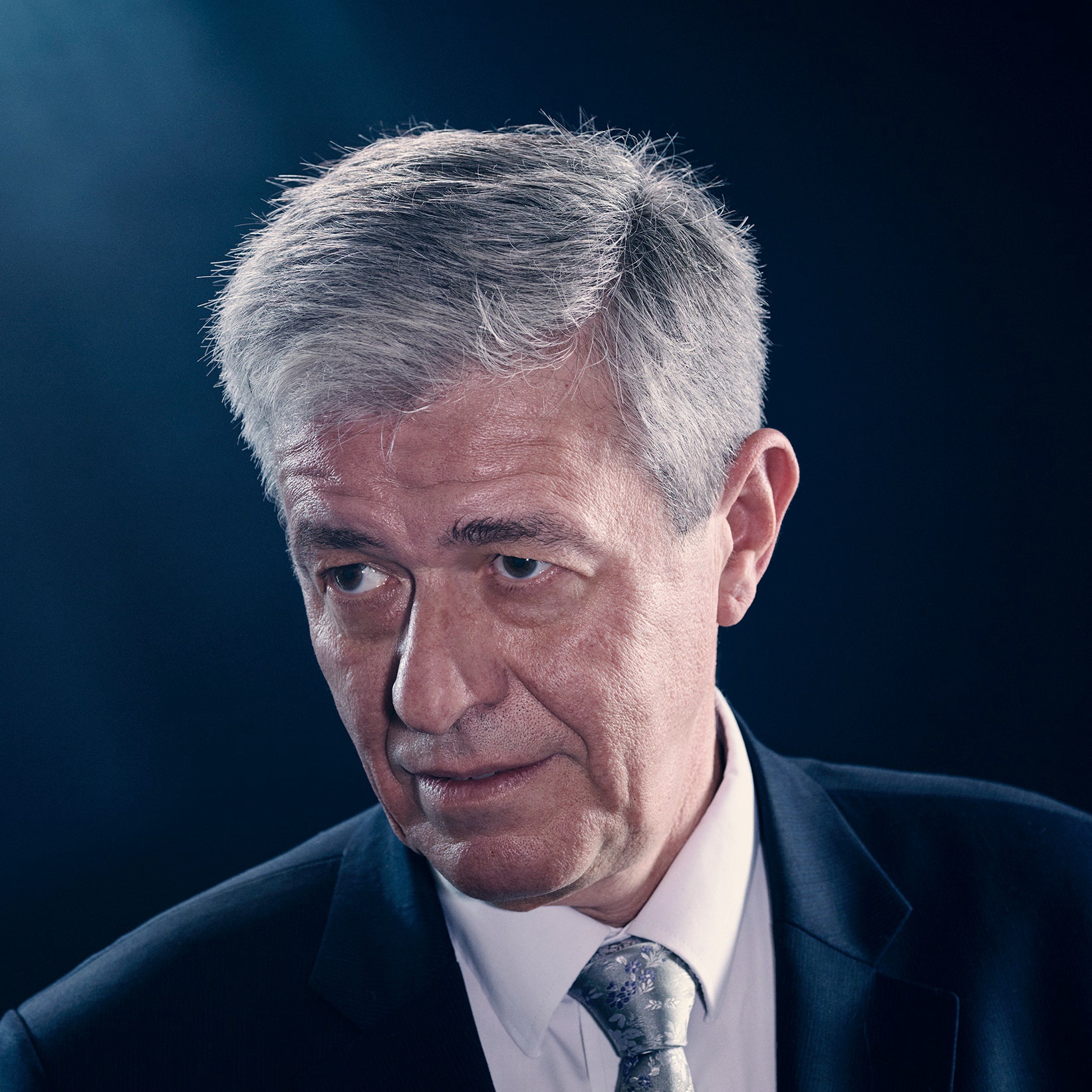
Karl J. Friston
British neuroscientist
5
APPEARANCES
5
PODCASTS
Sep 21, 2026

speaker_1HOST
And I'm particularly interested in what kind of things can it tell us and what kind of things can it tell us in the future, perhaps, to that symptom-based diagnosis wouldn't be able to.

Karl FristonGUEST
I'll briefly say what computational psychiatry is from my point of view, and then focus on a particular application, which I suspect is what you're interested in.
Karl FristonGUEST
So computational psychiatry was invented by people like Reed Montague and Peter Diane many years ago as a rallying call to try and attract funding and young clinicians and academics into a more computational, formal, theoretical approach to psychiatry.
16 MINS LATER
speaker_1HOST
Now, I'm curious, in terms of treatment, what can we do in terms of treatment to decrease the resistance that a false belief has to contradictory


Seiara ImanovaHOST
So how could FEP and this theory apply to a condition like schizophrenia? And I guess my simple understanding is that maybe there's too much of that precision weight being given to, you know, noisy, irrelevant sensory signals, but maybe you can help us better understand that a little.
Karl FristonGUEST
I mean, we introduced Parkinson's disease as a particular example of a failure of sensory attenuation or the failure to attenuate the precision afforded prediction errors.
Karl FristonGUEST
So if you read, um, The more philosophical treatment of predictive processing, very often you'll be talking about not just the minimization of prediction errors, but the minimization of precision-weighted prediction errors.
Karl FristonGUEST
It scores the credence or the confidence that you're placing in a very context-sensitive way in this particular source of information that is going to be used to drive your belief updating.
Karl FristonGUEST
So a very simple example of that would be, say, I'm in a hotel room and it's dark and I've just shut the door and I don't know where the light switch is.
32 MINS LATER
Seiara ImanovaHOST
And then I see a lot of scientists or, you know, people studying medicine signed to the comments saying like no this paper is not arguing at all that stress has no impact on the body absolutely stress has impact on the body it's more arguing that the trauma storing is like a metaphor it's not a literal meaning of it you know so that's the kind of overall gist of it


Mike AzarinHOST
I guess what causes one person from the free energy perspective to be more okay with uncertainty versus another person who may be less okay with uncertainty?

Carl FristonGUEST
Well, I think I'll simply answer just by noting, of course, everybody's completely different because we're all trying to learn our world models or generative models.
Carl FristonGUEST
And the only source of learning is what we sense, our sensorium, and that is unique and private to everyone.
27 MINS LATER
Mike AzarinHOST
So what about them from the perspective of the free energy principle? What makes them different?

YvetteGUEST
[laughs] Yes
Karl FristonGUEST
The, um, just something that might, um, tie together the, um, the missing information perspective on probability and the first, um, scale invariant, or, um, looking for invariances or symmetries at multiple scales.
Karl FristonGUEST
Uh, um, o-one response as a physicist, um, with very little training, and my training was a year of quantum, um, uh, mechanics and a year of probability theory, um, is that it's all about probability.
Karl FristonGUEST
Um, and on that view, information is just an attribute of a probability density.
24 MINS LATER
JoelPANELIST
Yeah.


Karl FristonGUEST
So I spent the first few years of my education being, uh, studying to become a doctor and then, uh, specializing in psychiatry.
Karl FristonGUEST
But at the earliest opportunity, um, tried to move into research, and that's where the list of mentors, um, arises.
Karl FristonGUEST
Uh, and the first mentor, um, was a gentleman called Phil Cowan, um, who comes from a stable of very influential, um, clinical academics in the UK that effectively established neuropharmacology as a discipline.