Kaplan–Meier estimator
43
MENTIONS
30
EPISODES
28
PODCASTS
Search complete. 43 mentions across 30 episodes found for "Kaplan–Meier estimator".
Oct 28, 2026

Carolyn LineenHOST
This translated into a hazard ratio for distant recurrence of 30.3.
Carolyn LineenHOST
The Kaplan-Meier curves shown in figure 2 are particularly striking.
Carolyn LineenHOST
The two groups separate very early, with 3-year distant recurrence-free interval estimated at approximately 95% among ctDNA negative patients.
Carolyn LineenHOST
while outcomes were substantially poorer among those who remained ctDNA positive.

Tara I. ChangHOST
So I think from a study design perspective, it was really interesting.
Tara I. ChangHOST
Unfortunately, I think every... every single Kaplan-Meier was just right on top of each other for the outcome.
Tara I. ChangHOST
At least
Laura DemberGUEST
it's a definitive answer.

Danny HengGUEST
I'll get in a word eventually.
Danny HengGUEST
Yes, the hazard ratio is 0.85. And that does take into account every piece of the Kaplan-Meier curve as opposed to just talking about the medians you're right.
Danny HengGUEST
I did want to say, though, that the p-value is 0.04689. And the p-value boundary set for statistical significance was 0.0223.
Danny HengGUEST
So officially, it's not statistically significant.
Tom PowlesHOST
Danny, when you look at the shape of that curve, you know...
Brian RiniHOST
Which one?
Tom PowlesHOST
The shape of the OS Kaplan-Meier curve.
Tom PowlesHOST
Yeah.
Martin VossHOST
right? We have these two studies here, two large randomized phase three trials that look into triplet versus doublet, exactly what Brian just said, right? And surprising to me, the difference here is that Cosmic 313 actually met its primary endpoint.
Martin VossHOST
And if you look at the slides at the Kaplan-Meier curves for PFS, the triplet actually does come out the winner.
Martin VossHOST
And if you look at the response data specifically at upfront failure, the triplet does look better.
Martin VossHOST
And then if you look at OSDS no difference and exposure duration of therapy becomes the same problem.

Beth FaimanHOST
Um, but it didn't matter, there was still a better overall response rate with the mezi KD.
Beth FaimanHOST
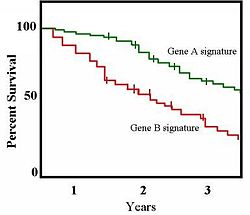
And then when we look at the, um, the SUCCESSOR-2 data with the progression-free survival, staying in remission, remember your Kaplan-Meier curves.
Beth FaimanHOST
[laughs] The green line is the top one that drifts out and stays higher.
Beth FaimanHOST
That mezi KD is 18, uh, months progression-free survival, a median progression-free survival.

Beth FaimanHOST
There was still a better overall response rate with the Mezzi KD.
Beth FaimanHOST
And then when we look at the successor to data with the progression-free survival staying in remission, remember your Kaplan-Meier curves.
Beth FaimanHOST
The green line is the top one that drifts out and stays higher.
Beth FaimanHOST
That Mezzi-KD is 18 months progression-free survival, medium progression-free survival.

Aisha AbdeenHOST
In the aseptic failure samples, only one combined immune cell population, the total macrophages and monocytes, was elevated both before and after the BH correction.
Aisha AbdeenHOST
So Kaplan-Meier analysis for all patients with PJI revealed a mean two-year survivorship free from infection recurrence in 88.8% of patients with a CD8 Treg ratio above the median and had a significantly better infection-free survivorship than those below the median.
Aisha AbdeenHOST
So the CD8 Treg ratio, it's something that compares the amount of killer T-cells or the CD8 cells to suppress the regulatory T cells or the Tregs in a tissue.
Aisha AbdeenHOST
And a higher ratio often points to a stronger immune system.
Aisha AbdeenHOST
And so that basically checked out that that was, you know, predictive of better survival for the case with PJI.
Aisha AbdeenHOST
Kaplan-Meier analyses for all other individual immune cell types, combined populations, immune cell ratios showed no significant association with infection recurrence.
Aisha AbdeenHOST
So, you know, I thought the study was well conducted.
Aisha AbdeenHOST
However, there were very limited aseptic failure samples, only 50 samples in comparison to the PGI failures of which there were 135 and aseptic failure can be better, very heterogeneous.

Abraham MorgentalerGUEST
But what's clear is that people with lower testosterone die sooner.
Paul TurekHOST
I mean, there was a big VA study, right? And it had Kaplan-Meier, and they don't live as long.
Paul TurekHOST
If you have lifelong low testosterone, you're not going to live as long as if you have had normal levels.
Paul TurekHOST
And you don't die of anything in particular.

EddieHOST
So may- maybe a little bit, maybe a little bit sicker there, but certainly a little more, worse renal function.
EddieHOST
Uh, he- here's their, there's, here's their, uh, Kaplan-Meier curve, and the Kaplan-Meier curve is, has a pretty clear split.
EddieHOST
It's a pretty clear split, pretty clear separation.
EddieHOST
It continues to separate beyond the one week.
EddieHOST
Their hazard ratio here was, uh, one point two six seven, with a confidence interval that went from, uh, one point one six to one point three eight.
EddieHOST
Um, so this is, uh, statistically significant by, you know, statistics, statistically significant by just looking at the Kaplan-Meier curve.
EddieHOST
They did a bunch of sensitivity analyses here, which I thought was interesting.
EddieHOST
So they had, instead of a ninety-day exposure window, only a thirty-day exposure.
20 more episodes mention Kaplan–Meier estimator.
Create an account to see the whole feed, search across every transcript, and follow the entities you care about.