Kansas–Nebraska Act
65
MENTIONS
28
EPISODES
26
PODCASTS
Search complete. 65 mentions across 28 episodes found for "Kansas–Nebraska Act".
Sep 18, 2026

MWUSAHOST
And so it also required states in the free states to assist in the capture and return of escaped slaves back to the south.
MWUSAHOST
if needed, so it did not solve every slave issue, temporarily reduced some political tensions, but there was the Kansas-Nebraska Act, the Dred Scott decision, and the Civil War, and all that stuff still coming, and it wasn't until the 16th president, your favorite president, before things started really getting resolved, and even then, He didn't have the power that he thought that he had.
MWUSAHOST
The California Gold Rush was underway during his presidency, 1849-1850, and he supported the construction of a national library in Washington, D.C.
MWUSAHOST
He was very interested in education and the establishment of what became the University of Buffalo.

Addison AndersonNARRATOR
The collapse of this second party system was at the center of increasing regional tensions that would lead to the birth of the Republican Party, the rise of Abraham Lincoln as its leader, and a civil war that would claim over half a million lives.
Addison AndersonNARRATOR
And if this collapse could be blamed on a single event, it would be the Kansas–Nebraska Act of 1854.
Addison AndersonNARRATOR
The story starts with the Missouri Compromise of 1820.
Addison AndersonNARRATOR
To balance the number of slave states and free states in the Union, it allowed slavery in the newly admitted state of Missouri while making it off-limits in the remaining federally administered Louisiana Territory.
Addison AndersonNARRATOR
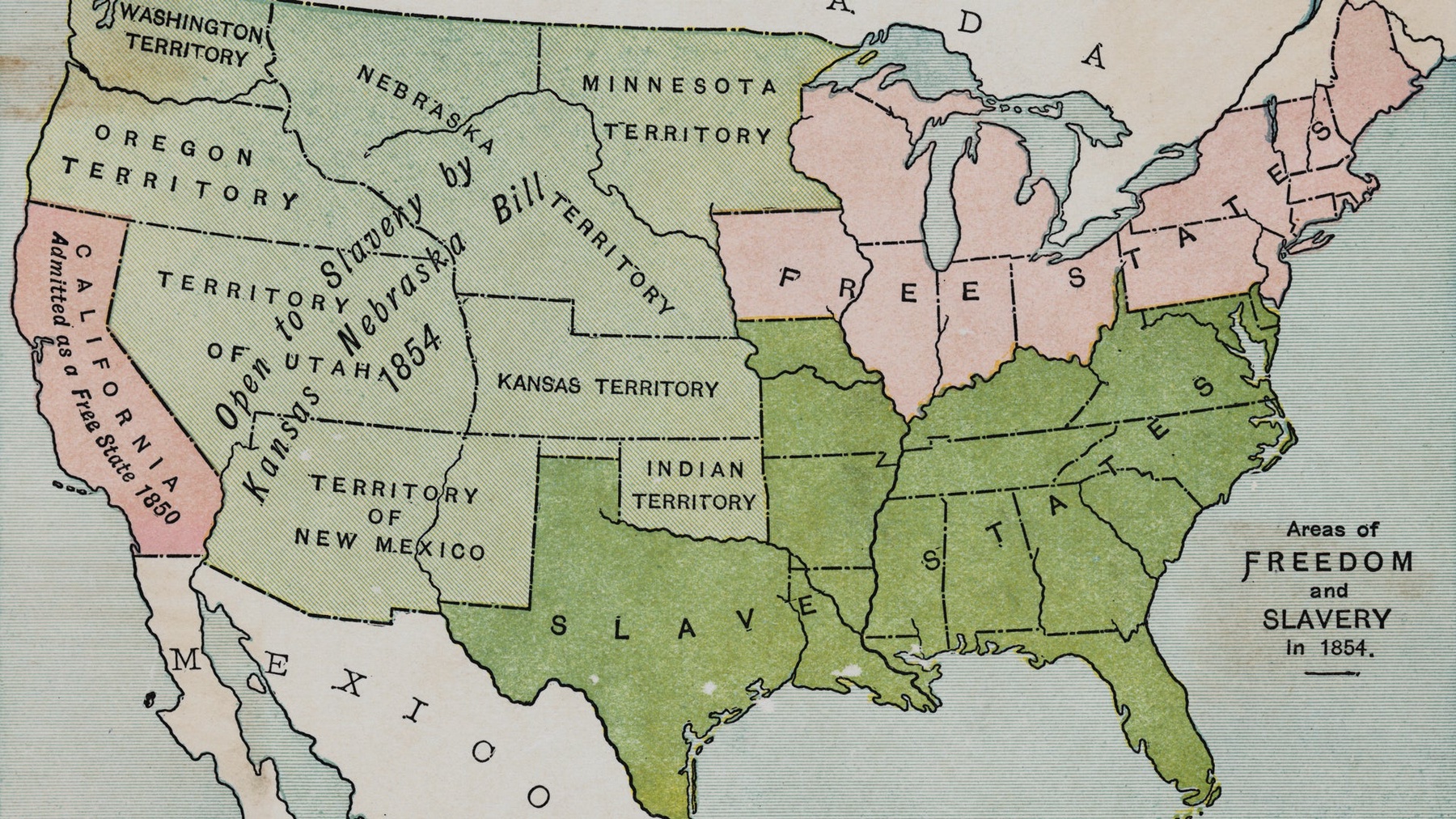
It would divide the large chunk of incorporated land into two new organized territories, Nebraska and Kansas, each of which would be open to slavery if the population voted to allow it.
Addison AndersonNARRATOR
While Douglas and his Southern supporters tried to frame the bill as protecting the political rights of settlers, horrified Northerners recognized it as repealing the 34-year-old Missouri Compromise and feared that its supporters' ultimate goal was to extend slavery to the entire nation.
Addison AndersonNARRATOR
Congress was able to pass the Kansas–Nebraska Act, but at the huge cost of bitterly dividing the nation, with 91% of the opposition coming from Northerners.
Addison AndersonNARRATOR
In the House of Representatives, politicians traded insults and brandished weapons until a sergeant at arms restored order.

Katie GibneyNARRATOR
Unwittingly the avalanche was started.
Katie GibneyNARRATOR
After a stormy debate, in which important amendments were forced on Douglas, the Kansas-Nebraska bill became a law on May 30, 1854.
Katie GibneyNARRATOR
The measure created two territories, Kansas and Nebraska, and provided that they, or territories organized out of them, would come into the Union as states with or without slavery as their constitutions may prescribe at the time of their admission.
Katie GibneyNARRATOR
Not content with this, the law went on to declare the Missouri Compromise null and void as being inconsistent with the principle of non-intervention by Congress with slavery in states and territories.
Katie GibneyNARRATOR
Stayed old Boston hanged him in effigy with an inscription, Stephen A. Douglas, author of the infamous Nebraska Bill, the Benedict Arnold of 1854.
Katie GibneyNARRATOR
City after city burned him in effigy until, as he himself said, he could travel from the Atlantic coast to Chicago in the light of the fires.
Katie GibneyNARRATOR
Thousands of Whigs and Free Soil Democrats deserted their parties, which had sanctioned or at least tolerated the Kansas-Nebraska bill, declaring that the startling measure showed an evident resolve on the part of the planters to rule the whole country.
Katie GibneyNARRATOR
A gauge of defiance was thrown down to the abolitionists.

Chris HaslerHOST
By 1856, American politics had become explosive.
Chris HaslerHOST
The Kansas-Nebraska Act under Franklin Pierce had destroyed old compromises.
Chris HaslerHOST
Violence in Kansas shocked the nation.
Chris HaslerHOST
New political parties were forming.

Doug VaughnHOST
Bleeding Kansas refers to a violent struggle in the Kansas Territory during the 1850s just before the Civil War.
Doug VaughnHOST
Essentially a small-scale preview of the Civil War fought over one central question: Would Kansas allow slavery or prohibit it? The crisis began after the Kansas-Nebraska Act of 1854 allowed settlers to decide by vote whether slavery would be permitted.
Doug VaughnHOST
Both sides rushed supporters into Kansas.
Doug VaughnHOST
Pro-slavery activists, many crossing over from Missouri, and sometimes called Border Ruffians- Clashed with anti-slavery free state settlers.
Martin KilcoyneHOST
Bleeding Kansas refers to a violent struggle in the Kansas Territory during the 1850s just before the Civil War.
Martin KilcoyneHOST
Essentially a small scale preview of the Civil War fought over one central question: would Kansas allow slavery or prohibit it? The crisis began after the Kansas-Nebraska Act of 1854 allowed settlers to decide by vote whether slavery would be permitted.
Martin KilcoyneHOST
Both sides rushed supporters into Kansas.
Martin KilcoyneHOST
Pro-slavery activists, many crossing over from Missouri, and sometimes called Border Ruffians-

Jonathan EarleGUEST
But that was in 1849.
Jonathan EarleGUEST
Five years later, The Kansas-Nebraska Act opens the territory to white settlement, and people rush in from the South, from Missouri, from the North, from Ohio and New York.
Jonathan EarleGUEST
And Kansas really does explode in the 1850s and becomes the epicenter of this political fight over whether or not slavery would stay where it was in the Southern states, or whether it would expand into places like Kansas territory where it was supposed to have been banned.
Jonathan EarleGUEST
way back in the Missouri Compromise of 1820.
Jonathan EarleGUEST
So Lincoln gets back into the game, back on the trail, denouncing the Kansas-Nebraska Act, forming a new Republican Party to stop slavery's expansion.
Jonathan EarleGUEST
That's Kansas the idea.
Jonathan EarleGUEST
Lincoln also decided to come to Kansas the place in 1859 at the invitation of a, I think he was a cousin of his mother, Nancy Hanks, Mark Delahaye, who was a journalist in Kansas and an early Lincoln supporter.

Damon RootGUEST
This is evidence that the founding fathers, the intent of the founding fathers was at a minimum that Congress could ban slavery in the federal territories.
Damon RootGUEST
And this comes up again and again in the 1850s, all of the big clashes we think about, the the battle over the compromise of 1850, battle over the Kansas-Nebraska Act, even the Dred Scott case at the US Supreme Court, this question of can Congress ban slavery, outlaw slavery in the federal territories is at the center of all of those disputes.
Damon RootGUEST
And the Northwest Ordinance, the language of the Northwest Ordinance says, there shall be neither slavery nor involuntary servitude in the said territory, otherwise than in the punishment of crimes whereof the party shall have been duly convicted.
Damon RootGUEST
So when anti-slavery activists and the anti-slavery Republicans are looking for language to abolish slavery, they naturally reach back to the Northwest Ordinance because it had been really at the center of the abolitionist kind of constitutional order, late 1840s throughout the 1850s.

Heather Cox RichardsonHOST
And when that happens, and there's often something very dramatic that makes people see that that's happening.
Heather Cox RichardsonHOST
In the 1850s, it was the Kansas-Nebraska Act, for example.
Heather Cox RichardsonHOST
The 1890s, it's the rise of the robber barons and especially the, never mind.
Heather Cox RichardsonHOST
There are specific things.
speaker_2NARRATOR
He was wrong.
speaker_2NARRATOR
The Kansas-Nebraska Act.
speaker_2NARRATOR
The Fatal Mistake.
speaker_2NARRATOR
The defining event of Pierce's presidency was the Kansas-Nebraska Act of 1854.
speaker_2NARRATOR
It was proposed by Stephen A. Douglas, who wanted to organize western territories to build a transcontinental railway.
speaker_2NARRATOR
The act repealed the Missouri Compromise, which had banned slavery north of a certain line.
18 more episodes mention Kansas–Nebraska Act.
Create an account to see the whole feed, search across every transcript, and follow the entities you care about.