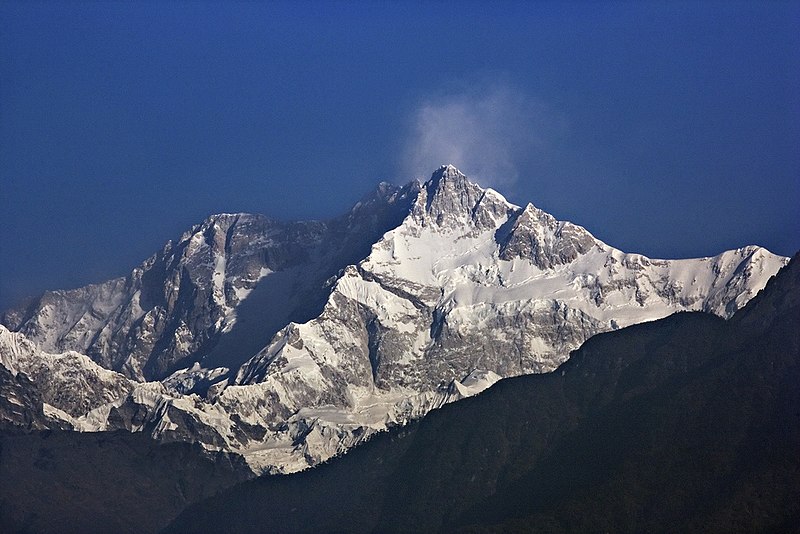
Kangchenjunga
Mountain in AsiaWikipedia
33
MENTIONS
17
EPISODES
16
PODCASTS
Search complete. 33 mentions across 17 episodes found for "Kangchenjunga".
Sep 12, 2026

William RamseyHOST
With frictions between Alistair and Rose increasing and becoming bored with married life, an opportunity for another Himalayan adventure presented itself to Alistair Crowley.
William RamseyHOST
Dr. Jules-Jacques Guillermond, a French explorer, approached Crowley with the idea of climbing Kanchenjunga, the third highest peak in the world, and claim a record for scaling a mountain never successfully ascended.
William RamseyHOST
Jules Guillermond is on the left in this picture that was taken during the Kanchenjunga expedition.
William RamseyHOST
Without taking the necessary time to plan and provision for the trip, on May 12, 1905, Crowley hastily boarded a ship for Calcutta.
William RamseyHOST
The team grouped at Darjeeling in northern India and on August 8, set out for base camp.
William RamseyHOST
One of the porters died on a treacherous series of steps cut into the ice by Crowley.
William RamseyHOST
Pierre Armand privately resigned himself to the fact that the expedition would result in failure.
William RamseyHOST
This is a picture taken during the Kanchenjunga expedition and Aleister Crowley is seated at center with a beard.

Nirmal PurjaSOUNDBITE_SPEAKER
We three started to bring this guy down.
Nirmal PurjaSOUNDBITE_SPEAKER
And it's quite technical, you know, because 50 meters below the summit of Kanchenjunga, the trend is not that easy.
Nirmal PurjaSOUNDBITE_SPEAKER
And it's quite hard to bring it down.
Nirmal PurjaSOUNDBITE_SPEAKER
So we three brought him down probably around 100 meters.

Rohit GokhaleNARRATOR
Far down birds called one another.
Rohit GokhaleNARRATOR
At last fell a white light on the Kanchenjunga range.
Rohit GokhaleNARRATOR
Then Mokalu appeared with an immense halo of opal back of his head.
Rohit GokhaleNARRATOR
the lower ranges as high as mont blanc put on their vesture of milk-white glory shapes and colors of stone and tree leaped into sight orchids trembled with morning dew now the sun like a lion leaped on the shoulder of the sky and the snow bastioned horizons bled with scarlet fire gond and rajah who had been awake already stood up then the latter a well-trained priest chanted the sanskrit vedic prayer to savitar the sun o thou blossom of eastern silence take thy ancient way untrodden of men go on thy dustless path of mystery reach thou the golden throne of god and be our advocate before his silence and his compassionate speechlessness the prayer frightened the eagles unaccustomed to human voices but ere they were excited to fury our little ritual was over and we hid ourselves under the stunted pine the eagles left without any breakfast looked out and scanned the sky for a sign of their parent they gazed below where flocks of parrots and jays flew small as humming-birds wild geese came trailing across the snowy peaks where they had spent the night on their journey southward soon they too grew small as beetles and melted into space hour after hour passed yet no sight of the big eagle the full-fledged eaglets felt hungrier and hungrier and began to fret in their nest we heard a quarrel going on in the interior of the eyrie which grew in intensity and noise till one of them left home in disgust and began to climb the cliff he went higher and higher up and up he walked without using his wings by now it was past midday we had luncheon yet still there was no sight of the parent birds we judged that the eagle left in the nest was the sister for she looked smaller than the other eaglet she sat facing the wind peering into the distance but she too grew downhearted strange though it may sound i have yet to see a himalayan eagle which does not sit facing the wind from the time of its birth until it learns to fly as a sailor boy might sit looking at the sea until he takes to navigating it about two in the afternoon that eagle grew tired of waiting in the nest she set out in quest of her brother who was now perching on the top of a cliff far above he too was facing the wind as his sister came up his eyes brightened he was glad not to be alone and the sight of her saved him from the melancholy thought of flying for food no eagle child have i seen being taught to fly by its parents that is why younglings will not open their wings until driven by hunger the parent eagles know this very well and that is why when their babies grow up and the time has come they leave them and go away the little sister laboriously climbed till she reached her brother's side but alas there was no room for two instead of balancing themselves on their perch the sister's weight knocked her brother almost over instantly he opened his wings wide the wind bore him up he stretched out his talons but too late to reach the ground He was at least two feet up in the air already, so he flapped his wings and rose a little higher.

Tom PollardHOST
So these things are still taking place, business as usual.
Tom PollardHOST
These include the Everest region, the Annapurna Circuit, Mustang, the Dolpo region, Kanchenjunga.
Tom PollardHOST
These are all open Manaslu, Dhalagiri, eastern Nepal expeditions.
Tom PollardHOST
They remain on schedule for the autumn season.
Tom PollardHOST
We know today it is referred to as Sagar Martha.
Tom PollardHOST
And on another point, as recently as the 1980s and 1990s, climbers Climbing Kanchenjunga in the eastern part of Nepal, western India, would stop just short, just a few feet or a few meters from the summit because the requests of the locals were, please don't stand on the summit of our god Kanchenjunga.
Tom PollardHOST
And so Phil Ursler, for instance, great American mountaineer who climbed Everest, one of the great American mountaineers of that era, stopped just short of the summit of Kanchenjunga out of respect for the people who lived for hundreds if not thousands of years in the shadow of Kanchenjunga.
Tom PollardHOST
That mountain was sacred and there are some things that are not for men to claim.
Tom PollardHOST
And so the world is moving in a different place now.

Tyler WayeHOST
I asked him about the hardest thing he had ever done.
Nimsdai PurjaGUEST
The hardest thing that I think I have ever done is the rescue of Kanchenjunga.
Nimsdai PurjaGUEST
Normally people go and sleep at camp one and then they go to camp two, they sleep over there.
Nimsdai PurjaGUEST
They go to camp three, they sleep over there.
Nimsdai PurjaGUEST
The next day they go to camp four and they kind of start summit push probably around 5 or 6 p.m. on Kanchenjunga because the summit push is very long.
Nimsdai PurjaGUEST
They do that but I wasn't doing any of that.
Nimsdai PurjaGUEST
I was straight into the summit push in one go and I still remember you know because I used to take those snow and put under my armpit because I was falling asleep and at one point I was just shouting so loud and we went up there and we summited Kanchenjunga and on the way down literally 50 meters below the summit we found a climber, Indian climber.
Nimsdai PurjaGUEST
He was out of his oxygen and he was basically left by his guide, by his team.

Jonty CraneGUEST
And then Everest Base Camp gets around 50,000 people a year.
Jonty CraneGUEST
So again, I was comparing it with when I did Kanchanjunga Circuit back in 2020, and that gets less than 2,000 trekkers a year.
Jonty CraneGUEST
And arguably it's a more spectacular trek, so I think if I was comparing between the two, I, I enjoyed Kanchanjunga more.
Jonty CraneGUEST
It was more spectacular.
Jonty CraneGUEST
It was quieter.
Jonty CraneGUEST
It's not somewhere where, you know, most people have heard of, but Kanchanjunga's the third-highest mountain on the planet, so it's quite impressive kinda landscape.
Jonty CraneGUEST
But it is definitely a harder trek, and yeah, probably the, as...
Jonty CraneGUEST
Manaslu would probably be a better kind of first trek for people coming to Nepal.

Nakul ChettriGUEST
Actually, there are three reasons behind this.
Nakul ChettriGUEST
I'm, I'm born and brought up in Kurseong, and from Kurseong, the Kanchenjunga mountain is visible from my, from my window.
Nakul ChettriGUEST
Always seeing that Kanchenjunga was an inspiration for me, standing tall, standing white, inspiring people.
Nakul ChettriGUEST
The tourism is blooming.
Nakul ChettriGUEST
We're admiring.
Nakul ChettriGUEST
So that brought me the attention towards Kanchenjunga landscape per se.
Nakul ChettriGUEST
And the second one is when I was working, I was studying in class 10 and 9, I was interested more on geography.
Nakul ChettriGUEST
One teacher came in class 8 and 9 and 10, and the way he taught biology also brought a lot of changes to me to bring interest towards nature, biodiversity, animals.

T.R. LoveNARRATOR
And in consequence, we were also in the hot weather haze.
T.R. LoveNARRATOR
During the whole of our journey, we never got a single view of the gorgeous southern faces of the Himalaya, of Kanchenjunga and of its supporters, and especially of the wonderful Seniol Chum peak.
T.R. LoveNARRATOR
This was a very great disappointment, as from several points on our road, a view of the southern face can be obtained.
T.R. LoveNARRATOR
Nevertheless, a journey through Sikkim is always a wonderful experience.
2 HRS 20 MINS LATER
Nick VlahakisNARRATOR
I think it would be worthwhile once more to point out what the course of the Arun is.
Nick VlahakisNARRATOR
The Arun is one of the principal tributaries of the Kosi River, that is evident from the map, and has a very long journey through Tibet, where it is known as the Bongchu.
Nick VlahakisNARRATOR
It rises near and drains the plains of Tingri and Kumba, and then turning due south forces its way through the main chain of the Himalaya, directly between the mountain passes of the Everest group on the one side and of the Kanchenjunga group on the other.
Nick VlahakisNARRATOR
Between our camp at Kharta and the village of Kiamathang, which is on the actual Nepal frontier, a distance of some twenty miles, the river drops a vertical height of four thousand feet, and therefore we were particularly interested in the exploration of this wonderful gorge, and we wished to find out, if we could, whether this tremendous vertical drop consisted of a series of great rapids and waterfalls or a steady fall in the bed of the river.

Guru SinghHOST
Like the great yogis of the Himalayas that meditate on the world to try and hold the balance.
Guru SinghHOST
There's some great historical, the Kanchenjunga mountain peaks used to be a 45,000 foot mountain, the largest mountain on earth that ever existed.
Guru SinghHOST
And when it blew in a volcanic eruption millions of years ago, it created a valley in the middle of these mountain peaks, Kanchenjunga, just outside of Darjeeling, India, in the Himalayas.
Guru SinghHOST
And this is where all of the great seers would go because of this intense energy.
Guru SinghHOST
It's one of those diamond energies of the earth, one of those meridians, those nadis of the earth.
7 more episodes mention Kangchenjunga.
Create an account to see the whole feed, search across every transcript, and follow the entities you care about.