Kami
DivinationWikipedia
34
MENTIONS
7
EPISODES
4
PODCASTS
Search complete. 34 mentions across 7 episodes found for "Kami".
Oct 7, 2026

Marianne SpiegelNARRATOR
He never imagined that it would be more profitable to breed them.
Marianne SpiegelNARRATOR
But the fact was presently discovered by one of his customers, a man named Kiriyama, then in the service of the Lord Aoyama Shimadzuki no Kami.
Marianne SpiegelNARRATOR
Kiriyama had bought from Chuzo several suzumushi, which were kept and fed in a jar half-filled with moist clay.
Marianne SpiegelNARRATOR
They died in the cold season, but during the following summer Kiriyama was agreeably surprised to find the jar newly populated with a number of young ones, evidently born from eggs which the first prisoners had left in the clay.
Marianne SpiegelNARRATOR
One of the guild, known as Mushi-ya Kojiro, Kojiro the Insect Merchant, who did business in Honjoku, returning to the city after a short visit to his native place in Kazusa, brought back with him a number of Kirigirisou which he sold at a good profit.
Marianne SpiegelNARRATOR
Although long famous elsewhere, these insects had never before been sold in Yedo.
Marianne SpiegelNARRATOR
When Mizu Echizen no Kami, says the chronicle, became Machi Bugyo, or Chief Magistrate, of Yedo, the law limiting the number of insect dealers to 36 was abolished.
Marianne SpiegelNARRATOR
Whether the guild was subsequently dissolved, the chronicle fails to mention.

Andrew M. HenryHOST
Jinja Honcho now claims that 119 million Japanese people are official followers of Shinto, and they actually use that terminology on their website, official followers.
Andrew M. HenryHOST
However, scholars of Japanese religion like John Breen and Mark Tuwin note that all the indications are that Shinto, as opposed to, say, Jinja or Kami, has no meaning at all to the vast majority of Japanese people.
Andrew M. HenryHOST
So remember from previous episodes in this series that most Japanese people do not identify as Shinto even if they regularly attend Shinto shrines, and many more do not distinguish between Shinto and Buddhism.
Andrew M. HenryHOST
Why am I bringing this up? Well, we can see that Jinja Honcho is making an indigenous argument.
Andrew M. HenryHOST
There is some historical precedent to universalizing Shinto.
Andrew M. HenryHOST
A Japanese intellectual named Ogasawara Shozo was one of the leaders of the overseas shrine projects that I mentioned earlier.
Andrew M. HenryHOST
Ogasawara envisioned Kami as a universal spiritual force and Shinto as an inclusive polytheistic tradition that could incorporate not just Japanese colonies, but all nations and their native traditions into a pluralistic global Shinto society.
Andrew M. HenryHOST
For example, Ogasawara was heavily invested in a debate over which Kami to enshrine in the chosen shrine in Seoul, Korea.
Andrew M. HenryHOST
Some shrines were expressly anti-Buddhist and advocated for the strict separation of kami veneration and Buddhist practice.
Andrew M. HenryHOST
A great example of a counter-cultural tradition is Yoshida Shinto.
Andrew M. HenryHOST
As I mentioned episode one, the Yoshida were an influential family of Shinto priests who worked in the Ministry of Kami Affairs for centuries.
Andrew M. HenryHOST
After the devastating Onin War in the late 15th century, the ministry was in a bad state, and Yoshida Kanetomo saw an opportunity to claim even greater power and authority for his family.
Andrew M. HenryHOST
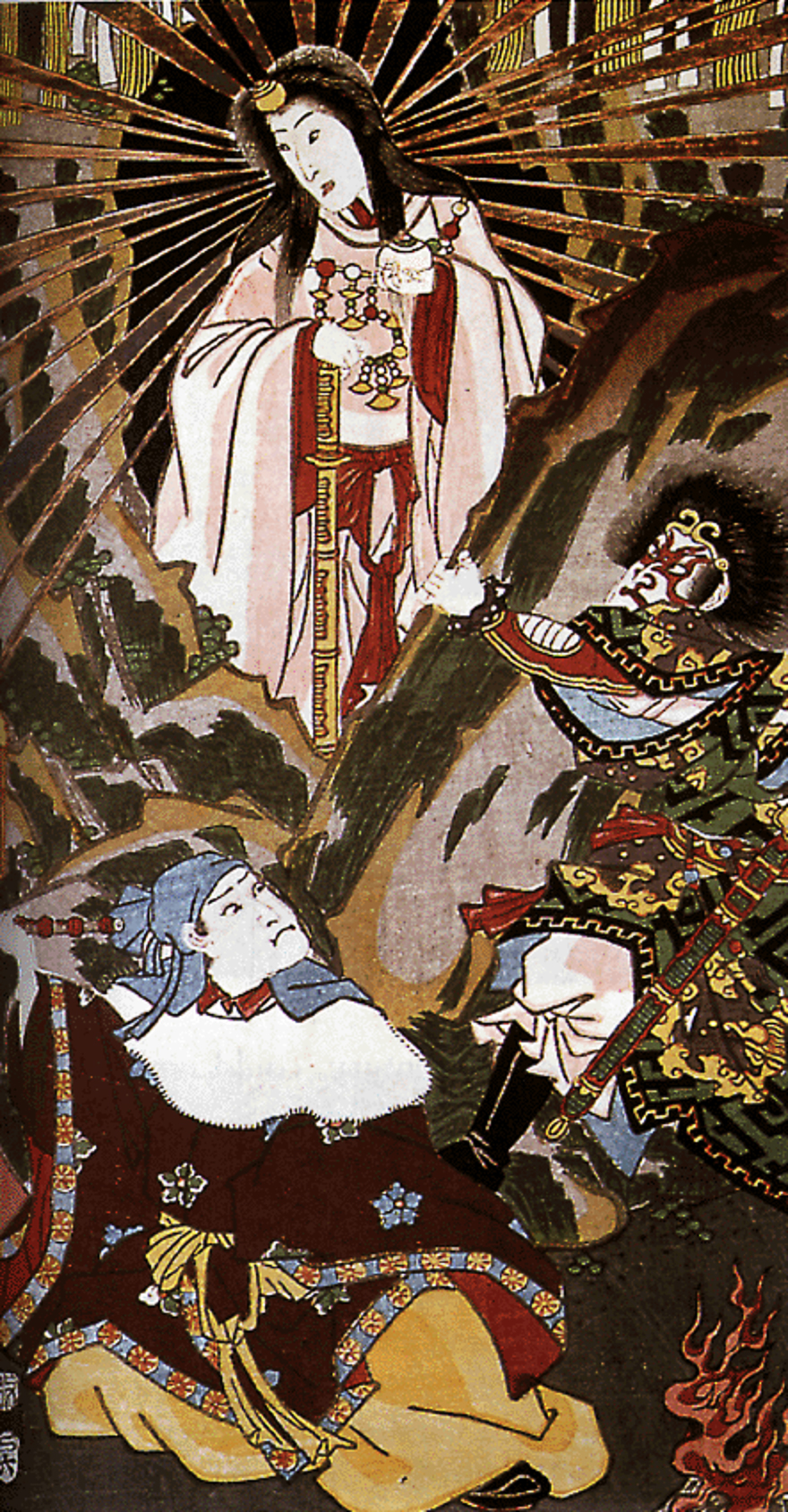
That's when he publicized his own version of Shinto, which he claimed was a secret ancient tradition given to his family by Amaterasu herself.
speaker_1ADVERTISER
Why wait? Ask your doctor, visit botoxchronicmigraine.com, or call 1-800-44-BOTOX to learn more.
Andrew M. HenryHOST
as private religious organizations.
Andrew M. HenryHOST
Despite this period of violence, if we fast-forward to today, Shinto and Buddhism seem to have found a new normal Shinto shrines are where you go to venerate the Kami, cleanse impurities, express gratitude, ask for blessings, and celebrate major milestones.
Andrew M. HenryHOST
The term kami can also refer to impersonal divine forces.
Andrew M. HenryHOST
A kami might be the spirit of a natural feature like a river or mountain, a natural force like wind, thunder, or fire.
Andrew M. HenryHOST
Kami may also inhabit sacred man-made objects such as mirrors, swords, and comma-shaped jewels called magatama.
Andrew M. HenryHOST
These objects also make up the three imperial regalia, sacred treasures passed down to the emperor by Amaterasu to signify his divine authority.
Andrew M. HenryHOST
Even certain humans can become kami after they die, such as Tenjin, the kami of education.
Andrew M. HenryHOST
It's sometimes said that there are 8 million kami, in other words, countless kami.
Andrew M. HenryHOST
However, kami are very different from the concept of gods in other religions, especially in religions like Christianity, Judaism, or Islam, in which God is transcendent.
Andrew M. HenryHOST
Kami are down to earth.
Andrew M. HenryHOST
Elevated to divine status after they died.
Andrew M. HenryHOST
What's important here is that the Kami are not transcendent beings living in some separate supernatural reality from humans.
Andrew M. HenryHOST
Kami are thought to live in the real world with humans, inhabiting objects, inhabiting natural phenomena like hot springs, or even natural features.
Andrew M. HenryHOST
Mount Fuji, for example, the mountain itself, is considered by many Japanese to be a kami.
Andrew M. HenryHOST
Okay, so if stars are kami, some sort of tangible being that share Mario's reality, then what's going on here? spirit possession.
Andrew M. HenryHOST
Romans would sacrifice to the gods, giving them something valuable, so that the gods will show favor in return.
Andrew M. HenryHOST
In Japanese Shinto, people petition kami at particular shrines.
Andrew M. HenryHOST
If you want to do well on your next exam, petition Tenjin at his shrine, the Kami of Education and Scholarship.