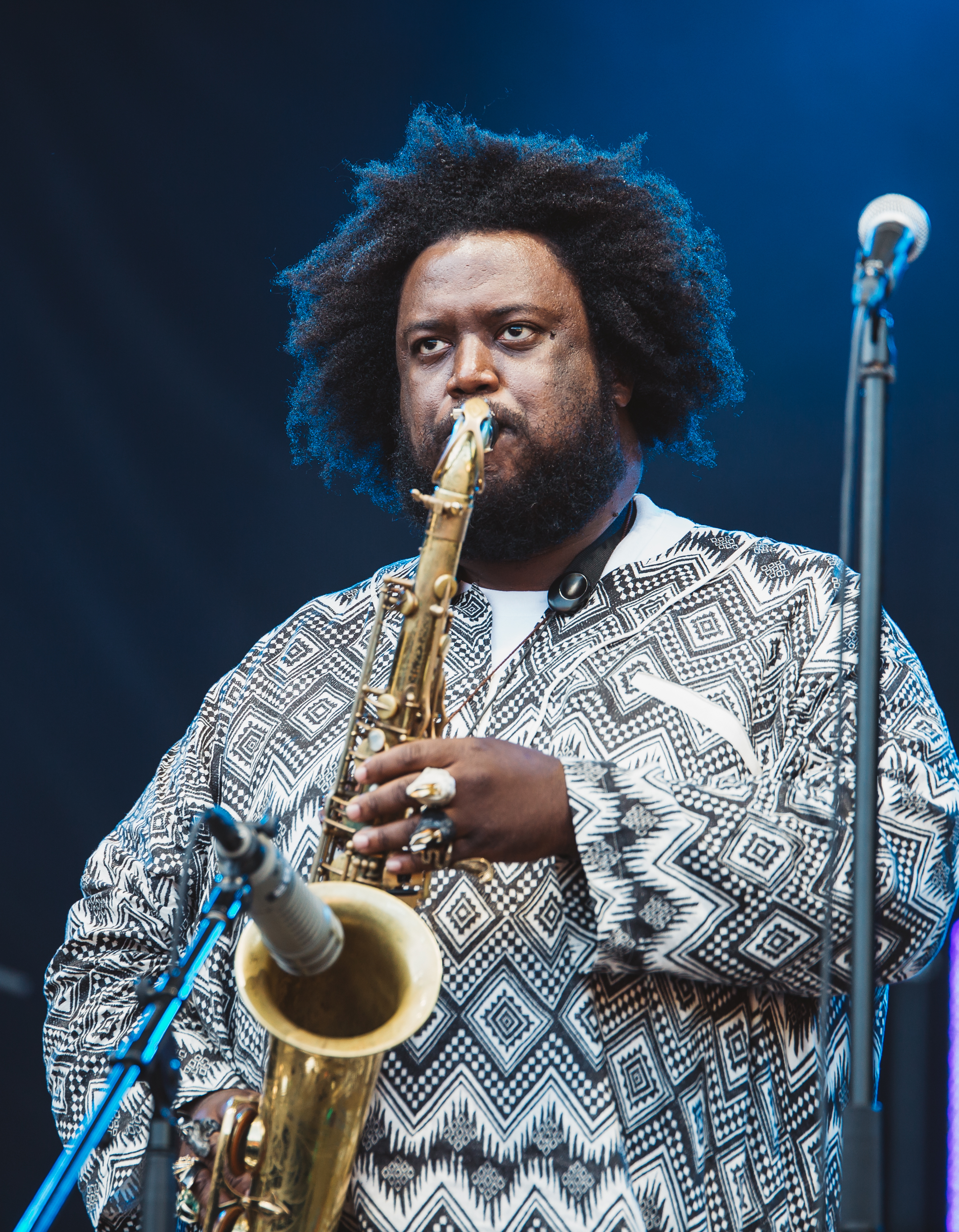
Kamasi Washington

Kamasi Washington

American composerWikipedia

Search complete. 31 mentions across 24 episodes found for "Kamasi Washington".

Oct 28, 2026

RhettmaticGUEST
35:49
Like the LA music scene in general, not just hip hop, but just in general, it's thriving.
RhettmaticGUEST
35:55
I mean, look, you talk about the jazz scene, you know, Kamasi Washington.
RhettmaticGUEST
35:58
Kamasi Washington, yeah.
RhettmaticGUEST
35:59
You know? Kamasi Washington, you know, you had Robert Glasper coming over here.
RhettmaticGUEST
36:05
You had the 1500 and nothing.
RhettmaticGUEST
36:07
They're also like jazz cats themselves.
Madeleine BrandHOST
37:12
Well, let's play some more music from the record.
Madeleine BrandHOST
37:15
This one is called Mama, and it features two Los Angeles artists, two artists we have had on this program, Sudan Archives and Kamasi Washington.
Madeleine BrandHOST
37:26
¶¶ ¶¶
speaker_9UNKNOWN
37:39
Bye.
speaker_9UNKNOWN
37:40
Bye.
Madeleine BrandHOST
37:56
Vocals by Sudan Archives and Violin and Kamasi Washington on, of course, the tenor saxophone.
Madeleine BrandHOST
38:03
And as I understand it, this song draws on the musical traditions of Sudan.
Madeleine BrandHOST
38:10
Is that why you had Sudan Archives? Right.
Esther IveremHOST
51:59
I feel like Victor E-R-E-M like Mary.
Esther IveremHOST
52:02
The music we played this hour included Truth Don't Die by Femi Kuti, What Rough Beast by Burnt Sugar, The Orchestra Chamber, Prologue by Kamasi Washington, and our theme music for the show is Voodoo Child by Jimi Hendrix.
Esther IveremHOST
52:18
The voices you heard in our On the Ground segment were Awa Dabo, United Nations Deputy High Commissioner for Human Rights, addressing the Human Rights Council during its 63rd session in Geneva on September 26, 2026.
Esther IveremHOST
52:36
Before her, Kari Siegenthaler, legal intern for the ACLU Human Rights Program, speaking during the same session on September 29th.
Caroline HepkerHOST
10:41
But apparently the instrument is back and it is restyled.
Caroline HepkerHOST
10:46
It's been building for a little while with Kamasi Washington, for example, an amazing player in the US.
Caroline HepkerHOST
10:53
So, yeah, that's the music I've been listening to for a lovely and groovy morning.
Caroline HepkerHOST
10:58
I'm going to put a link to that story, though, in our podcast show notes, I think, to inspire some of you musicians or musician lovers.
Ray DanielsHOST
52:15
You can't tell him shit about nothing, so that's all I say.
Jason "Problem" MartinGUEST
52:18
Like, no Kamasi Washington if that don't happen? Like, really? I didn't think about it from that
Mickey SohoHOST
52:24
perspective when I said it.
Ray DanielsHOST
52:26
Yo, Prala, can I tell you something? He's light-skinned.
JerryGUEST
7:28
He's got layers upon layers of clothing, probably too much for this environment, but he comes from a colder environment.
JerryGUEST
7:36
It looks a lot like, if you're into jazz, Kamasi Washington.
JerryGUEST
7:40
So it looks a lot like him.
JerryGUEST
7:42
a little bit like me so and my lesson is what does it take to be a warrior

Unknown podcast

Spirituals vs. Jazz: The Tug‑of‑War Over Musical Identity

Oct 13 · 1 Mention

speaker_1UNKNOWN
4:08
That loss sparked a second wave of authenticity debates.
speaker_1UNKNOWN
4:12
Did jazz need to go back to its roots, or could it evolve beyond them? Today, we still hear those spiritual threads in the works of artists like Esperanza Spalding and Kamasi Washington, who weave gospel harmonies into modern improvisation.
speaker_1UNKNOWN
4:29
Yet these musicians also blend contemporary pop sensibilities, making the lineage a living conversation rather than a static archive.
speaker_1UNKNOWN
4:39
The battle over jazz's identity is ongoing, but it now includes voices that were historically silenced, women, immigrants, and youth from urban gentrified neighborhoods.

Unknown podcast

The Newport Rebels: Redefining Jazz through Collective Improvisation

Oct 13 · 1 Mention

speaker_1UNKNOWN
8:28
Some algorithms inadvertently favor tracks with clear, straightforward rhythms, pushing polyrhythmic pieces to the margins unless listeners actively search for them.
speaker_1UNKNOWN
8:39
Yet artists like Kamasi Washington and Robert Glasper have countered that by embedding polyrhythm into hip-hop beats, making it more palatable to a mainstream audience without diluting its complexity.
speaker_1UNKNOWN
8:52
Jazz schools now teach polyrhythms through ear training apps that use visual metronomes.
speaker_1UNKNOWN
8:58
This democratizes knowledge but also risks reducing the improvisational spontaneity that once defined jazz practice.

Unknown podcast

Syncopation's Spark: From 19th‑Century Coon Songs to Modern Jazz

Oct 13 · 1 Mention

speaker_1UNKNOWN
9:12
Today's soloists still echo this practice, whether they're playing on vinyl or streaming in the cloud.
speaker_1UNKNOWN
9:19
After Goetz's breakout recordings, a new generation of saxophonists, think John Coltrane, Sonny Rollins, Even contemporary players like Kamasi Washington picked up that same lyrical phrasing and applied it to vastly different harmonic contexts.
speaker_1UNKNOWN
9:38
That lyrical phrasing influenced a whole generation of sax players who adapted it to new harmonic languages.
speaker_1UNKNOWN
9:45
On the other hand, Goetz's collaborations with big band leaders such as Woody Herman or Quincy Jones showed he could scale his intimacy up to a full horn section without losing that conversational nuance.

Unknown podcast

Ma Rainey: The Blues Queen Who Prefigured Swing

Oct 13 · 1 Mention

speaker_1UNKNOWN
15:52
These programs taught students that swing was the pinnacle of jazz evolution, while marginalizing the work song lineage.
speaker_1UNKNOWN
16:00
Yet contemporary artists, think Kamasi Washington or Esperanza Spalding, have started to weave explicit references to work songs into their compositions, layering call and response patterns and lyrical themes about labor.
speaker_1UNKNOWN
16:19
This revival is a cultural reclamation that challenges the sanitized narratives taught in schools.
speaker_1UNKNOWN
16:25
Technology is pushing this conversation further.

14 more episodes mention Kamasi Washington.

Create an account to see the whole feed, search across every transcript, and follow the entities you care about.

We value your privacy

We use cookies to understand how you use our platform and to improve your experience. Click “Accept All” to consent, or “Decline non-essential” to opt out of non-essential cookies. Read our Privacy Policy.