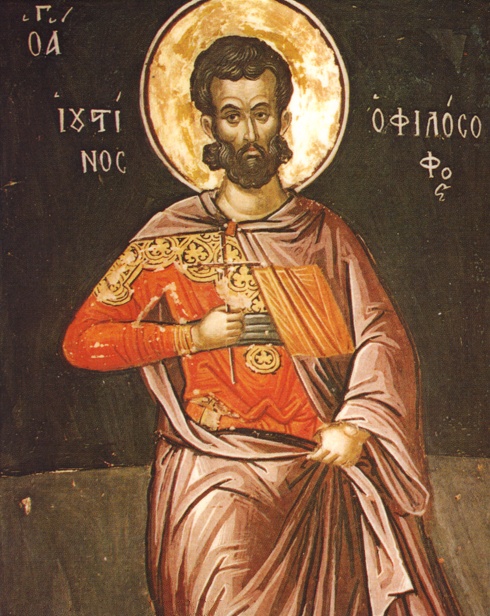
Justin Martyr
PhilosopherWikipedia
247
MENTIONS
131
EPISODES
110
PODCASTS
Search complete. 247 mentions across 131 episodes found for "Justin Martyr".
Nov 2, 2026

Kyle NormanHOST
Something testified about Jesus' own death.
Kyle NormanHOST
Also, the early Christian teacher Justin Martyr notes how the wooden spits used to roast the Passover lamb actually formed a cross-like shape.
Kyle NormanHOST
These scriptural connections only increase when we move into the prophets.
Kyle NormanHOST
Undoubtedly, Jesus would have pointed to the suffering servant passages in Isaiah.
Kyle NormanHOST
So no wonder the disciples say that their hearts were burning within them as Jesus unlocks the scriptures for them.
Kyle NormanHOST
Jesus wasn't just a rabbi, smart or revolutionary.
Kyle NormanHOST
He wasn't just a teacher of morals and ethics whose thoughts about love and sacrifice we continue to turn to today.
Kyle NormanHOST
Jesus himself, in his birth, in his ministry, in his death and his resurrection, he connected all the various prophecies and verses sprinkled throughout the Old Testament.

John WilliamsonHOST
And that distinction matters, because as Christianity spread through the Greek-speaking Roman world, Christian thinkers increasingly used the language of demons in a much more negative way, and they began applying it to the gods of surrounding religions.
John WilliamsonHOST
One of the clearest examples comes from a second century Christian writer named Justin Martyr.
John WilliamsonHOST
Justin lived in a world where Christianity was still a minority religion.
John WilliamsonHOST
Christians could face suspicion, hostility, and persecution.

Luke MadridHOST
Simon returns, demonstrates his superiority by magical means, and takes the title of the Standing One.
Luke MadridHOST
Justin Martyr already portrays Simon as a Samaritan magician who claimed to be the highest power, carried about with him a woman named Helena, whom he called his first thought or Anoia.
Tim HackerHOST
The first thought.
Tim HackerHOST
Damn.
8 MINS LATER
Luke MadridHOST
That.
Luke MadridHOST
I got better.
Luke MadridHOST
So Justin Martyr already doubted the cannibalism and incest stories circulating about Christians in general.
Luke MadridHOST
I think many of us today also would doubt that.

Mike RigglesworthHOST
Examples of patristic apologists, medieval apologists, early modern 19th century, 20th century content.
Mike RigglesworthHOST
I mean, it all it goes all the way back to like Justin Martyr.
Mike RigglesworthHOST
It goes back to Origen, Irenaeus, Athenagoras of Athens, Tertullian, all of these people.
Mike RigglesworthHOST
And Mike, I mean, these are people, for instance, Irenaeus, right? Do you know who he studied under? Who's that? Polycarp.
13 MINS LATER
Ryan WillardHOST
Second, Scripture calls us to participate.
Ryan WillardHOST
1 Peter 3.15 says to explain the hope that we have in Jesus, and the rest of Scripture shows God's people reasoning, defending the truth, and participating in the proclamation of the gospel.
Ryan WillardHOST
And then third, the church has always needed apologetics from Justin Martyr to Irenaeus to Christians throughout the century.
Ryan WillardHOST
You have people responding to the challenges and false accusations to give reasons to believe.
John WilliamsonHOST
Some could be feared, some could be blamed for terrible things.
John WilliamsonHOST
And over centuries, different Greek writers used the word in different ways.
John WilliamsonHOST
There was never one universally agreed definition, but that's precisely the point.
John WilliamsonHOST
Daimon was not originally another word for an evil spirit.
12 MINS LATER
John WilliamsonHOST
Not every later Jewish idea requires a Persian explanation.
John WilliamsonHOST
And the third problem is perhaps the most important.
John WilliamsonHOST
Even if Jewish writers encountered Persian ideas, cultures don't simply photocopy one another.
John WilliamsonHOST
They reinterpret, they argue, they reject, they absorb, they transform.

Paul FaceyGUEST
But then you'll also see some instances where they do entertain battling over scriptural interpretation with these outsiders.
Paul FaceyGUEST
Like one of the best examples, Justin Martyr, his dialogue with Trifo, with a Jew outside of the church.
Paul FaceyGUEST
And, well, whatchamacallit.
Paul FaceyGUEST
Who was it? You'll have responders to Porphyry, one of the arch enemies of the church, who said, oh, your scriptures say this.

Sean FinneganHOST
And this is common to the period.
Sean FinneganHOST
It drove Philo, the Gnostics, Justin Martyr, who was also a Platonist, And so the Logos is absolutely huge to understand Platonism.
Sean FinneganHOST
And it's really important in Philo because Philo talks about the Logos all the time.
Sean FinneganHOST
Now, the idea is this, that God could not possibly have created the universe or acted.

Peter MartinoGUEST
Let's go all the way to the mid second century.
Peter MartinoGUEST
And Justin Martyr was an early Christian evangelist.
Peter MartinoGUEST
writer and he's writing approximately 155 to 160 AD and he writes this book called Dialogue with Trifo and here he's debating with Jewish opponents of Christianity and once again he's saying that you know that the stolen body allegation was false so he's still you know a hundred plus years later still addressing the stolen body controversy and we have that again at the end of that century With Tertullian writing around 197 to 200 AD, again, the objection isn't that the tomb wasn't empty, but that the apostles moved the body.
Peter MartinoGUEST
So what we have is this earliest recorded counter story being addressed for 150 years that the disputed explanation was how the body disappeared.
15 MINS LATER
Peter MartinoGUEST
That would require a separate explanation.
Peter MartinoGUEST
You've got James, I mentioned earlier, who's the doubting relative of Jesus, who basically becomes a subsequent leader of the early church and also gets executed for his beliefs in the early 60s.
Peter MartinoGUEST
And as I mentioned already, the centuries long counter story talks about, you know, the stolen body, not the, you know, allegation, but it's addressed by Justin Martyr in the mid second century.
Peter MartinoGUEST
It's addressed by Tertullian.

Avery Austin Jr.GUEST
Yeah, but so these people wouldn't be Christians that they're debating against.
Avery Austin Jr.GUEST
So you have Polycarp, you have Irenaeus, and you have Justin Martyr who all condemned Marcion as a heretic because he, one, rejected the gospel and held on to Luke and edited Luke, wrote his own things into Luke.
Avery Austin Jr.GUEST
to match up with his theology while rejecting the gospel that's written by Matthew, Mark, and John, and then rejects the entire Old Testament.
Avery Austin Jr.GUEST
So you can't be rejecting the entire Old Testament and any other gospel accounts and be a Christian.

Nathan BetzGUEST
It's entered into the consciousness of the Christian church fairly broadly.
Nathan BetzGUEST
Justin Martyr is using it.
Nathan BetzGUEST
He's referencing it probably already in the 130s.
Nathan BetzGUEST
He talks about the apocalypse of John and the image of the new Jerusalem.
121 more episodes mention Justin Martyr.
Create an account to see the whole feed, search across every transcript, and follow the entities you care about.