Just transition
38
MENTIONS
5
EPISODES
4
PODCASTS
Search complete. 38 mentions across 5 episodes found for "Just transition".
Oct 28, 2026

Paolo GrazianoGUEST
The just transition is a transition that is just both for the environment and for social equality, to put it very broadly.
Paolo GrazianoGUEST
But today, it's still very difficult and to a certain extent very rare to find policies that do this effectively.
Paolo GrazianoGUEST
And the European Green Deal was the strategy that combined many policies in an integrated way that was going in this direction.
Paolo GrazianoGUEST
So in order to continue going in that direction, not only do we have to revamp the European Green Deal, but perhaps we have to learn the lessons that are connected to the implementation of some of the directives.
Bethany StauntonHOST
Just Transition, the concept of implementing environmental policies in a socially equitable way, is a longstanding demand of the trade union movement that has made some impressive inroads into policy over the past decade, not least at the EU level.
Bethany StauntonHOST
Recent years have of course seen serious political setbacks to the climate movement more generally, but the social questions thrown up by the decarbonization agenda, however stop and start, forwards and backwards, are not going away anytime soon.
Bethany StauntonHOST
So what is the current scholarly thinking around just transition? How does it interrelate with ideas about eco-social transformation? What is the best way to define and enact the justice part of the concept? And perhaps most importantly, how do we get the policy design right, particularly in an often unsympathetic political environment? This is a discussion, and sometimes a bit of a debate, between two scholars who have recently co-authored separate pieces of research for the ETUI asking these very questions, but from different perspectives.
Bethany StauntonHOST
Paolo Graziano is Professor of Political Science at the University of Padua and Research Associate at the European Social Observatory.

Mairead WintersGUEST
And what I'm seeing is the space of Lampin, cabin lodges coming through on a working farm, looking to diversify, looking to, I suppose, to attract visitors to stay longer in their area.
Mairead WintersGUEST
So I worked a lot on the Just Transition project, which covers Carrick and Perlis.
Mairead WintersGUEST
And a lot of those people that applied for Just Transition funding would have had a farming background of some sort.
Mairead WintersGUEST
So I think...
Mairead WintersGUEST
That is where it's going.

Amanda CahillGUEST
So if we're not even having the conversation with our neighbour, with our family members, with the person down the street, and people are hesitant to even start that conversation, you're not getting that positive reinforcement from people around you in the day-to-day that gives you the courage to then go, actually, you know, I heard something different when somebody comes out with the misinformation.
Bec HorridgeHOST
We continue with the Women's Climate Conversation, Beyond the Fossil Fuel Deadlock, Building an International Roadmap for a Just Transition.
Bec HorridgeHOST
It's about the Transitioning Away from Fossil Fuels, or TAF, conference held in Santa Marta, Colombia.
Bec HorridgeHOST
This conference represents a significant multilateral process outside of the conventional UN climate negotiations aiming to develop an international roadmap for a just transition from fossil fuels.
Bec HorridgeHOST
First, Dr Amanda Carhill talks about the conference process method of funneling.
Bec HorridgeHOST
She's the founder of The Next Economy, a non-government organisation that supports communities across Australia to manage the economic impacts of decarbonisation.
Tzeporah BermanGUEST
But besides those detailed issues, the most important thing that came out of this conference is a commitment to keep the outside diplomatic track of conversations going outside the UNFCCC space.
Tzeporah BermanGUEST
There was a lot of people who wanted to take this energy and say, oh, great, you've had your little conference now.

Marcus CunninghamGUEST
I ...
Marcus CunninghamGUEST
So I have done, I have done, I have done a decent amount of work in the Just Transition Movement, which is, you know, a, a transition from the, the, the ...
Marcus CunninghamGUEST
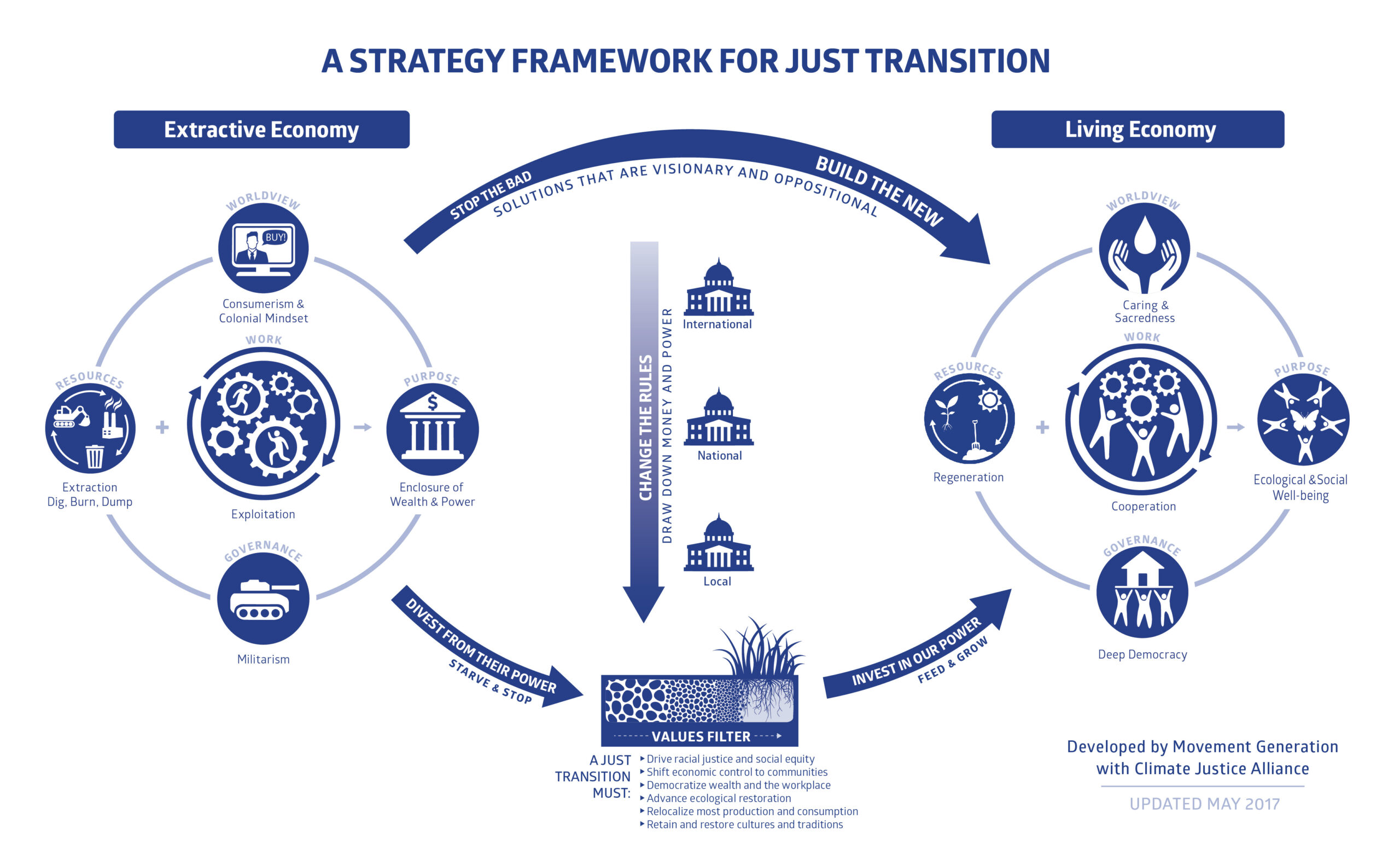
If you use the, so I'm using specifically the, the language of Climate Justice Alliance here, like this transition from a more extractive and individualistic society to a more cooperative, to a more, you know, ecologically centered, centered society.
Marcus CunninghamGUEST
And so in J- in the, in Just Transition, we talk about, you know, the current reality versus the future state, but we also talk about what happens in between.
Amanda CahillGUEST
Yeah, well, it was all a little bit unexpected, actually.
Amanda CahillGUEST
So actually, and I went to Copp and Belém in Brazil for the first time ever, mostly because I I work on Just Transitions.
Amanda CahillGUEST
Just Transitions was going to be a big theme and Australia was going to get COP this year.
Amanda CahillGUEST
So basically I was sort of strong-armed into going.
Amanda CahillGUEST
I didn't actually believe in international processes because I'd had a really bad experience in 2012 at the RioPlus20 summit about how that doesn't work.
Amanda CahillGUEST
And so I was like, I'm never doing international work.
Amanda CahillGUEST
But given that Australia was going to be hosting COP, I went to Billing and then somehow I kind of by accident ended up in the middle of negotiations around establishing a new global mechanism to support just transitions based on work I'd done with the Australian government around setting up the NZ sorry net zero economy authority and studying what other countries were doing around governance mechanisms so suddenly I'm in the middle of international negotiations and this amazing conference gets announced around transitioning away from fossil fuels so I was very lucky.
Amanda CahillGUEST
Canna, Climate Action Network of Australia, asked me to attend and to get involved in that.