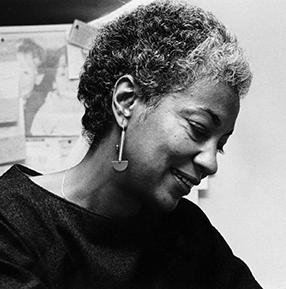
June Jordan
American poet and essayistWikipedia
22
MENTIONS
5
EPISODES
5
PODCASTS
Search complete. 22 mentions across 5 episodes found for "June Jordan".
Sep 9, 2026

Warda FarahHOST
It was very much just, um, you know, just stuck, stuck to that.
Warda FarahHOST
And for me, the liberation I found in reading other fields, in reading, um, for me, it was Sylvia Wynter and June Jordan, and finding those people and thinking, "Okay, this is the, like, I'm not just, you know, thinking about things on my own.
Warda FarahHOST
There is a history and a lineage of people who have been questioning, who have been trying to find, who have left traces through their writing." And I never had access to that because this specific field excluded all of that like it never existed.
Warda FarahHOST
And finding those pieces of work here, there, and everywhere is what has informed me.

Régine Jean-CharlesGUEST
Okay.
Régine Jean-CharlesGUEST
So I was rereading June Jordan's Black Studies, Bringing Back the Person.
Régine Jean-CharlesGUEST
And I think it's really relevant, especially in the age of AI, the person, thinking about Black life.
Régine Jean-CharlesGUEST
How do we keep Black life and Black flourishing at the center of the work? And what does that actually mean for all of the communities that we inhabit? And all of the people that we that we are in contact with.
Régine Jean-CharlesGUEST
I use examples from the Cumbie River Collective.
Régine Jean-CharlesGUEST
Right.
Régine Jean-CharlesGUEST
I use examples from Barbara Smith and from June Jordan and from other black feminists who came before me.
Régine Jean-CharlesGUEST
Hi, girls.

Charisse Burden-StellyGUEST
Yeah, you know, and I think it's because it's, It's a way to try to influence, I think on the one hand, it's a way to try to influence Black people away from people who don't read, who don't know anything about the political situation, to make it seem as if, oh, Black people aren't supporting this, so why should I, right? When in fact, a lot of Black people are supporting Palestine, either explicitly or implicitly.
Charisse Burden-StellyGUEST
And related to this, few years back there was all of these charges of anti-semitism and this is prior to um october 7th and so many claims about anti-semitism are levied at black people so i don't know if you remember like nick cannon kyrie irving so there's something there too there's a way that it's like and and you know and we'll talk about this when i talk about this is america My This is America project, but June Jordan back in like 1990 when she wrote the speech talked about how it's not enough that we give billions of dollars to Israel.
Charisse Burden-StellyGUEST
We also have to have this unyielding fealty and pro-Israel position or you're a subversive.
Charisse Burden-StellyGUEST
So there's also there's something there.
23 MINS LATER
Charisse Burden-StellyGUEST
And so I had to include his.
Charisse Burden-StellyGUEST
His was like the first one that I was like, I need to include this.
Charisse Burden-StellyGUEST
And then finally, on day 30, I did June Jordan's Intifada USA because... free Palestine, obviously free Lebanon.
Charisse Burden-StellyGUEST
She was somebody who I turned to, and I want to shout out JT Roan, who's a scholar at Rutgers, but he's writing about her now, but he kind of put me on to like her politics.

Nikita GillGUEST
... that came before us, poets that came before us.
Nikita GillGUEST
And recently, I was looking into how Toni Morrison was such an archivist of amazing poets like June Jordan and Lucille Clifton-
V.E. SchwabHOST
Mm
Nikita GillGUEST
... and how she preserved their work.
Nikita GillGUEST
And because of her, and because of them, I am the writer that I am because I read June Jordan and Lucille Clifton as a teenage girl.
V.E. SchwabHOST
I wanna also ask a little bit about self-definition.
V.E. SchwabHOST
It's this kind of concept that I've started asking the, the novelists that come onto the podcast because I have this real resistance towards the segmentation of the bookstore, right? This idea of like, um, where publishing puts us versus where we would put ourselves, how we are-

Kristen JeffersHOST
It was very interactive, and I really, really wanted that.
Kristen JeffersHOST
I want more people to be inspired, like I'm inspired by June Jordan and, of course, her inspiration from Buckmeister Fuller and others to make new fantasies.
Kristen JeffersHOST
And, of course, Make New Fantasies alludes to how Audre Lorde said, if I don't make the new fantasies for myself, I'll be chewed up and spit out by other people.
Kristen JeffersHOST
I know I'm paraphrasing, but we know.
Kristen JeffersHOST
So...
Kristen JeffersHOST
Let's get into today's post.
Kristen JeffersHOST
I have called it June Jordan is why I'm unerasing myself from the urbanist narrative.
Kristen JeffersHOST
Now that in the subtitle, at least on Substack, now that we've defined ourselves, we must continue to speak up and show up for the land and its earth.