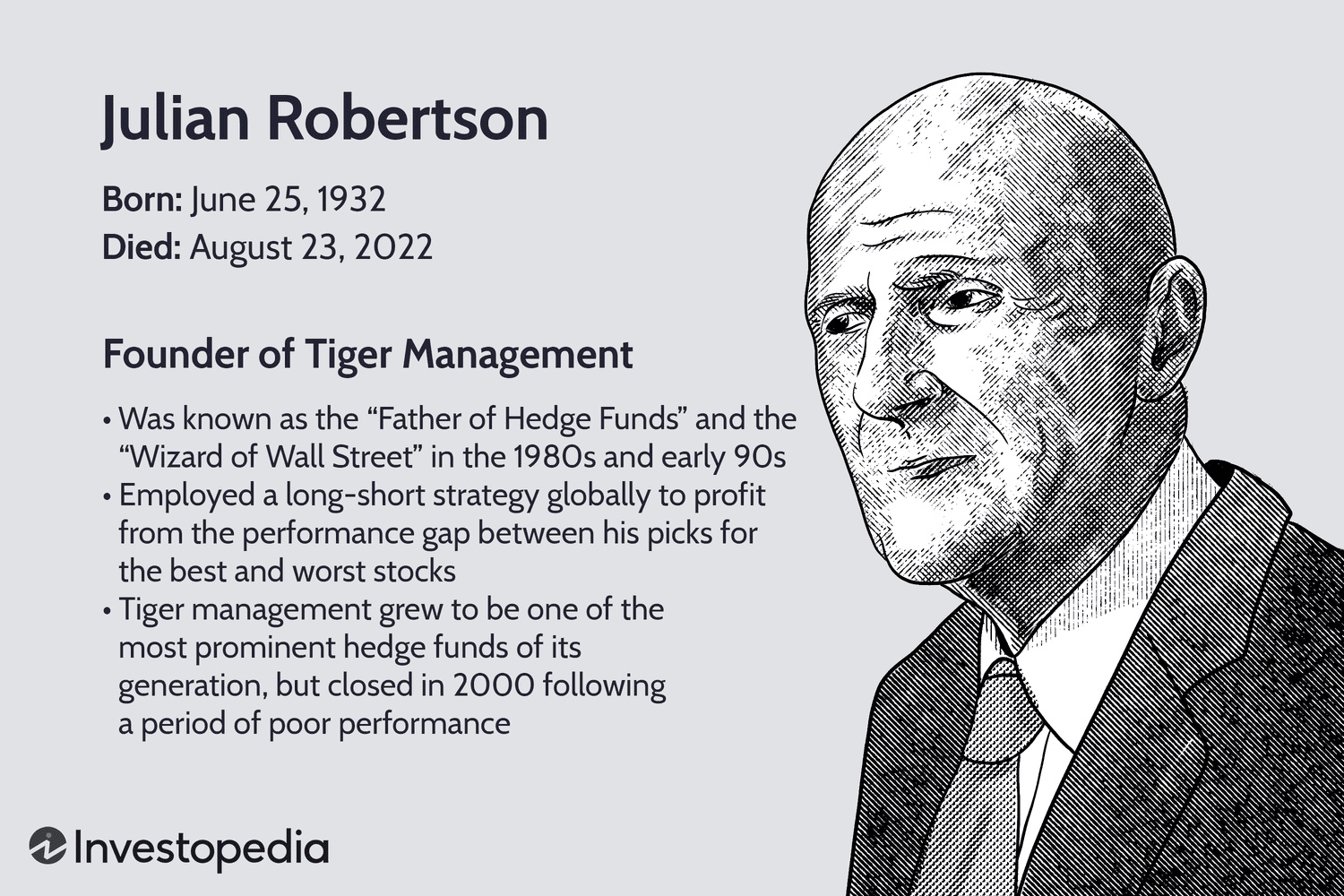
Julian Robertson
American investorWikipedia
19
MENTIONS
12
EPISODES
9
PODCASTS
Search complete. 19 mentions across 12 episodes found for "Julian Robertson".
Nov 13, 2026

Tom HardinGUEST
We were seeded by Tiger Management, which was one of the most legendary hedge funds on Wall Street ever.
Tom HardinGUEST
And so by the time we were seeded, Julian Robertson was in his mid-70s and had sort of retired from actively managing money and was seeding the next generation.
Tom HardinGUEST
So at 28 years old, I had this great seat.
Tom HardinGUEST
And then we lost money in the first quarter.

Dan TapieroGUEST
I come from the macro hedge fund business.
Dan TapieroGUEST
I worked 20 years as a portfolio manager working for Julian Robertson and Steve Cohen and Stan Druckenmiller.
Dan TapieroGUEST
I come from the old world.
Dan TapieroGUEST
So diligence is very important for us, and it's very difficult to diligence many of these venture companies, and I don't like the idea that you can make 100 investments, 99 go to zero, and then maybe one hopefully is a Google, or maybe one is Polymarket, you know, one that has a tremendous lift, and that's just not the style of investment.

Patrick BoyleHOST
Okay, at number seven on our list, we have the short squeeze that came at the end of the dot-com bubble in 1999.
Patrick BoyleHOST
Julian Robertson gained notoriety in the late 90s for turning a starting capital of $8 million into over $7 billion in around 15 years.
Patrick BoyleHOST
His strategy was to invest in undervalued stocks and to sell short the overvalued securities.
Patrick BoyleHOST
A strategy that sounds simple, but very few people managed to do well.
Patrick BoyleHOST
Before losing his $30 billion fortune, Bill was the greatest trader you'd never heard of.
Patrick BoyleHOST
He began his career working for Julian Robertson at Tiger Management, one of the best performing hedge funds in history.
Patrick BoyleHOST
He then started his own fund called Tiger Asia Management, which went on to become one of the biggest Asia-focused hedge funds.
Patrick BoyleHOST
In 2012, he was accused of insider trading in Chinese bank stocks.

speaker_1GUEST
He had backed Howard Marks and Oak Tree in a ton of different funds.
speaker_1GUEST
He knew Julian Robertson.
speaker_1GUEST
Like he was really well connected in the institutional finance world.
speaker_1GUEST
And one of the questions I asked Mark when I first met him was, I said, what separates the top three guys from the top 1%? So not the top 1% to the top 50%, but with the top three guys from the top 1%.
7 MINS LATER
speaker_1GUEST
And I, This is about a year and a half after this.
speaker_1GUEST
But I remember going, Mark Yusko took me to meet one of these legends of finance.
speaker_1GUEST
And we went and we saw Julian Robertson.
speaker_1GUEST
We saw Howard Marks and a couple of other people all in one single day.
Patrick BoyleHOST
This loss that happened over a day or two has to be one of the greatest losses of personal wealth in history.
Patrick BoyleHOST
So first up, who is Bill Hwang and is he a dummy? Well, he started out his career working for Julian Robertson, who's one of the most legendary fund managers.
Patrick BoyleHOST
Julian Robertson ran Tiger Management, which was one of the best performing hedge funds in history.
Patrick BoyleHOST
And he's up there with people like Soros, Buffett and Simons.
Patrick BoyleHOST
He's one of the greats.
Patrick BoyleHOST
And those funds went on to have great returns and they were known as Tiger Cups.
Patrick BoyleHOST
They often had the word Tiger in their name.
Patrick BoyleHOST
And Bill Hwang is one of the people seeded by Julian Robertson, so it's probably reasonable to say that he's not a dummy.

Jesper KollGUEST
You remember it was 1986 that the first foreign firms got a seat at the Tokyo Stock Exchange, and one of them, S.G. Warburg, you know, hired me as their chief Japan economist.
Jesper KollGUEST
And from then on, you know, J.P. Morgan, Julian Robertson, Merrill Lynch, back to JP Morgan.
Jesper KollGUEST
I mean, you know, I had a lot of fun over the last, you know, 35, 40 years in Japanese
Bilal HafeezHOST
finance.

Philippe LaffontGUEST
So it made me think that when you have too good of a deal, be careful because the other side probably also knows it's too good of a deal.
Philippe LaffontGUEST
So I ended up working for Tiger Management and I went from working for free to working for Tiger, which at the time was one of the two largest hedge funds in the world and had a slew of really young, ambitious people and led by this incredibly charismatic leader who I've also learned a lot from and which I'm sure you knew pretty well, which was Julian Robertson.
David NovakHOST
Yeah, he was a big shareholder when we first came out, and I was so impressed with him and everybody at Tiger because just the questions you asked were so good.
David NovakHOST
But as I understand it, when you went to Tiger and wanted to get in, you didn't get the job.
Philippe LaffontGUEST
And the guy who interviewed me was European.
Philippe LaffontGUEST
And we just hit it off and he gave me a chance.
David NovakHOST
And I understand you had a two-minute interview with Julian Robertson.
David NovakHOST
Is that correct or not?

Jason JohnsHOST
all right welcome back to in the harbor i'm your host jason johns joined by my co-host sean richland sean how we doing i'm doing great it's good to see you i'm excited for today's conversation uh it covers a lot of what you and i talk about in the office on a daily basis So today's guest is Spencer Reich.
Jason JohnsHOST
Spencer started on the Goldman Sachs trading floor became a portfolio manager at Tiger management working directly for Julian Robertson, and then left hedge funds to join an AI startup years before AI was on everyone's radar.
Jason JohnsHOST
That was boosted dot AI.
Jason JohnsHOST
We've had Josh panting on before.
Spencer ReichGUEST
And, you know, went to the hedge fund space for about a decade after that.
Sean RichlandHOST
So let's talk about that.
Sean RichlandHOST
You were at tiger management and had the opportunity to report straight to Julian Robertson.
Sean RichlandHOST
What was it like working for him?
Adam RobinsonGUEST
say.
Adam RobinsonGUEST
It was all the Tiger Cub guys that made a fortune riding the tech wave, which is kind of ironic because Julian Robertson did not ride the internet boom, But then all his tiger cubs that he spawned, they did really well when tech was going through the roof.
Adam RobinsonGUEST
And you think, oh, wow, everything that I'm doing is great.
Patrick BoyleHOST
Until
2 more episodes mention Julian Robertson.
Create an account to see the whole feed, search across every transcript, and follow the entities you care about.