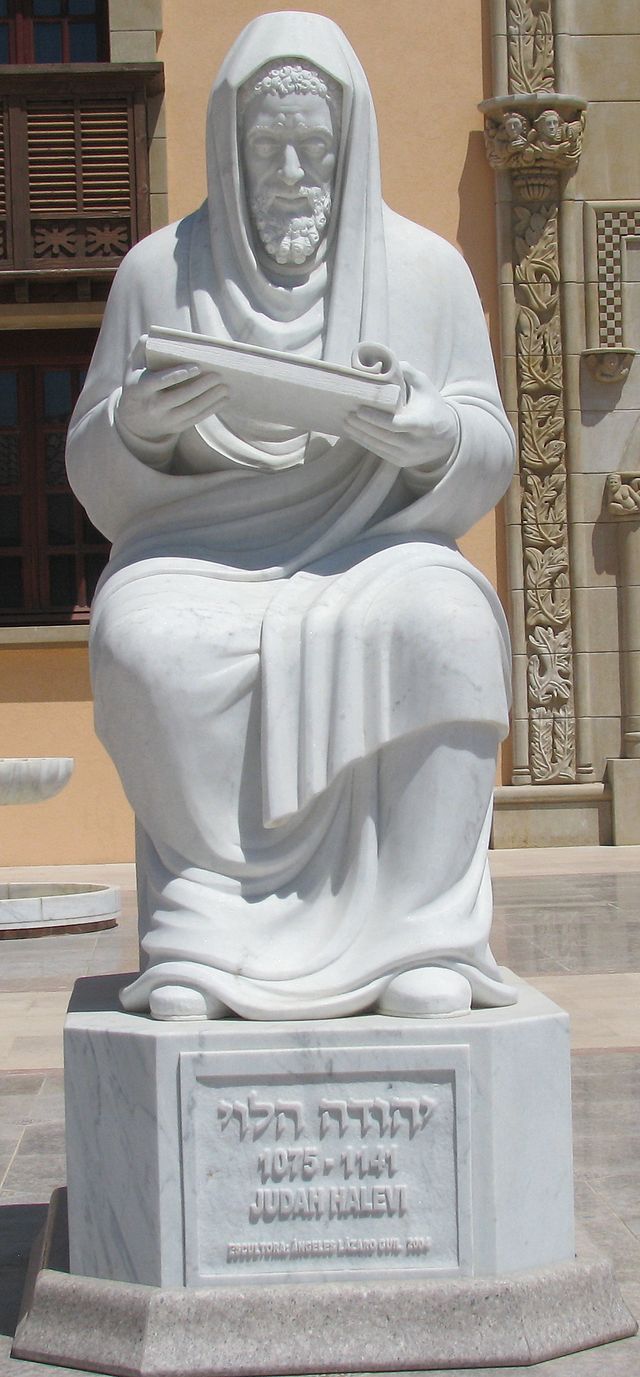
Judah Halevi
Poet and physicianWikipedia
18
MENTIONS
12
EPISODES
12
PODCASTS
Search complete. 18 mentions across 12 episodes found for "Judah Halevi".
Sep 24, 2026

Michael AlperHOST
Tonight I want to share a story with you that was written down by a Jewish poet who lived in Spain more than a thousand years ago.
Michael AlperHOST
The story was written in Arabic and the poet's name was Yehuda Halevi.
Michael AlperHOST
It goes something like this.
Michael AlperHOST
A long time ago, there was once a great and wise king.
Michael AlperHOST
The king is pleased.
Michael AlperHOST
Judaism wins.
Michael AlperHOST
The king converts to Judaism his entire kingdom, converts along with him Yehuda HaLevi, the author of the story.
Michael AlperHOST
He called it the Kuzari.

Eva MroczekGUEST
And what this makes me think of is a much, much later tradition, a medieval text, probably from 10th, 11th century, very debated, connected to the legend of the Khazars.
Eva MroczekGUEST
So this is probably best known from Yehuda Halevi's Khazari, which is like this half legendary kingdom, Central Asian kingdom that, according to tradition, converted to Judaism en masse.
Eva MroczekGUEST
This is what Halevi writes in his account.
Eva MroczekGUEST
Now, we don't really have reliable historical evidence about this, but we do have storytelling.

Noam WeissmanHOST
But there's a surprising amount of poetry in the Jewish tradition, from the deeply erotic Shir Hashirim, AKA Song of Songs, to the passionate religious piyutim, or liturgical poems, of the medieval mystics.
Noam WeissmanHOST
Rabbi Yehuda Halevi's Libi Bamizrach, Where My Heart Is In The East, falls somewhere on the tamer end of the spectrum.
Noam WeissmanHOST
It's a poem of passionate longing for Zion, not composed in the 20th century, but composed in Muslim Spain sometime in the 12th century during the 88-year period of crusader control over Jerusalem when Jews were barred from the city The original is in Hebrew.
Noam WeissmanHOST
Yep, contrary to popular opinion, the Hebrew language never died, but that's a story for another time.
Noam WeissmanHOST
The longing goes deeper than prayer and poetry.
Noam WeissmanHOST
Over the centuries, many Jews did return to Zion, or try to anyway.
Noam WeissmanHOST
100 years after Rabbi Yehuda Halevi wrote this poem, Rabbi Moses ben Nachman, AKA Ramban, AKA Nachmanides, arrived in Jerusalem.
Noam WeissmanHOST
The crusaders had been vanquished, but the holy city was in ruins.

Yehoshua GranatGUEST
And sometimes with some sort of an additional element like Chazak or Chazan or Yechi and so forth.
Yehoshua GranatGUEST
And we have it also in the piyutim of, you know, of the Sephardi poets, the paytanim from Sepharad, Rashbag, Solomon ibn Gabirol, who uses the acrostic Shlomo or longer ones, and Yehuda Halevi and so on and so forth.
Yehoshua GranatGUEST
So it became really universal.
Yehoshua GranatGUEST
But the earliest piyutim are, as I said, anonymous.

Yitzchak BreitowitzHOST
Okay, that is common sense.
Yitzchak BreitowitzHOST
But is every Jew closer to God than any goy? What if you have a goy that's a very, very righteous goy, and you have a Jew that's parkois, ve-very bad? Does God love that inferior Jew more than he loves that holy goy? Meaning, is there an essential nafkamina in the neshamah irrespective of the particular behaviors? So if you look at Yehuda Halevi, and certainly in Hasidus and Kabbalah, which follow the Kuzari in this prat, you see this idea that a Yid is different.
Yitzchak BreitowitzHOST
A Jew is different.
Yitzchak BreitowitzHOST
Yeah, of course, Hashem doesn't want a person to be a Russia, but every single Yid is special, treasured, elevated.

Albert SettonHOST
Good morning, High Holiday Prayers, Day 24.
Albert SettonHOST
Continuing for Kippur, the poem of Rabbi Yehuda HaLevi called Ya Shema Evionecha.
Albert SettonHOST
Rabbi Yehuda HaLevi, his poems are mentioned throughout Rosh Hashanah and Kippur in the Sephardic communities.
Albert SettonHOST
He lives in Spain in the 11th century.
Albert SettonHOST
He becomes basically the most beloved poet of of the Spanish Jews, and his poems are so famous that a thousand years later, Neely was still saying these poems.

Simi LernerHOST
And music is a vehicle for that and a very powerful vehicle for that.
Yitzchok AdlersteinHOST
Or to put it in terms of more medieval philosophy, reviewed Halevi in Kuzari.
Yitzchok AdlersteinHOST
It says that the idea of music, the beauty of music, is that it can touch on the emotions like nothing else can.
speaker_2UNKNOWN
We don't

Mordechai TorczynerHOST
He wasn't the first.
Mordechai TorczynerHOST
In the Middle Ages, Rabbi Yehuda Halevi and Rabbi Avram Ibn Ezra did likewise, but those were really just poetic versions of Kaddish, summoning their audience to honor and elevate the name of Hashem.
Mordechai TorczynerHOST
Agnon went for a different message, as he memorialized these murdered men.
Mordechai TorczynerHOST
The full title of his work was Psicha l'Kaddish Achar Mitasam Shel Harugei Eretz Yisrael, an introduction to Kaddish following the caskets of the murdered of Eretz Yisrael.

Bitzal SakachevskyHOST
He's providing himself with his own blessing.
Bitzal SakachevskyHOST
Whereas the Ebenezer brings from Rav Yehuda HaLevi, in contrast to that which HaKadosh Baruch Hu is cursing the sinner, he provides himself a blessing instead.
Bitzal SakachevskyHOST
What is that blessing? Lemur saying to himself, Shalom yeholi, there shall be peace unto me.
Bitzal SakachevskyHOST
Everything's going to be fine.
36 MINS LATER
Bitzal SakachevskyHOST
Avraham Avinu says to HaKadosh Baruch Hu, will you even destroy? David C.
Bitzal SakachevskyHOST
Hoffman brings that this is what's found in the Septuagint, this is what's found in the Vulgate, that Sfos means to cut off.
Bitzal SakachevskyHOST
So how does that fit into the Pasuk? So the Ibn Ezra quotes from Yehuda HaLevi that he interpreted Rava and Smea in the same sense as the Ibn Ezra did.
Bitzal SakachevskyHOST
That the Pasuk is saying Laman Sfos because I am able to cut off and destroy that which is a curse, right? This is what we're concerned about.

Arnie WittensteinHOST
It is a historically true story, but obviously the details here, I wouldn't call it historical fiction.
Arnie WittensteinHOST
I would call it, it was a way for Yehuda Levi to present Jewish ideas to the people of his times.
Arnie WittensteinHOST
Anyway, fine.
Arnie WittensteinHOST
So the king says to the Chafim, to the rabbi, King, tell me, how do you define someone, how do you define in our times someone who's considered a chassid, a righteous person? See, part of the question is it was obvious in the times of prophecy that a prophet is a righteous person.
2 more episodes mention Judah Halevi.
Create an account to see the whole feed, search across every transcript, and follow the entities you care about.