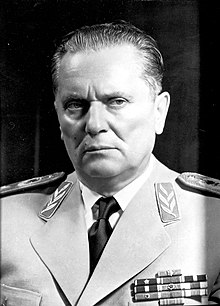
Josip Broz Tito
Statesperson and former President of the Socialist Federal Republic of YugoslaviaWikipedia
229
MENTIONS
76
EPISODES
57
PODCASTS
Search complete. 229 mentions across 76 episodes found for "Josip Broz Tito".
Oct 30, 2026

Fritz SpringmeierGUEST
on some other things to to talk about um oh you know this is history this is this is not this is not modern history but uh one of the things when when i had a internet presence and i don't for people you have to order my books directly from me uh spring meyer messages at hotmail.com but back when i had a facebook account before it got hijacked i talked about how in 1913 uh some very important people were living in Vienna within a very small area, possibly bumping into each other.
Fritz SpringmeierGUEST
You had Hitler and Stalin and Trotsky and Freud and Tito.
Fritz SpringmeierGUEST
They were all within a two square mile area there in Vienna.
Fritz SpringmeierGUEST
And then in 1917, in Ascona, Italy, you had another meeting of all kinds of future world leaders, um, at that conference that was put on by the OTO.

Fred WatsonGUEST
So one of my claims to fame is that I bled in bled.
Fred WatsonGUEST
And it's because on the shoreline of Lake Bled is the former residence of President Tito when he was the head of the Yugoslav consortium, I suppose, collaboration.
Fred WatsonGUEST
And my colleague in Ljubljana, a really good friend, Tomas Vita, said, dropped me off at the top of the property that Tito used to have and said, you can walk down through the property.
Fred WatsonGUEST
I think it's a sort of museum now.
Fred WatsonGUEST
And he said, there'll be a gate at the bottom and that'll bring you out onto the lake and I'll be parked nearby.

Philip PilkingtonHOST
Beyond that, Russian involvement in the economy is actually much less important than Chinese investment.
Philip PilkingtonHOST
Serbia is a huge hub for China, and although they have cultural affinities for Russia, strong cultural affinities for Russia, and that's very real in Serbia, actually their main partner for a very long time has been China, and that goes back to the Tito period, to the Yugoslav period, when they were the non-Soviet Union communist economy, and so China was a very logical partner there.
Philip PilkingtonHOST
to do business with at various levels.
Philip PilkingtonHOST
So, for example, Serbia's military, which is a very impressive military for the size of the country, its very high-end equipment, like air defense and so on, is actually Chinese.

JoeHOST
What was the name of the dictator from Yugoslavia? I can't remember his name.
JoeHOST
Tito.
JoeHOST
Tito?
ZachHOST
Tito?
JoeHOST
I think it's
ZachHOST
pronounced...
ZachHOST
It's something Tito.
ZachHOST
I don't know, it's Tito.

Damian LewisGUEST
Yeah, of course, Churchill had basically said he would work with anyone who would fight the Nazis.
Damian LewisGUEST
Hence, we were at this stage of the war in bed with the Yugoslav partisans, Tito's communist partisans.
Damian LewisGUEST
And in fact, we'd dropped the Chetniks who were the right wing partisans in Yugoslavia.
Damian LewisGUEST
So Churchill was very adamant that it didn't matter what your politics were, as long as you're willing to fight the Nazis and defeat Nazism, we would work with you.
21 MINS LATER
Damian LewisGUEST
So these invidious, treacherous, horrendous campaigns run by these pro-communist traitors, because they were traitors, supposedly serving in our secret agencies, they led to people like Mike Leese, but others too, Leese is not alone, being pilloried by our own services because false documentation was planted in the archives, which seemed to suggest that Leese and others would have behaved in a less than appropriate way because of their political leanings.
Damian LewisGUEST
Completely untrue.
Joe KirwinHOST
So of course, this whole debate also links up with what happened in Yugoslavia with Tito, as you mentioned, and the decision to switch allegiance to him.
Joe KirwinHOST
And there's still a debate about how much that was influenced by communist-leaning SOE members and others.

George SzamuelyGUEST
And he said, no, they were illegal secessions.
George SzamuelyGUEST
Of course, they were illegal secessions and had said that this Federal Republic of Yugoslavia, of which he was president, was the successor state to the SFRY, the Socialist Federal Republic of Yugoslavia that had been ruled by Tito.
George SzamuelyGUEST
The NATO powers, of course, were very, very agitated about that, because otherwise, if that were accepted, that this was a successor state, that means the secessions, the very secessions that the NATO powers had encouraged, were indeed illegal.
George SzamuelyGUEST
And therefore, NATO had violated international law by recognizing these secessionist states.

Sean MathewsGUEST
I mean, the main backers of the Greek communists in the 1940s, it was basically Yugoslavia.
Sean MathewsGUEST
Tito, right? And he didn't do that out of kind of solidarity with Marxism or anything like that, Marxist-Leninism.
Sean MathewsGUEST
He did that because he was a Balkan ruler and he saw supporting the Greek communists as the best way to increase Yugoslavia's power in his back door, right? So there were more ancient kind of historic great power games being played here.
Sean MathewsGUEST
And Stalin himself never really believed in the Greek communists.

Jen Big NastyHOST
We fret constantly about our failing math and reading scores, and should.
Jen Big NastyHOST
But a nation that does not teach successive generations about the differences between capitalism, socialism, and fascism, or about the horrifying carnage of Lenin, Stalin, Mao, Pol Pot, Ho Chi Minh, Hoja, and Tito, or about the basics of personal finance and business is a nation defenseless against the pull of fantasy ideologies.
Jen Big NastyHOST
We can do better.
Jen Big NastyHOST
Go online right now and look up the 1912 8th grade examination for Bullitt County, Kentucky schools.

Shekhar GuptaHOST
That's where Sheila Dixit built her ill-fated bus rapid transport program.
Shekhar GuptaHOST
Now, Marshall Tito brought all these countries together, six republics together.
Shekhar GuptaHOST
That is Serbia, Croatia, Slovenia.
Shekhar GuptaHOST
Bosnia and Herzegovina, that's one.

Ivan PongracicGUEST
And Yugoslavia was doing quite well in the 1960s and the 70s, mostly because it was quite effective at playing the West against the East and extracting quite a bit of money from the West in the process.
Ivan PongracicGUEST
So what Marshall Tito, the communist dictator of Yugoslavia, was very capable of doing is guaranteeing to the West that he's going to act as kind of a bulwark against the Soviet Union.
Ivan PongracicGUEST
And as a result, the Western countries, the World Bank, the IMF showered Yugoslavia with money.
Ivan PongracicGUEST
So when I was growing up in the 1970s, actually life was quite good.
Ivan PongracicGUEST
And there were German tourists.
Ivan PongracicGUEST
Tito opened up Yugoslavia, opened up the border so people could leave, emigrate.
Ivan PongracicGUEST
And they started sending back a lot of money from West Germany and the United States and Canada and all these places.
Ivan PongracicGUEST
So Yugoslavia was flush with money.
66 more episodes mention Josip Broz Tito.
Create an account to see the whole feed, search across every transcript, and follow the entities you care about.