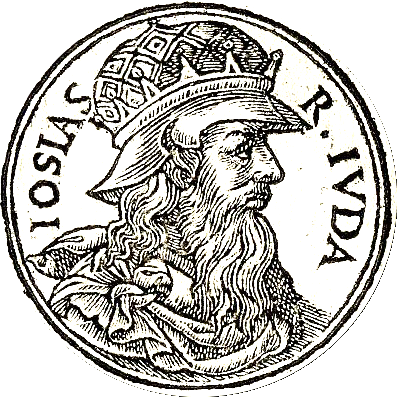
Josiah
Former King of JudahWikipedia
1.1k
MENTIONS
215
EPISODES
145
PODCASTS
Search complete. 1070 mentions across 215 episodes found for "Josiah".
Sep 14, 2026

David SpenceGUEST
About 640 B.C. to 609 B.C. is really the time frame here.
David SpenceGUEST
He and King Josiah, who was a good king in Judah, they started out the same year, 640 B.C., And so you've got Zephaniah, whose name means God hides or Yahweh hides.
David SpenceGUEST
He preaches about judgment.
David SpenceGUEST
He preaches about the judgment of Almighty God.
David SpenceGUEST
And Kevin, there's a revival during his lifetime.
David SpenceGUEST
King Josiah and Zephaniah.
David SpenceGUEST
There's a beautiful revival here.
David SpenceGUEST
It kind of fades away later, but there is a good revival here.

Chris RoseboroughHOST
Here's the reason why.
Zachary HeltonSOUNDBITE_SPEAKER
Because in the seventh century BCE, a man came to power named Josiah, and it seems like Josiah had this ambitious political vision as king.
Zachary HeltonSOUNDBITE_SPEAKER
We can't be exactly sure of his motives, but it looks like he wanted to consolidate power on a massive scale to ensure that he and his family held all the cards in this area.
Zachary HeltonSOUNDBITE_SPEAKER
And the best tool he could use to do that was religion.
Zachary HeltonSOUNDBITE_SPEAKER
See, up to that point, there had been shrines in virtually every city, so religion was localized, and religious leadership was democratized.
Zachary HeltonSOUNDBITE_SPEAKER
But Josiah, wanting to put all the power in one place, declared there was only one temple, and it was in Jerusalem, where he worked.
Zachary HeltonSOUNDBITE_SPEAKER
And there was only one god, a male and a king, like Josiah, and that was Yahweh.
Zachary HeltonSOUNDBITE_SPEAKER
And every other shrine was to be torn down, all the other idols destroyed, all worshipers of anyone but Yahweh condemned.

Kurt SkellyHOST
We're in 2 Kings 24.
Kurt SkellyHOST
And we talked a bit about Jehoiakim, who is one of the sons of Josiah, as you know, an evil man, reigned for 11 years.
Kurt SkellyHOST
Jeremiah actually prophesied against him.
Kurt SkellyHOST
He was very, very rude and evil to Jeremiah, but God dealt with him.
Kurt SkellyHOST
The Bible says in verse number seven, right? Actually, verse number six, 2 Kings 24 and verse six.
Kurt SkellyHOST
So Jehoiakim slept with his fathers and Jehoiakim, his son, reigned in his stead.
Kurt SkellyHOST
So this is the grandson now of Josiah, the son of Jehoiakim.
Kurt SkellyHOST
And it says that in verse number seven, the king of Egypt came not again anymore out of his land for the king of Babylon had taken from the river of Egypt, had taken from the river of Egypt, that would be the Nile, obviously, onto the river Euphrates, all that pertained to the king of Egypt.

Benjamin LokoHOST
Arriving there just as Jeroboam was approaching the altar to burn incense.
Benjamin LokoHOST
Verse two, "Then at the Lord's command he shouted, 'Oh, altar, altar, this is what the Lord says: A child named Josiah will be born into the dynasty of David.
Benjamin LokoHOST
On you he will sacrifice the priests from the pagan shrines who come here to burn incense, and human bones will be burned on you.' That same day, the man of God gave a sign to prove his message.
Benjamin LokoHOST
He said, 'The Lord has promised to give this sign.

Joe VassakHOST
Of the 22 men who reigned over the southern kingdom of Judah, and 22 includes the first three kings, Saul, David, and Solomon, who reigned over the entire nation.
Joe VassakHOST
Of the 22, some were godly kings like David, Josiah, and Hezekiah.
Joe VassakHOST
Many others were wicked kings like Manasseh, Ahaz, and Ahaziah.
Joe VassakHOST
In the books of 1 and 2 Kings and 1 and 2 Chronicles, God gives us a general summary of each king's spiritual success.

Paul LeBoutillierHOST
When we went through 1 and 2 Kings, you learned about all the things that Hezekiah had to clean out.
Paul LeBoutillierHOST
And all the things Josiah, when he came to the Lord, had to clean out of.
Paul LeBoutillierHOST
There were prostitutes living in the temple of God.
Paul LeBoutillierHOST
That's how bad idolatry had become in the land.

Jack VizueteHOST
Obedience comes from hearing, listening, reading God's instructions, and following them, which is, again, going to be an issue in Zephaniah.
Jack VizueteHOST
The timing of Zephaniah is very, very cool because it's just before Josiah's reforms, during which they rediscover the Word of God.
Jack VizueteHOST
And so it's this amazing thing where there is an expectation, but because of the neglect that's happened so far during that time period, it's one of these things where it's like, hey, go and read your Bible.
Jack VizueteHOST
And it's this awkward moment where the priests are like, I think I left it over here somewhere.

Anthony DevoreHOST
Turn back to Matthew, please, if you weren't there already.
Anthony DevoreHOST
Verse 7, Solomon was the father of Rehoboam, Rehoboam the father of Abijah, and Abijah the father of Asa, and Asa the father of Jehoshaphat, Jehoshaphat the father of Jerom, and Jerom the father of Uzziah, Uzziah the father of Jotham, Jotham the father of Ahaz, Ahaz the father of Hezekiah, Hezekiah the father of Manasseh, Manasseh the father of Ammon, Ammon the father of Josiah, Josiah became the father of Jeconiah and his brothers at the time of the deportation to Babylon.
Anthony DevoreHOST
The one that sticks out to me there is Manasseh.
Anthony DevoreHOST
Manasseh.

Reggie LisembyHOST
That's very interesting.
Reggie LisembyHOST
Even with the spiritual renewal under King Josiah, and the keeping of Pesach, or Passover.
Reggie LisembyHOST
The Feast of Trumpets is not mentioned.
Reggie LisembyHOST
By Josiah's own admission, and you can read that in 2 Chronicles 34, the observance of God's Word and the holidays of Yehovah were neglected.
Reggie LisembyHOST
The Babylonian captivity was punishment for Israel's neglect of the sabbatical year.
Reggie LisembyHOST
one year of captivity for every seventh year unobserved, therefore 70 years captivity for 490 years of disobedience.

Doug MetzgerHOST
Some of the meat and other sacrificial offerings must go to the regime.
Doug MetzgerHOST
As a hodgepodge of Samarian refugees sought homes in and around Jerusalem and more invasions shook the Levant, through the reigns of Hezekiah and especially his great-grandson Josiah during the end of the 600s, a nativist core of Judahites in Jerusalem sought to curtail the religious diversity that had characterized Canaan since time immemorial and enforce a monotheistic monarchy with a central locus for worship and tithe collection.
Doug MetzgerHOST
Facing internal dissension from assorted populations of newcomers, the significant inertia of polytheism's long and embedded history, and most threateningly the military might of multiple Mesopotamian empires, the Judahite monarchy, with its dowdy monotheism, eventually collapsed.
Doug MetzgerHOST
When the First Temple was destroyed in 586 BCE and a generation of Judahite intelligentsia were taken to the Akkadian world of Babylon, they were strangers in a strange land.
205 more episodes mention Josiah.
Create an account to see the whole feed, search across every transcript, and follow the entities you care about.