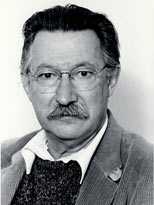
Joseph Weizenbaum
German-American computer scientist and professorWikipedia
41
MENTIONS
10
EPISODES
9
PODCASTS
Search complete. 41 mentions across 10 episodes found for "Joseph Weizenbaum".
Sep 14, 2026

Laurel LefkowNARRATOR
Yet there were, as ever, skeptics.
Laurel LefkowNARRATOR
Joseph Weizenbaum, an MIT engineer who in 1966 had developed ELIZA, the first of what would come to be called a chatbot, objected to the development of artificial intelligence as leading inevitably to the automation of the functions of the state.
Laurel LefkowNARRATOR
Writing in 1976, he described as obscene any project that proposed to substitute a computer system for a human function that involves interpersonal respect, understanding, and love.
Laurel LefkowNARRATOR
He also warned against research that would one day result in a fully automated battlefield.

Michael SafiGUEST
You know, you would sit and talk to it, and it would just mirror what you were saying back at you.
Michael SafiGUEST
And the guy who created it, this professor there, Joseph Weizenbaum, the thing he found most unnerving was that he would sit people in front of ELIZA and have them talk to it, and he talks about how his secretary at one point asked him to leave the room, and he asked her why, and she said, "I wanna have a conversation with it." And he just like he, he ends up writing later, he couldn't believe how this, again, quite crap chatbot-
Madeleine FinlayHOST
[laughs]
Michael SafiGUEST
... could, I think his words were, "evoke powerful delusions in otherwise normal people".

speaker_0SOUNDBITE_SPEAKER
It was an impressive feat of programming, but just a collection of key words that related to the words written to the phrases in the database.
Mark ChrislerHOST
Eliza's author, Joseph Weizenbaum, then a young computer science professor at MIT, would have agreed with Lambda.
Mark ChrislerHOST
He had written the script for Eliza mainly as a way to show what computers were capable of to people who were clueless about computers.
Mark ChrislerHOST
It didn't take very long, however, before he realized that many people were very much overestimating those capabilities.
21 MINS LATER
Mark ChrislerHOST
His time at MIT grew unpleasant.
Mark ChrislerHOST
At the birthplace and epicenter of the cognitive revolution, the beating heart of artificial intelligence, no one would even eat lunch with him.
Mark ChrislerHOST
No one, aside from Joseph Weizenbaum, the father of Eliza, who made it a point to sit with Dreyfus to show their colleagues how juvenile they were.
Mark ChrislerHOST
In 1968, Dreyfus left MIT, even though he had tenure.
FelienneHOST
I have one more tattoo quote.
FelienneHOST
And maybe also one more thought about how this relates to other episodes, in that I think a lot of our episodes are about... how technology shapes thinking or how technology shapes individuals, right? So Turkel, Weizenbaum, Dreyfus are talking about what does a person do? And maybe Winner is sort of the generalization about this, where he talks more about what does technology do not to one person.
FelienneHOST
Turkel has this beautiful quote, right, where she says like, oh, I've...
FelienneHOST
From a student she interviews that says, oh, by all this programming, I sort of lose my humanity, something like this.

Ian MontHOST
A technology that almost 60 years in the future would explode into the mainstream, alter the global economy, and raise significant questions about the future.
speaker_4SOUNDBITE_SPEAKER
MIT professor Joseph Weizenbaum carries on a dialogue with a computer through a typewriter.
speaker_4SOUNDBITE_SPEAKER
A computer can play many roles depending upon how it's programmed.
Joseph WeizenbaumSOUNDBITE_SPEAKER
I have told the computer that it's to understand what I'm saying, say in the context of being a doctor.
Joseph WeizenbaumSOUNDBITE_SPEAKER
If I then tell the computer, for example, my head hurts, I expect the computer to respond to that as a doctor might.
Ian MontHOST
And it turns out that that man, Joseph Weisenbaum, would also become one of its earliest critics, seeing it as deceptive and playing upon our natural vulnerabilities.
Ian MontHOST
I'm Ian Mont.
Ian MontHOST
This week on Campus Files, Eliza at MIT, the world's first chatbot.

TomHOST
Then, in 1959, the term machine learning was coined when talking about a computer that learned how to play a mean game of checkers.
TomHOST
But then, in 1966, we got Eliza, a natural language conversation program created by Joseph Weizenbaum, the world's first chatbot.
TomHOST
She was an incredibly rudimentary form of AI compared to what we're used to now.
TomHOST
The user would input some line of dialogue, then Eliza would scan the input for key words.

HannaHOST
Let's talk a little bit more about the implications of this for computer science education.
FelienneHOST
Yeah, so we said this in another episode as well, I think the one on Weizenbaum, where I think the most interesting general thought from this book is computers can be bad.
FelienneHOST
Automization can be bad.
FelienneHOST
And I think if you study computer science...

Luke StarkGUEST
You know, I think one of the interesting things about the history of AI is that there's actually a really long story about the research into ethics, social impacts, which is what I do.
Luke StarkGUEST
Um, the guy who invented Eliza, Joseph Weizenbaum, who I mentioned, he was so kinda taken aback by how much people were taken in by this very simple program that he wrote a whole book in the '70s about things, you know, what computers can do and can't do related to humans.
Luke StarkGUEST
A- and every, every, you know, every f- you know, decade or so, there's a big upsurge in that work.
Luke StarkGUEST
What seems to happen, though, is that when a new technical innovation, a new, you know, a new thing, maybe it's the personal computer, maybe it's the internet, maybe it's social media, maybe it's smartphones, maybe it's the, the first wave of AI about 10 years ago, maybe now it's LLMs, when those come in You know, for whatever reason, you know, politicians and the media, you know, they tend to forget there's been all this other research on, on the impacts of these tools, and all of a sudden everything is shiny and new and amazing and great.

Russell MearsGUEST
It isn't a hunch.
Russell MearsGUEST
The second, the second thing was there was a professor called Joseph Weizenbaum, uh, and he built something called ELIZA, which was one of the first conversational programs.
Russell MearsGUEST
It was like a few hundred lines of code.
Russell MearsGUEST
He actually built it as a reaction at the time to, to the psychology of the era, which was Rogerian.

speaker_1HOST
Yeah.
speaker_2HOST
In fact, the book highlights a quote from the computer scientist, Joseph Weizenbaum, that really sets the stakes for what we're talking about.
speaker_2HOST
He wrote, uh, "The computer programmer is a creator of universes for which he alone is responsible."
speaker_1HOST
Creator of universes.