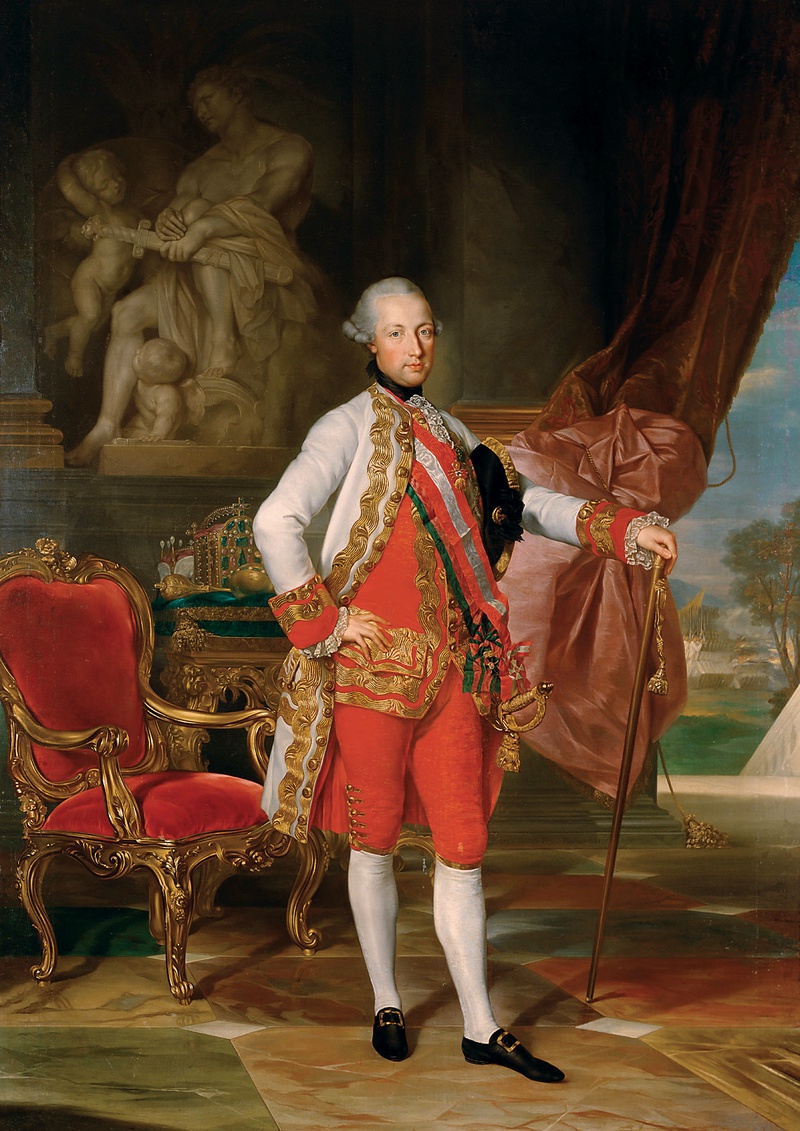
Joseph II, Holy Roman Emperor
Former Holy Roman emperorWikipedia
118
MENTIONS
21
EPISODES
19
PODCASTS
Search complete. 118 mentions across 21 episodes found for "Joseph II, Holy Roman Emperor".
Oct 18, 2026

Bob WoodleyHOST
By limited freedom of worship, it only applies to Christians, those who were not Roman Catholic.
Bob WoodleyHOST
It was Holy Roman Emperor Joseph II of the Austrian Habsburg Dominions in Central Europe who granted the new freedom of religion to the people while maintaining the posture of the Catholic Church.
Bob WoodleyHOST
Emperor Joe wasn't done there, though.
Bob WoodleyHOST
In January of 1782, he also freed Jews in the territory from restrictions based on discrimination.

Vít PohankaHOST
This settlement pattern gradually became the basis of local administration.
Vít PohankaHOST
Under Maria Theresa and Joseph II in the 18th century, individual villages acquired formally defined local authorities.
Vít PohankaHOST
Over the generations, the office of mayor and the municipal council became closely connected with local identity, and the result can still be seen in the figures I mentioned earlier.
Vít PohankaHOST
So again, Czechia has on average the smallest municipalities in the European Union.

speaker_0HOST
In the early 1700s, that was not yet the case, and Enlightenment thinkers wanted to change that.
speaker_0HOST
They found a willing ear with Enlightened monarchs like Frederick the Great of Prussia or the Habsburg Emperor Joseph II.
speaker_0HOST
As part of their rationalization efforts, as they saw it, they slightly improved the situation of Jews top-down, even though neither of them had a favorable opinion of Jews.
speaker_0HOST
The French Revolution would be more drastic.

Phil ChenevertNARRATOR
If Germany does not let slip her chance, but puts it into her pocket before the Cossacks can dip their hands into it, she will soon have the best share in the partition of the world.
Phil ChenevertNARRATOR
As soon as some thousand armed German colonists begin to till the splendid soil, the fate of Near Asia will be in the hands of the Emperor.
Phil ChenevertNARRATOR
This was written in 1886.
Phil ChenevertNARRATOR
I will not detain you by recalling how these ideas were realized.
Phil ChenevertNARRATOR
I suppose you know all about the friendship of William with the Red Sultan, about the Emperor's theatrical journeys in 1898 to the tomb of Saladin in Damascus and to the holy places in Jerusalem, with all that display of German splendor and with the profession by the Emperor that he is the only and the best friend of the Sultan, the only one who does not think of any partition of Turkey, and that because he wants her all for himself, the Emperor the true and faithful protector of the Moslem all over the world.
Phil ChenevertNARRATOR
And then after the Emperor came the Krupps and Von der Goltz, instructors for the Turkish army and concessions for German capital, the railway line, very short at first, from Haidar Pasha to Izmit, then just a little further to Angora, then by a shortcut down to the south to Konay, and finally in 1899 from Konay to its terminus on the Persian Gulf.
Phil ChenevertNARRATOR
This is, in a few words, the story of the Baghdad railway.
Phil ChenevertNARRATOR
I am not going to dwell on all these developments which I suppose to be known, and I pass on to my chief point.

Leon HarveyNARRATOR
1688-1697, France entered by Pace of Reiswick.
Leon HarveyNARRATOR
Joseph I, 1705-1711.
Leon HarveyNARRATOR
1791-1714, France entered by Pace of Rastelt.
Leon HarveyNARRATOR
1701-1711, Revolt of Francis Recoxy II entered by Treaty of Sultmar.
Leon HarveyNARRATOR
Charles VI, 1711-1740, 1716-1718, Turkey ended by peace of Peselowitz, 1718-1720, Spain, war of quadruple alliance, 1733-1735, France and Poland, war of Polish succession, 1737-1739, Turkey ended by peace of Belgrade, Maria Theresa 1740-1780 1740-1748 France ended by a peace of Auxerre-Capel 1740-1742 Prussia ended by a peace of Breslau 1744-1745 Prussia ended by a peace of Dresden 1756-1763 prussia ended by a peace of herbertburg third salesian war 1778-1779 prussia ended by a peace of tessin mediated by russia Joseph II, 1780-1790, 1787-1791, Turkey ended by peace of Sistova, 1787-1790, revolted Belgian provinces, especially in Brevent.
Leon HarveyNARRATOR
Leopold II, 1790-1792, Francis II, 1792-1835, 1792-1797, France ended by peace of Campo Forneo, First Coalition.
Leon HarveyNARRATOR
seventeen ninety eight eighteen o one france ended by a peace of lumenville second coalition eighteen o five france ended by a peace of prezberg third coalition eighteen o nine france ended by a treaty of schoenbrunn eighteen o nine russia eighteen twelve eighteen thirteen russia eighteen thirteen eighteen fourteen france and by first treaty of paris and in fifteen france les cent joues eighteen fifteen naples and by flight of morat eighteen twenty one intervention naples and sardinia eighteen thirty one eighteen thirty two rising in modena parma and the romagna fernand i eighteen thirty five to eighteen forty eight eighteen forty intervention egyptian in broglio eighteen forty six rising in galicia and cracow put down by the powers eighteen forty eight second vienna insurrection in white capture of vienna by francis joseph eighteen forty eight eighteen forty eight ten forty nine sardinia campaign of novara eighteen forty eight eighteen forty nine hungarian insurrection put down by russians at villegosse eighteen forty eight denmark austria took part as member of germanic confederation eighteen fifty nine france and sardinia ended by peace of zurich eighteen sixty four denmark austria and the ally of prussia peace of vienna eighteen sixty six prussia ended by peace of prague the seven weeks war eighteen sixty nine eighteen seventy rising at dalmatia eighteen seventy eight eighteen seventy nine occupation of bosnia and the 1881-1882 Risings in the Herzegovina Bosnia and Southern Dalmatia 1897-1898 Intervention in Crete 1914 Serbia, Russia, France, England, Belgium, Japan, Italy End of section 3

Peter CudlipHOST
And it was performed by the C.P.E. Bach Chamber Orchestra, conducted by Peter Schreier.
Peter CudlipHOST
The opera was based on a libretto by Carlo Goldoni, the Italian playwright, but it went through a few extra hands before being chosen by the young Emperor Joseph II in Vienna as the right project for the very young Mozart.
Peter CudlipHOST
It concerns a smart young woman who poses as somewhat less bright than she really is to outwit two disappointingly unworthy suitors.
Peter CudlipHOST
Which sounds like it would have been a fun night out for the court, but it was not exactly.
27 MINS LATER
Peter CudlipHOST
Okay, guess what? Time for another subgenre in the world of opera, but this one is easy.
Peter CudlipHOST
Whilst most of the European courts believed for most of the 1700s that if the singers were not singing in Italian it wasn't an opera, there was some pushback developing.
Peter CudlipHOST
And one champion of the idea of opera-like productions written and sung in German was Emperor Joseph II.
Peter CudlipHOST
He took the term for a play with songs, Zingspiel, and in 1788 established the National Zingspiel for the express purpose of creating operas that were in German, plus ditching the Italian recitative, that is, sung dialogue with very simple and frequently improvised harpsichord accompaniment, with spoken dialogue.

Pamela NagamiNARRATOR
Nor could she with safety attempt to exercise direct political influence in Germany.
Pamela NagamiNARRATOR
The history of the Fürstenbund had proved that any such attempt would be resisted by Prussia, and the lesson of the failure of Joseph II was not lost on his successors.
Pamela NagamiNARRATOR
The Habsburgs were bound to rely on the rivalry between the smaller states which invited their intervention, and on the jealousy with which the ever-growing power of the Hohenzollerns was regarded.
Pamela NagamiNARRATOR
But most of all, they placed their trust in the feeling of traditional loyalty to themselves as the recognized heirs of the medieval emperors, a feeling which twenty-five stressful years had not sufficed to eradicate.
3 HRS 49 MINS LATER
Pamela NagamiNARRATOR
Radetzky, commanding the imperial forces, was compelled to retire behind the lines of the quadrilateral, and when Charles Albert declared war, when the armies of the other states hastened to the help of Sardinia, when the Austrians were actually beaten in the field at Goito, the overthrow of Habsburg power in Italy seemed to be imminent, if not complete.
Pamela NagamiNARRATOR
Nor could help be sent from Vienna, since upon the whole Austrian Empire burst the storm which had been brewing for nearly a hundred years.
Pamela NagamiNARRATOR
Joseph II had pursued the ideal of centralization, not wisely but too furiously.
Pamela NagamiNARRATOR
He had accentuated diversity in his search for uniformity, and his successors reaped the fruit of his unwisdom.

Pamela NagamiNARRATOR
He conceded for the sake of argument that such indulgence might be a fatal error.
Pamela NagamiNARRATOR
But he insisted that if Pitt's character was to be blackened because he used parliamentary corruption, the same censure ought in justice to be extended to the greatest monarchs of past times, Louis XIV, Joseph II, Frederick the Great, who to serve their own ends outraged the immovable principles of humanity and morality in a far graver manner than could be laid to the charge of the illustrious statesman who consolidated the United Kingdom of Great Britain and Ireland.
Pamela NagamiNARRATOR
On Cavour's own grounds, those of expediency, it might be objected that a bargain which on one side you allow to be discreditable leaves the legacy of an indestructible desire on that side to wipe out the discredit by tearing it up.
Pamela NagamiNARRATOR
Though Cavour became great by his connection with the movement which before all things was swayed by sentiment, he never entirely recognized the part that sentiment plays in politics.
51 MINS LATER
Pamela NagamiNARRATOR
At this first stage in the long struggle, the Roman Curia might have settled the matter in a friendly way, but it would not.
Pamela NagamiNARRATOR
Cardinal Antonelli replied to a respectful invitation that the Holy Father was ready to go to the antechamber of the devil's house to please the king of Sardinia, but he really could not go inside.
Pamela NagamiNARRATOR
Yet at the same date, the Archbishop of Paris, Cibourg, admitted to a Piedmontese visitor that the Sardinian government had no option under the new institutions but to establish the equality of all citizens before the law, and in Austria they were laughing at the progressive monarchy in its laborious efforts to obtain reforms carried out in the despotic empire by Joseph II.
Pamela NagamiNARRATOR
The reason that Rome refused to treat was that she thought herself strong and Sardinia weak.

Violet BlueNARRATOR
Unsuspected conditions.
Violet BlueNARRATOR
Joseph II.
Violet BlueNARRATOR
Reforms by a progressive Habsburg
Violet BlueNARRATOR
are a failure.

Herman PoppleberryHOST
Which leads us to the imposition.
Herman PoppleberryHOST
Joseph II, Holy Roman Emperor, issues a decree.
Herman PoppleberryHOST
July 23, 1787, some sources say November 12th.
Herman PoppleberryHOST
either way hapsburg jews are compelled to adopt german first names and family names and it doesn't stop there prussia follows russia in eighteen o four france in eighteen o eight the german states after that
Herman PoppleberryHOST
They're neither.
Herman PoppleberryHOST
So what's the positive claim? Beider argues the compound German names, the Goldsteins and Rosenthals and Silberbergs, were invented by Christian clerks in Vienna, combining two German roots.
Herman PoppleberryHOST
And they reflect the Germanizing spirit of Joseph II's Edict of Tolerance in 1782.
Herman PoppleberryHOST
Goldstein isn't a name someone chose.
11 more episodes mention Joseph II, Holy Roman Emperor.
Create an account to see the whole feed, search across every transcript, and follow the entities you care about.