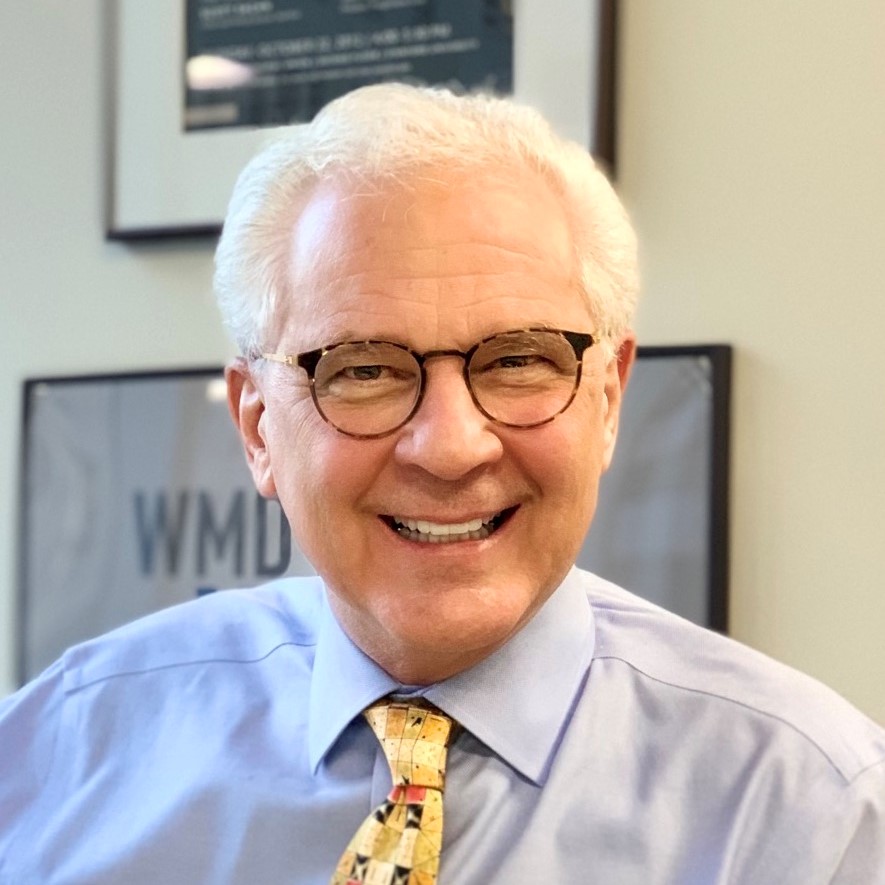
Joseph Cirincione
Author
22
APPEARANCES
12
PODCASTS
Sep 3, 2026


Thom HartmannHOST
What's your take on the extent to which the stupid war and the damage it's done to our military and the weakness of America that it has exposed – enhances or increases the chances that Putin will become more adventurous in former Eastern Europe and that Xi will do the same in Taiwan and that Trump's stupidity thus could be leading us directly into World War III.


David RothkopfHOST
Especially since one of the biggest betrayals of Trump's last term was of the Kurds.

Joe CirincioneGUEST
When, when, when George H.W. Bush b- o- encouraged the Kurds to rise up against Saddam Hussein, they did, and they got slaughtered, and we didn't lift a finger, okay? So there's a long history here, um, that p- people old enough will remember.
Joe CirincioneGUEST
People were surprised at this because they thought, "Why are you g- why are you bringing other countries into the war?" That is the point, understanding that they can't win militarily.
14 MINS LATER


Joe CirincioneGUEST
You know, if you ask most Americans, how many nuclear weapons do we need? You know, you'd get an answer somewhere between zero and a few hundred.
Joe CirincioneGUEST
So- Why? This is the question presidents often ask when they come into office and they're first briefed and they're first showed how to use the nuclear football.
Joe CirincioneGUEST
They go, why do we have so many? And the answer to that question quickly moves away from the effects of these weapons to abstract theories of deterrence and controlling the escalatory ladder and targeting and all this.
10 MINS LATER


Martin DeCaroHOST
What is the history of Saudi Arabia's nuclear ambitions? For instance, Saudi Arabia did not benefit from the Atoms for Peace program under Eisenhower in the nineteen fifties, although Iran did.
Joe CirincioneGUEST
In the nineteen fifties, Eisenhower thought that the way to solve this problem of sharing nuclear technology without giving people the means to make nuclear weapons was this Atoms for Peace program, where we would sell s- technology for peaceful nuclear purposes so they could build reactors, et cetera, do medical research.
Joe CirincioneGUEST
You know, we had installed the Shah of Iran in the nineteen fifty-three coup, where we overthrew the government of Iran and put the Shah in.
Joe CirincioneGUEST
And in the nineteen seventies, the Shah of Iran was very interested in building up a nuclear program in Iran and made deals with the United States that included not just building nuclear reactors, but also plans for uranium enrichment, plans for plutonium reprocessing.


Joseph CirincioneGUEST
And the actual implementation of the destruction of purely civilian targets, a bridge, a power plant, is a war crime prohibited by multiple international agreements.
Joseph CirincioneGUEST
So there's... a president of the United States is blatantly committing war crimes and promising to commit more.
Joseph CirincioneGUEST
While it is difficult to predict when you have two volatile authoritarian regimes involved, the Iranian regime and the Trump regime, my best guess is that we are in a new forever war.
6 MINS LATER

Joe CirincioneGUEST
These people have, uh, Jared Kushner, Steve Witkoff, have, have no experience, don't understand Iran, don't understand the nuclear issues, don't understand how to negotiate, don't understand foreign policy.
Joe CirincioneGUEST
All they know is, you know, how to take money from these, these Arab state m- m- monarchs and tyrants that they're friends with, and that's their whole point, and th- and they, and they have an inflated opinion of their own skills.
Joe CirincioneGUEST
We're in this mess n- not because Trump lost the war, which he did, not because he negotiated a surrender document, the MOU.
Joe CirincioneGUEST
I think we did a podcast that, where y- you aptly titled it, David, this is a fig leaf for surrender.
20 MINS LATER


Major GarrettHOST
And I'd like you to get your analysis of what's happening and this conflict over the Strait and whether the United States can be its guardian and who it's going to charge tolls to.
Joe CirincioneGUEST
Well, the fighting is flared up again basically because after President Trump lost this war and sent Jared Kushner and Steve Witkoff to negotiate a very tricky memorandum of understanding to end the war and to open up the strait again.
Joe CirincioneGUEST
It's very clear that they botched the job, that paragraph five of this MOU gives Iran clear authority over the strait, that Iran is charged with opening up the strait, and that any passage through the strait has to be coordinated with Iran.
Joe CirincioneGUEST
About three weeks ago, President Trump just seems to have decided that he wanted to open up another channel through the Strait of Hormuz, one that hugged the coast of Oman, the state on the other side from Iran and on the strait.
Joe CirincioneGUEST
They said that was a violation, that all shipping had to go through their authority.
Major GarrettHOST
That's a little bit of shade that the Iranian foreign minister is throwing at the president of the United States.
Unknown podcast
Trumps Tony Soprano approach to Iran shows he has no cards to play - Foreign policy expert
Jun 21 · 8m
DavidHOST
But why all this mixed messaging and what actually is or potentially was being debated in Switzerland, given how things have unfolded today?
Joe CirincioneGUEST
This is yet another sign that this administration simply does not know what it's doing.
Joe CirincioneGUEST
It doesn't have competent people in charge of the government on what you would believe to be some of the most fundamental and important issues.
Joe CirincioneGUEST
priorities of any administration to safeguard this national security of the United States.
DavidHOST
Does it?


Alex WittHOST
But why all this mixed messaging and what actually is or potentially was being debated in Switzerland, given how things have unfolded today?
Joe CirincioneGUEST
This is yet another sign that this administration simply does not know what it's doing.
Joe CirincioneGUEST
It doesn't have competent people in charge of the government on what you would believe to be some of the most fundamental and important issues.
Joe CirincioneGUEST
priorities of any administration to safeguard this national security of the United States.
5 MINS LATER

13:36

Can we just begin by putting this into a historical context by you reminding our listeners how long the U.S. has been trying to constrain Iran's nuclear program?
Joseph CirincioneGUEST
The United States actually sold Iran its first nuclear reactor in 1957 to the Shah of Iran, the dictator we had created.
Joseph CirincioneGUEST
uh imposed on the people after we overthrew the government in 1953 the shah had very ambitious plans to build reactors research reactors power reactors even uranium enrichment and we were happy to sell them that technology but we got into a trap because the government didn't last when he was overthrown in 1979 we had a very different view of the islamic republic and didn't trust them at all with this technology Fortunately, the program lay largely dormant until the 1990s when Iran started ramping up the program.
Joseph CirincioneGUEST
Iran offered to negotiate its program with us in 2003 after the U.S. invaded Iraq.
Joseph CirincioneGUEST
But Vice President Cheney rejected that offer, famously saying, we don't negotiate with evil, we defeat it.


Vladimir BobetićHOST
Was Iran giving more in regards of their nuclear program in that agreement than in this one?
Joe CirincioneGUEST
He could have achieved this without fighting, 'cause what the Iranians were offering on February 26th was a good deal.
Joe CirincioneGUEST
I mean, that's when I was saying, "Oh, well, this might, you know, maybe he could get better than the JCPOA." Uh, [chuckles] and like, then they just bungled it.
35 MINS LATER
Vladimir BobetićHOST
So if Iran eventually decides to move toward a nuclear weapon, what would be the first indicators that intelligence agencies would look for?
Joe CirincioneGUEST
This is a, a, a major defeat for, for Donald Trump, and now you understand why he kept the text secret, 'cause he wanted a few days to create this alternative reality by just the words he was saying that to, to portray this as a victory.
Joe CirincioneGUEST
He has great faith in his ability to hypnotize the American people, to convince them that the, his illusions are actually real, that his name is still on the Kennedy Center, that the reflecting pool is blue, not algae green, that he won this war, not lost it.
Joe CirincioneGUEST
Well, this is a very difficult illusion to maintain because the reaction to this agreement has been shock across the political spectrum.
Joe CirincioneGUEST
And the reason is that shock, is because Iran commits to very little in this one-and-a-half page memorandum of understanding other than opening up the strait, which of course just is the situation we encounter- we, we, we were in 108 days ago before this w- war began.
Joe CirincioneGUEST
And first, it's, it's part of the president's attempt to shift the focus from the numerous failures of this war, the catastrophes, the disasters, the unfulfilled goals that we can talk about later, and shift it over to this frame, where he's trying to cast this as a tremendous victory because he's done two things, open the straits, which of course were open before he started the war, and that he's going to get a pledge from Iran never to develop a nuclear weapon, which of course has been in effect, and Jon knows this, since 1966, which is the first time Iran pledged never to get a nuclear weapon, and has renewed those kinds of pledges in all kinds of places, including the very first page of the 2015 JCPOA, Joint Comprehensive Plan of Action, that [laughs] Obama signed then and Trump tore up.
Joe CirincioneGUEST
And so, and then to the question itself of whether this stuff is valuable, it is enormously valuable.
David RothkopfHOST
Please just walk away," wouldn't that be, in military and diplomatic terms, what we would call a defeat and a surrender?
Joe CirincioneGUEST
One, this is a larger discussion about the American way of war, which I believe is now ob- been proven to be obsolete, 'cause I agree with your point.
Joe CirincioneGUEST
And in fact, T- Trump makes his point, even in the cabinet meeting yesterday.
Joe CirincioneGUEST
He says, "Well look, what are you talking about? We've only been at this a few months.
17 MINS LATER
David RothkopfHOST
We have a whole new strategic landscape, and there were all these little guys writing articles for, for different publications going, "Isn't this amazing?" Hey, guess what? None of it's true.
Joe CirincioneGUEST
It was the strongest non-proliferation agreement I've ever seen, and I've been tracking non-proliferation for 45 years.
28 MINS LATER
David RothkopfHOST
[bell dings] And the winner by knockout is Pataday! [crowd cheering] Pataday, bring it on.
David RothkopfHOST
Um, uh, uh, uh, so, uh, perhaps in reflection, you're gonna sign on to Ed's war of whim, eh, Joe?
Joe CirincioneGUEST
W- w- what do you, what do you call that snake that, that eats its own tail? A, an Ouroboros?
Joe CirincioneGUEST
I mean, it's, it's actually just, just an amazing, um, uh, d- well, it's a disgrace.
Joe CirincioneGUEST
It's been going on for about 25 years ever since George H- uh, George W. Bush pulled out of the Anti-Ballistic Missile Treaty in 2001, and there's been a series of agreements that administrations ha- have, mostly Republicans, have pulled out of.
11 MINS LATER
David RothkopfHOST
And so I just wanted to turn to you guys, and turn to you first, Joe, and then t- then, then to you, John, and get your reaction to this shift
10 MINS LATER
David RothkopfHOST
What are you hearing about the plans of the Trump-Hegseth administration regarding their nukes? Like, what, what are they gonna do, uh, over the course of the next couple months that we've gotta look out for because it's gonna be a sign that things are shifting even further?

Jon WolfsthalHOST
when, when, when Trump went after Syria, when Obama went after Syria, when we go after, uh, terrorist groups in, in Africa, um, it, uh, we use cruise missiles launched from attack submarines.
Joe CirincioneGUEST
So I'm not gonna go through everything, but basically everything across the board in this vast nuclear complex that we have in America, everything's gonna be accelerated, everything's gonna be expanded.
Joe CirincioneGUEST
For example, they want to unsign the Comprehensive Nuclear Test Ban Treaty, the treaty that bans nuclear weapons testing.
Joe CirincioneGUEST
The only country that's tested a nuclear weapon in this century is North Korea, and even they, you know, did it underground, uh, at least, not an atmospheric test like we used to do.
7 MINS LATER
Jon WolfsthalHOST
How do you expect Russia, China in particular, our main nuclear competitors, to respond in that environment?
Joe CirincioneGUEST
Uh, since 1945, since we exploded the first nuclear weapon in a, in the, the test in, at Los Alamos and depicted dramatically in the Oppenheimer film, we've tested 1,054 times.
Joe CirincioneGUEST
We accumulated a vast scientific knowledge of nuclear explosions and their dynamics so that in, in 1992, we stopped testing.
Joe CirincioneGUEST
We said, "Uh, uh, we led the world in this," and the rest of the countries of the world soon followed.
24 MINS LATER


Anderson CooperHOST
How hard is it to know with any certainty how close Iran is to getting a nuclear bomb before these airstrikes?
Joseph CirincioneGUEST
We do know that they have enough, um, medium enriched uranium, uranium enriched to 60%, that they could quickly put back into those centrifuges at Fordow or elsewhere and turn into bomb-grade material, 90% enriched uranium.
Anderson CooperHOST
It, with 60%, which is what they have already, can you fashion a crude device? Because I guess my question is, if Iran feels they have no other, you know, if their back is against the wall, they feel this is a, uh, the regime is, is going to live or die based on this and they are so inclined, could they fashion some sort of crude nuclear device?

9:51

Um, what was, what was the problem back then? Well, we'll get to the physics a little bit more, but there was also some just, like, practical dollars and cents problems that would make SDI not feasible.
Joseph CirincioneGUEST
So, uh, y- you know, very few people thought Reagan was serious about this when he announced it.
Joseph CirincioneGUEST
He surprised his own, uh, uh, military chiefs and his technical advisors.
Joseph CirincioneGUEST
In fact, the day he gave that speech, Air Force, uh, uh, leaders were testifying on Capitol Hill that th- this was not the time to be accelerating, uh, laser programs, um, or, or accelerating anti-missile programs because they thought the physics just weren't there.
Joseph CirincioneGUEST
The whole thing, s- one of them said, filled me with a great deal of trepidation.
Joseph CirincioneGUEST
It'd be like trying, it'd be like standing on top of the Washington Monument and aiming at a baseball on the Empire State Building while both were moving thousands of miles per minute, you know, you just, or hours.
6 MINS LATER