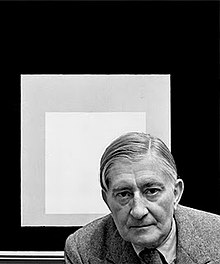
Josef Albers
German-American artist and educatorWikipedia
11
MENTIONS
8
EPISODES
8
PODCASTS
Search complete. 11 mentions across 8 episodes found for "Josef Albers".
Nov 2, 2026

Mark RömischGUEST
He brought with him colleagues from the Bauhaus.
Mark RömischGUEST
Marcel Breuer came over, Josef Albers, Herbert Bayer, and some of them moved on to Chicago, some moved on to Yale or MIT further then.
Mark RömischGUEST
And there was this hub of Bauhaus ideas in Cambridge.
Mark RömischGUEST
Massachusetts at first.

Susan HableGUEST
I just think of this one book.
Susan HableGUEST
It's Joseph Albers.
Susan HableGUEST
It's a hot pink.
David PhoenixGUEST
Oh, yes.
David PhoenixGUEST
Isn't that fabulous?
Susan HableGUEST
That's an incredible
David PhoenixGUEST
book, the Joseph Albers.
David PhoenixGUEST
I don't have that one.

Mark HavensGUEST
Ira Gittler became the New York editor for Downbeat and one of the world's preeminent jazz historians, receiving a Guggenheim Fellowship in 1974.
Mark HavensGUEST
Scott Hyde went on to collaborate with such 20th century giants as Joseph Albers and John Cage and documented some of the earliest Fluxus events.
Mark HavensGUEST
He was awarded a Guggenheim Fellowship in 1965, and his work is in the collections of the Museum of Modern Art, the Metropolitan Museum of Art, and the International Center of Photography, among others.
Mark HavensGUEST
Esmond Edwards was variously a composer, arranger, and pioneering record executive, heading Verve Records and becoming vice president of A&R for Chess.

speaker_1NARRATOR
In a sense, we put a little bit of ourselves into the color.
speaker_1NARRATOR
In the book Interaction of Color, the artist Joseph Albers discusses the way in which color is relative.
speaker_1NARRATOR
In visual perception, a color is almost never seen as it really is, as it physically is.
speaker_1NARRATOR
This fact makes color the most relative medium in art.

Mark RolandHOST
That, that, like this one, is inspired by, um, Saul Bass.
Mark RolandHOST
That was inspired by Josef Albers, a, another-
PushHOST
Right
Mark RolandHOST
... designer that I know Mark Hall, you know-

Herb Vincent PetersonHOST
Um, I think there's something really important about being able to see that.
Herb Vincent PetersonHOST
You know, do you recall the first time you ever saw something that you had only seen in one kind of spa- you know, like, one kind of space? Like, I remember the first time opening up Josef Albers's, uh, "Interaction of Color", the very first edition, wearing white gloves at the Wexner Center Library.
Herb Vincent PetersonHOST
And looking at these stereographs, which are essentially like real screen prints that he had made with his students at, at Yale, and just being mind-blown of how different the real thing was compared to the, the multiple, um, editions that had been printed, right? Like, the paperback version does nothing in comparison to the, the reality of looking at the real print [chuckles] or the real thing.
Herb Vincent PetersonHOST
You know, like, oh, wow, that's interesting.

Brandy MaslowskiHOST
One is a very light background in paper, and one is very dark background in quilt, but how do you approach cover- color? What's your, what's your process there?
Sarah HibbertGUEST
Um, I've never studied, even though my father was a graphic designer and the house was full of color, and also I've been a huge follower of Josef Albers for many years, and obviously the color and things.
Sarah HibbertGUEST
I don't un- me, personally, and I don't mean to be, you know, funny about this, but I don't understand color theory.
Sarah HibbertGUEST
I just don't get it.

Maddie Rose HillsHOST
Mm.
Lucy MayesGUEST
So, um, I mean, we could talk about Rothko, we could talk about, uh, also Josef Albers.
Lucy MayesGUEST
We could talk about Bauhaus painters, we could talk about Hilma af Klint.
Maddie Rose HillsHOST
Yeah, yeah.
Maddie Rose HillsHOST
Mm.
Lucy MayesGUEST
Um, so I've got a lot of books on, um, color theory and color diagrams.
Lucy MayesGUEST
So I think, and some of th- there's a bit of an overlap between sort of art and color, color theory in terms of, like, I think a lot of color theorists, like Josef Albers, for example, see it through lens of being art as well.
Maddie Rose HillsHOST
Mm.