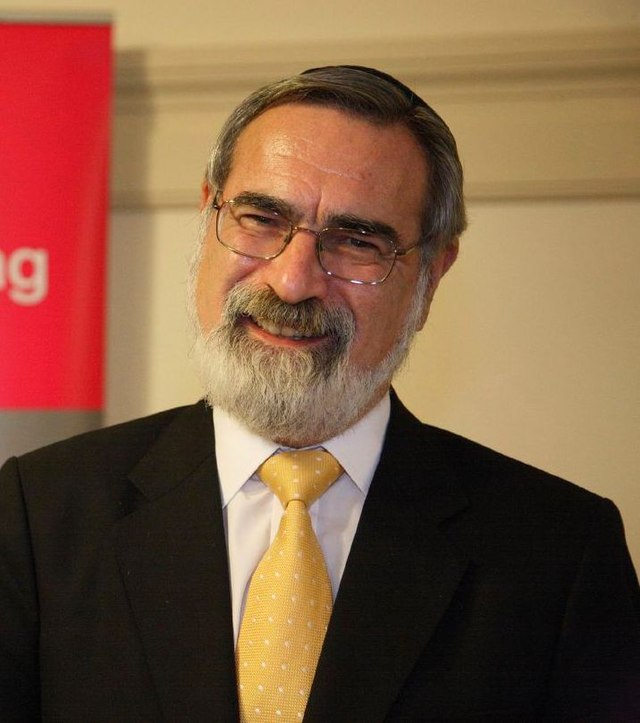
Jonathan Sacks, Baron Sacks
Rabbi and philosopherWikipedia
90
MENTIONS
55
EPISODES
46
PODCASTS
Search complete. 90 mentions across 55 episodes found for "Jonathan Sacks, Baron Sacks".
Sep 11, 2026

Damian EisnerHOST
That's what this is about.
Damian EisnerHOST
Rabbi Jonathan Sacks said, teshuva teaches us that our past does not determine our future.
Damian EisnerHOST
You cannot change a second of what has happened.
Damian EisnerHOST
You cannot unsay what you said or unmake those decisions, but you can refuse to let those things determine what happens next.

Aryeh LebowitzHOST
Um, he was not the Mesader Kiddushin, but he was at the wedding.
Aryeh LebowitzHOST
So on my way back to my seat, I said, uh, "Rabbi Sacks, um, this is what just happened." He's like, "Oh." [laughs] You know, so apparently that was not supposed to happen.
Aryeh LebowitzHOST
So, uh, uh, during the first dance, um, Rabbi Sa-- They, they, they went to Yichud, which is a question in its own right.
Aryeh LebowitzHOST
Can you go to Yichud if you have a partial ketubah? But they went to Yichud, and during the first dance, Rabbi Sacks sat down with, with a piece of stationery.
Aryeh LebowitzHOST
First, he went over to the Mesader Kiddushin, who was an older Rav, and he asked for permission to, uh, to do this, for permission to, uh, to r- you know, rewrite the ketubah.
Aryeh LebowitzHOST
He was in-- Mesader Kiddushin was older already.
Aryeh LebowitzHOST
He was not interested.
Aryeh LebowitzHOST
He was like, "Whatever you want, I don't care.

Tali LoewenthalGUEST
And he wrote how shocked he is at the lack of decorum.
Tali LoewenthalGUEST
Now, here we are in St. John's Wood Synagogue, and the late Lord Rabbi Jonathan Sacks.
Tali LoewenthalGUEST
In various ways, he struggled to break the shell of decorum, English decorum.
Tali LoewenthalGUEST
So I was told, I wasn't here, but I was told, which came from someone who was here, that it was one Simchat Torah, and Rabbi Sacks, he was Chief Rabbi at the time, Rabbi Sacks said, it's Simchat Torah today.

Philip McCormackGUEST
It fundamentally influenced the founding fathers of the United States of America, in particular writers like Thomas Jefferson and John Adams.
Philip McCormackGUEST
And then with the influence of Benjamin Franklin and Thomas Jefferson upon the French, you see these concepts then being embedded in French Enlightenment philosophical thought so that when you have the French Revolution and you have this Declaration of the Rights of Man, you find the same principles embedded within it, but this time from a secular perspective because it was obvious to them, it was self-evident to them I was struck, however, listening to Lord Jonathan Sacks, the former Chief Rabbi, who was perhaps one of the most brilliant erudite minds of the 20th century.
Philip McCormackGUEST
And it was my privilege to both meet him and to talk to him about this, but also to listen to his lecture.
Philip McCormackGUEST
And I remember Listening to him where he said, Thomas Jefferson said, we hold these truths to be self-evident.

Mijal BittonHOST
Let's put this, her theory aside.
Mijal BittonHOST
Rabbi Jonathan Sacks, so I'm gonna...
Mijal BittonHOST
I wanna go to the way that he understood this.
Noam WeissmanHOST
Yeah.
Mijal BittonHOST
Rabbi Jonathan Sacks really took these ideas of shame cultures and guilt cultures, and he applied it very strongly, although not the way that she did, like Japan versus the West.
Mijal BittonHOST
For him, it was, uh, it, it was different.
Mijal BittonHOST
Uh, he argued that, that Jewish tradition, uh, really believed in sin culture, and he argued that actually-

Lizzi HeydemannHOST
And that music... is really what has the power to carry you through that experience of wanting to connect.
Lizzi HeydemannHOST
Rabbi Jonathan Sachs talks about how words may be the language of the mind, but music is the language of the soul.
Lizzi HeydemannHOST
And we're trying to speak the language of the soul.
Harry Nathan GottliebGUEST
But the words, they do mean something to you, don't they?

Reuven BrandHOST
And by asking, we are acknowledging, we are saying, "You are the only source of everything." It's almost like an expression, a manifestation of emunah.
Reuven BrandHOST
You know who describes it like this? Rabbi Sacks, zekher livracha.
Reuven BrandHOST
He loved this idea.
Reuven BrandHOST
He said, "We don't have faith, we pray faith." Great line.

Rivka KrinskyHOST
We have been blessed to have incredible guests for Rosh Hashanah.
Rivka KrinskyHOST
One of them was Rabbi Lord Jonathan Sachs.
Rivka KrinskyHOST
And every year on Rosh Hashanah, we get incredible responses.
Ida SchottensteinHOST
Overwhelmingly beautiful.
1 HR 12 MINS LATER
Esti HamiltonGUEST
And what did I use for a good purpose? What did I use not for a good purpose? Or what did I not use at all? And why am I not using it? And in terms of everything, everything in my life.
Esti HamiltonGUEST
Yeah, yeah, yeah.
Ida SchottensteinHOST
One of the things that come up a lot, we interviewed Lord Rabbi Jonathan Sachs, it was actually a Rosh Hashanah episode.
Ida SchottensteinHOST
It was this time of year.

Reuven BrandHOST
And by asking, we are acknowledging, we are saying, "You are the only source of everything." It's almost like an expression, a manifestation of emunah.
Reuven BrandHOST
You know who describes it like this, Rabbi Sacks, zekunim livracha.
Reuven BrandHOST
He loved this idea.
Reuven BrandHOST
He said, "We don't have faith, we pray faith." Great line.

Jim FriedmanGUEST
You know, it's a pity that, that we have people like that in the world uh because they make the world just so much less safe for everybody else you know something that i i am interested in as I approach retirement is I've been doing a lot of reading about interfaith dialogue and all of these groups that are led by, among others, Jews who are interested in seeking out people of other faith groups and talking to them, trying to build bridges, showing that it's possible to respect, other people's faiths and other people's beliefs and other people's ways of life and still maintain your own.
Jim FriedmanGUEST
I'm very heavily motivated by things that Rabbi Sacks wrote, said, and did in this area.
Jim FriedmanGUEST
He was a big, big, big believer in this.
Jim FriedmanGUEST
You look at something like 9-11 and it kind of makes you think, well, maybe that's just not possible.
Jim FriedmanGUEST
So that's an issue for me right now.
Jim FriedmanGUEST
That's something that I'm trying to work through.
Jim FriedmanGUEST
I keep saying to myself, Rabbi Sacks certainly knew about September 11th, and he still thought this was a worthwhile endeavor.
Jim FriedmanGUEST
So it's something that I hope to be able to pursue in retirement, but I'm still sorting through a lot of things about it in my own
45 more episodes mention Jonathan Sacks, Baron Sacks.
Create an account to see the whole feed, search across every transcript, and follow the entities you care about.