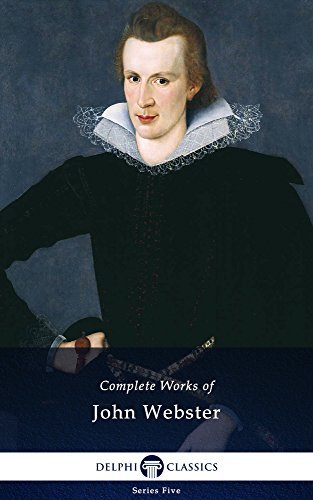
John Webster
English dramatistWikipedia
18
MENTIONS
6
EPISODES
6
PODCASTS
Search complete. 18 mentions across 6 episodes found for "John Webster".
Sep 16, 2026

ExpatriateNARRATOR
Often a play is written round a poem or series of poems, as will be seen in the course of this book.
ExpatriateNARRATOR
This use of existing material exceeds the practice of Western dramatists, but it must be remembered that if we were to read Webster, for example, in editions annotated as minutely as the Noh plays, we should discover that he was far more addicted to borrowing than we had been aware.
ExpatriateNARRATOR
It seems to me that in the finest plays this use of existing material is made with magnificent effect and fully justifies itself.
ExpatriateNARRATOR
The reference which I have just made to dance ballads brings us to another question.
17 MINS LATER
ExpatriateNARRATOR
For the action, in the commonest class of play, does not take place before our eyes, but is lived through again in mimic and recital by the ghost of one of the participants in it.
ExpatriateNARRATOR
Thus we get no possibility of crude realities, a vision of life indeed, but painted with the colors of memory, longing or regret.
ExpatriateNARRATOR
In a paper read before the Japan Society in 1919, I tried to illustrate this point by showing, perhaps in too fragmentary and disjointed a manner, how the theme of Webster's Duchess of Malfi would have been treated by a no writer.
ExpatriateNARRATOR
I said then, and the Society kindly allows me to repeat those remarks, the plot of the play is thus summarized by Rupert Brooke in his John Webster and the Elizabethan Drama.

Michael ShermerHOST
You had, uh, Christopher Marlowe.
Michael ShermerHOST
Uh, w- they also had Queen Elizabeth, Fran- Francis Bacon, Ben Jonson, and John Webster.
Michael ShermerHOST
Yeah.
Michael ShermerHOST
Do you suppose it's because he-- it is so exceptional what he did, and that he was a commoner? I mean, he-- I guess he had a grammar school education, but that's it.

speaker_6HOST
You had all these brilliant playwrights working at the exact same time.
speaker_6HOST
Christopher Marlowe, Ben Johnson, John Webster.
speaker_6HOST
But Diamond argues that if you look at the output of William Shakespeare, specifically a masterpiece like Hamlet, it just stands completely apart.
speaker_5HOST
OK, so he's saying it's completely singular.

ExpatriateNARRATOR
Often a play is written round a poem or series of poems, as will be seen in the course of this book.
ExpatriateNARRATOR
This use of existing material exceeds the practice of Western dramatists, but it must be remembered that if we were to read Webster, for example, in editions annotated as minutely as the Noh plays, we should discover that he was far more addicted to borrowing than we had been aware.
ExpatriateNARRATOR
It seems to me that in the finest plays this use of existing material is made with magnificent effect and fully justifies itself.
ExpatriateNARRATOR
The reference which I have just made to dance ballads brings us to another question.
16 MINS LATER
ExpatriateNARRATOR
Thus we get no possibility of crude realities.
ExpatriateNARRATOR
A vision of life indeed, but painted with the colors of memory, longing or regret.
ExpatriateNARRATOR
In a paper read before the Japan Society in 1919, I tried to illustrate this point by showing, perhaps in too fragmentary and disjointed a manner, how the theme of Webster's Duchess of Malfi would have been treated by a no writer.
ExpatriateNARRATOR
I said then, and the Society kindly allows me to repeat those remarks, the plot of the play is thus summarized by Rupert Brooke in his John Webster and the Elizabethan Drama.

ExpatriateNARRATOR
Often a play is written round a poem or series of poems, as will be seen in the course of this book.
ExpatriateNARRATOR
This use of existing material exceeds the practice of Western dramatists, but it must be remembered that if we were to read Webster, for example, in editions annotated as minutely as the Noh plays, we should discover that he was far more addicted to borrowing than we had been aware.
ExpatriateNARRATOR
It seems to me that in the finest plays this use of existing material is made with magnificent effect and fully justifies itself.
ExpatriateNARRATOR
The reference which I have just made to dance ballads brings us to another question.
15 MINS LATER
ExpatriateNARRATOR
For the action in the commonest class of play does not take place before our eyes, but is lived through again in mimic and recital by the ghost of one of the participants in it.
ExpatriateNARRATOR
Thus we get no possibility of crude realities, a vision of life indeed, but painted with the colors of memory, longing or regret.
ExpatriateNARRATOR
In a paper read before the Japan Society in 1919, I tried to illustrate this point by showing, perhaps in too fragmentary and disjointed a manner, how the theme of Webster's Duchess of Malfi would have been treated by a Noh writer.
ExpatriateNARRATOR
I said then, and the Society kindly allows me to repeat those remarks, the plot of the play is thus summarized by Rupert Brooke in his John Webster in the Elizabethan Drama.