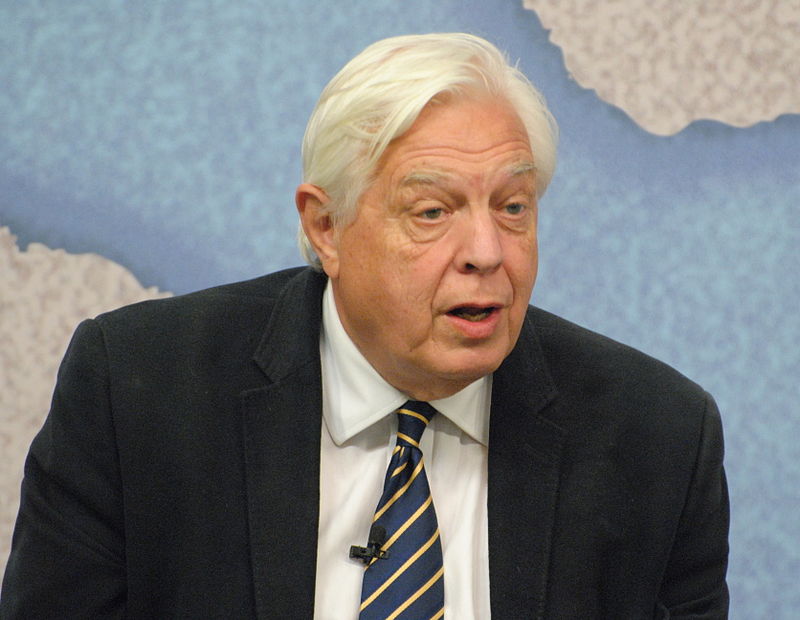
John Simpson
Correspondent
12
APPEARANCES
6
PODCASTS
Oct 23, 2026

Shane ColmanHOST
I was going to ask you if you've loved every minute of it, and then it wasn't even formulated in my head when I realised that was a ridiculous question, because you've obviously had an extraordinary career, but you've been through incredibly challenging times, not least in Lebanon, where you were abducted and tortured.

John SimpsonGUEST
Yeah, I mean, I'm not going to say that When they were doing that to me, I was thinking, this is a great job and I'm enjoying it.
John SimpsonGUEST
But, you know, quite quickly afterwards, I don't know how long afterwards, a day or so, I felt that, yeah, I was so lucky to be, well, to be alive at that stage because they put me through a mock execution, which seemed to be real and genuine until the click of the gun.
John SimpsonGUEST
And I mean, apart from anything else, and I'm not just saying this in order to ingratiate myself, but it's enabled me to see into different countries and I think almost entirely, almost always, learn to love them.
Shane ColmanHOST
Is it true the former Prime Minister, when he was Prime Minister, Harold Wilson, actually whacked you in the stomach, punched you in the stomach?

John SimpsonGUEST
It's all very reminiscent of an era before I was actually, even I was reporting.
John SimpsonGUEST
And I think the main reason why Donald Trump wants to be, uh, seen fairly close to, uh, to the Russian leader is that, I mean, it's partly personal.
John SimpsonGUEST
He's got an admiration, uh, for tough guy leaders who can ... don't have to worry about oppositions or the newspapers and so on.
John SimpsonGUEST
But it's also because he's bought into this kind of thing that Vladimir Putin already believed in, which is kind of great power politics.
John SimpsonGUEST
If you're a great power, you've got your sphere of influence, and you want to control that.
11 MINS LATER

Laura KuenssbergHOST
And do you just think that leaders of democracies were maybe sort of daft to think that stability was something permanent? Because stability's not been a feature of the UK either in the last 10 years.

John SimpsonGUEST
Uh, it, it looks, things do look bad, but I would say they've always looked quite bad.
John SimpsonGUEST
[laughs] I mean, I grew up in the, in the Cold War when I, I think I probably assumed that there would at some stage be all nu- all out thermonuclear war, that I, I and everybody I knew would die in that.
John SimpsonGUEST
And- If like me, you've seen the wall falling, if like me, you've watched close up as the Soviet Union collapsed, I mean, I was the BBC correspondent in Southern Africa in the worst period of apartheid in the 1970s.
John SimpsonGUEST
If you see that coming to an end peaceably, it does give you a different view.

John SimpsonGUEST
I mean, I think that I, I've m-managed to kind of deal with these things by talking about them, by, by, um, writing about them in particular.
John SimpsonGUEST
I mean, if you, if you were to have a, an unpleasant experience and you went to a, a, a physiothera-- uh, not a physiotherapist, a psychotherapist, chances are they'd say, "Look, talk about it to the people close to you.

speaker_5UNKNOWN
The
John SimpsonGUEST
And the man standing beside me, our translator, got an injury that he died of within minutes.
Chris TerrillNARRATOR
With his interpreter lying fatally wounded nearby, the reality of the new technology meant John Simpson was still under pressure to file another report.
John SimpsonGUEST
There's still rockets and bullets in them are still exploding and coming around.


Matt ChorleyHOST
Uh, Barry, uh, Preston's just messaged to say, since that, um, in your coverage of the, the fall of Kabul back in 2001, he says, "What are your reflections on life in Afghanistan today?" That, you know, i- in many respects, it's, it's really gone full circle.
John SimpsonGUEST
Well, I'll tell you the first thing, as I said to you, I, I'm just gonna be honest all the time.
John SimpsonGUEST
[laughs] I mean, not that I'm not honest the, uh, the rest of the time, but I, you know, the, I, I, I don't always sort of, uh, say, uh, things which, um, you know, might, might, might cause, uh, difficulties.
John SimpsonGUEST
But I never, never in 1,000 years thought that the Taliban would come back after the city fell, Kabul fell.
9 MINS LATER

Anton SavageHOST
Should we be looking at Israel's declining to get involved in this phase with some hope, or is there a possibility they will now rejoin the field, the theatre of war?
John SimpsonGUEST
You know, I mean, the whole issue of the 28th of February attacks, when the supreme leader and lots of other members of the government were killed, that's been very bad for the relationship between Israel and the U.S., the relationship which actually Israel's future entirely depends on, President Trump was absolutely furious when it came out that he'd been sold a pup in effect that that Israel had promised him that they could just simply destroy the entire Islamic Republic authority and replace it with something else well we know of course that that didn't that the son of the Supreme Leader, Ali Khamenei, who was buried yesterday, the son, Mojtaba Khamenei, just simply stepped into the role, something that would never normally have happened in Iran, but that was the emergency result of the attacks.
John SimpsonGUEST
So I think we can be pretty certain that Israel will keep quiet for the time being, won't get involved, won't want to get more involved than it already is.
John SimpsonGUEST
It doesn't look to me from the outside as though either side knows quite what to do.
John SimpsonGUEST
And Donald Trump is now starting to talk about resuming the war, resuming attacks on Iran.
Anton SavageHOST
Typical diplomatic language from Donald Trump, but that's obviously where his head is.
Anton SavageHOST
Interestingly, in respect of those ceasefires, iran has seized two cargo vessels one flagged out of panama one flagged out of liberia the american response to this has been well they're not american so that doesn't breach the ceasefire john reading between the lines that would look like america is very eager to get this ceasefire to hold for a while
John SimpsonGUEST
yes i mean i think that is what's going on i think that uh there's a a desire on both sides actually not to push this too far, to let it kind of play itself out.
John SimpsonGUEST
It's very difficult to work out really what Donald Trump wants because as one of his officials was saying the other day, he does an awful lot of talking.
John SimpsonGUEST
I mean, I think other people in his administration might say he does too much talking.
John SimpsonGUEST
He does maybe three or four interviews a day and he doesn't always say the same thing.
Anton SavageHOST
All of this in the run-up to midterms that will be seen as significant for the Republican Party, that must be taking a toll.


Tristan RedmanHOST
How concerned are you about the fact that the war is spreading outside of Iran through the region?
John SimpsonGUEST
Well, of course it, that's Iran's way of saying, "You may hit us, uh, and you may hit us hard, but we can hurt you back.
John SimpsonGUEST
We can hurt your pride, we can hurt your reputation, and we can show that we're still in full control of ourselves and our weaponry." I mean, in terms of the actual attacks that, uh, uh, that Iran carried out on the UAE, for instance, in Dubai, um, they were, of course, headline news right across the world.
John SimpsonGUEST
I mean, nothing that compared with what Israel, for instance, has done in, in Gaza.
John SimpsonGUEST
Uh, it's a tragic number, but it's a relatively small number for this kind of war.
8 MINS LATER
speaker_6AUDIENCE
Thank you for that nice bit of praise.
John SimpsonGUEST
Well, I mean, the key objective, I suppose, from the American point of view, the key hope is that it'll be possible to just collapse the regime in Iran and that the regime will simply not be able to carry on fighting and will just surrender.
John SimpsonGUEST
I mean, that would be the ideal solution, the solution that, from America's point of view, I mean, and that's a solution that they seem to have wanted.
John SimpsonGUEST
And I think the The key battlefield, rather, as you were saying, is now the Strait of Hormuz.
Anton SavageHOST
And we have Lord Mandelson resigning his title and also facing possible criminal prosecution.
John SimpsonGUEST
But I mean, you know, we mustn't think of this as being purely some sort of British scandal, even though right up to the top levels of the royal family, there was such contact with Epstein.
John SimpsonGUEST
in the United States, in France, in Norway, in Israel, all of these countries, and indeed one or two others, there are reverberations from the Epstein scandals.
John SimpsonGUEST
Of course, just being mentioned in the Epstein papers doesn't necessarily mean guilt.
Anton SavageHOST
Was that purely because that's the kind of guy he is, or do you think there was a nefarious reason?