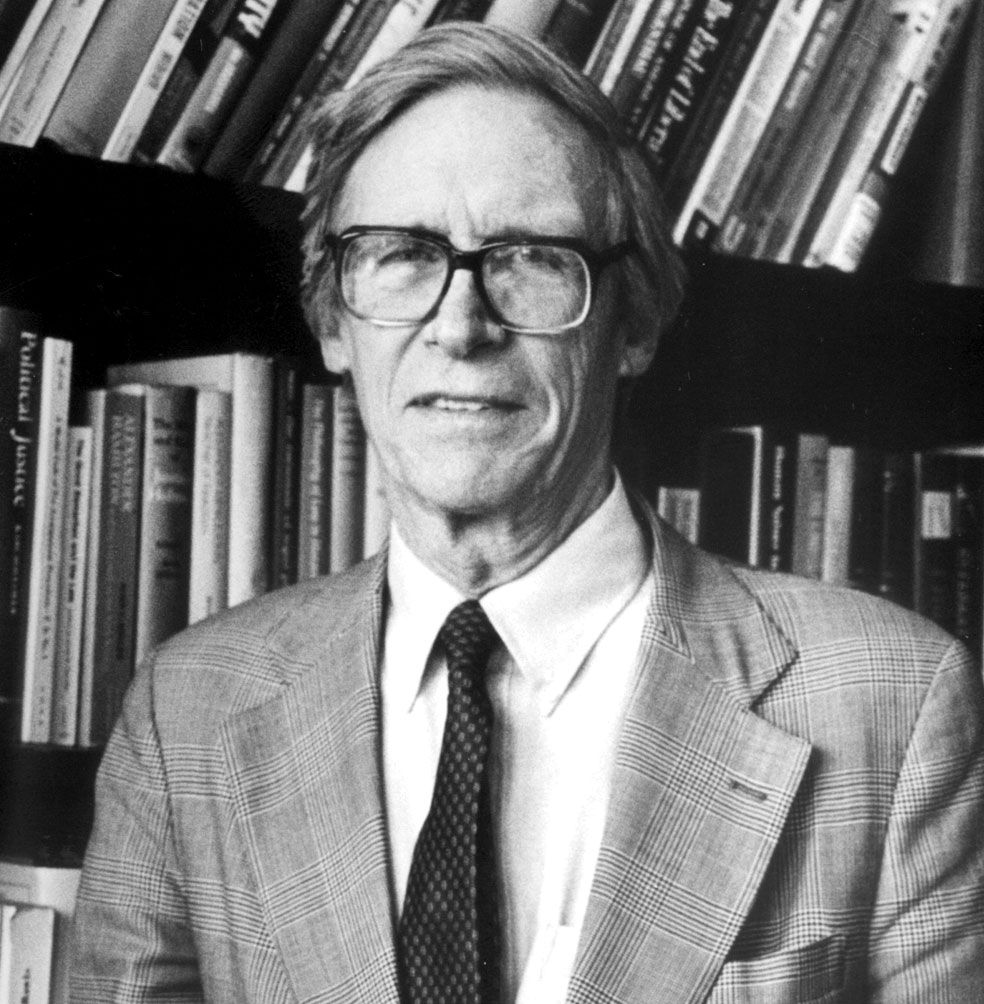
John Rawls
American philosopherWikipedia
120
MENTIONS
51
EPISODES
44
PODCASTS
Search complete. 120 mentions across 51 episodes found for "John Rawls".
Sep 11, 2026

James O'BrienHOST
I g- I suppose other philosophers, you know, you...
James O'BrienHOST
P- people like John Rawls and the veil of ignorance and coming into just maybe if we did things like...
James O'BrienHOST
Th- this is...
James O'BrienHOST
That's what excites you, the idea, my God, things don't have to be like this.

Thomas SowellSOUNDBITE_SPEAKER
From the other point of view, from the cosmic perspective, it's fair only when the two fighters enter the ring with the same prospects of winning.
Thomas SowellSOUNDBITE_SPEAKER
John Rawls has sort of summarized and epitomized these two differences.
Thomas SowellSOUNDBITE_SPEAKER
He distinguishes what he calls fair equality of opportunity from merely formal equality of opportunity.
Thomas SowellSOUNDBITE_SPEAKER
Traditional justice or fairness by Rawls's standards means simply that people are judged by the same rules.

Jack Russell WeinsteinHOST
2,500 years and only a handful of feminist philosophers later, the presumption that politics was for men still dominated.
Jack Russell WeinsteinHOST
John Rawls' theory of justice, the most important political theory of the late 20th century, came out the same year as the first Ms. magazine.
Jack Russell WeinsteinHOST
It argued that the rules of a just society were separate from family relations, assuming in the process that families were built on love and goodwill.
Jack Russell WeinsteinHOST
They were not political units for Rawls.

Robert P. JonesHOST
Early books actually by political theorist.
Robert P. JonesHOST
It was John Rawls's theory of justice that for me was I was realized like, oh, you could take this kind of.
Robert P. JonesHOST
instinct about the golden rule and then be like really rigorous in how you think about its social implications, political implications.
Robert P. JonesHOST
And that's really what that book does.

ClaireHOST
The convergence of formulations does not imply a convergence of groundings, and the groundings matter for how the rule is understood and applied.
SeanHOST
There is one more grounding worth examining the contractarian tradition associated with Thomas Hobbes, John Locke, and most recently John Rawls.
SeanHOST
In this framework, the moral rules that govern a just society are those that rational agents would agree to from a position of rough equality rules that no one could reasonably reject because they would be willing to live under them themselves.
SeanHOST
This is the golden rule translated into the language of social contract.
SeanHOST
The rules you should follow are the rules you would choose if you did not know in advance which position in society you would occupy.
SeanHOST
Rawls's veil of ignorance, which we discussed in the trolley problem episode, is essentially a philosophical device for applying the golden rule at the level of social institutions rather than individual interactions.
ClaireHOST
The contractarian grounding is particularly interesting because it does not require any claims about God, about human nature, or about metaphysics.
ClaireHOST
It grounds the golden rule purely in the rationality of agents who want to secure their own interests under conditions of uncertainty.

Christopher RobichaudSOUNDBITE_SPEAKER
You know, we're gonna go through it all.
Christopher RobichaudSOUNDBITE_SPEAKER
We're gonna go through consequentialism, deontology, uh, John Rawls and so forth, and maybe just do a little bit of dabbling with cases.
Christopher RobichaudSOUNDBITE_SPEAKER
Others lean in hard on cases.
Christopher RobichaudSOUNDBITE_SPEAKER
Let's look at protagonists in these situations and seeing what they're doing.

Michael GoveHOST
You make the point that the prosperity and freedom that the West enjoys is as a result of liberalism.
Michael GoveHOST
And there are different strains and flavors of liberalism, whether you draw from Kant and Rawls on the one side, or if you look at a tradition drawn from Hobbes and looking at human nature.
Michael GoveHOST
But Liberalism is to an extent a universalist creed.
Michael GoveHOST
It argues either there are universal freedoms that should extend irrespective of human nature or that human nature will dictate the nature of those freedoms, but humans are alike in that regard.

Michael GoveHOST
You make the point that the prosperity and freedom that the West enjoys is as a result of liberalism.
Michael GoveHOST
And there are different strains and flavors of liberalism, whether you draw from Kant and Rawls on the one side, or if you look at a tradition drawn from Hobbes and looking at human nature.
Michael GoveHOST
But...
Michael GoveHOST
Liberalism is to an extent a universalist creed.

Paul MasonGUEST
The other thing is class.
Paul MasonGUEST
Liberalism, in particular, as defined by John Rawls' theories of justice, is a little bit blind to class.
Paul MasonGUEST
It's kind of a calculus of what's the least worst thing we can do to everybody.
Paul MasonGUEST
Yes, the
Paul MasonGUEST
They had Rerum Novarum, the papal encyclical in the late 19th century that explained the...
Paul MasonGUEST
the nobility of work and its inclusiveness and the importance of social justice.
Paul MasonGUEST
So when we reduce liberalism to a kind of Rawlsian, Western sort of John Stuart Mill to John Rawls type tradition, I think there's more in the Western
Matt d'AnconaHOST
tradition.

Jonathan QuongGUEST
So I didn't really fully understand what analytic political philosophy was, and I didn't really fall in love with it until I moved to the UK to do my graduate work.
Jonathan QuongGUEST
And I went to Oxford and one of the very first talks that I attended as a graduate student there was a talk by the legendary political philosopher Jerry Cohen, who gave what was then an early version of his paper called Freedom and Money.
Jonathan QuongGUEST
And I'd never seen anything like that.
Jonathan QuongGUEST
And I remember walking back from the lecture with some friends and they were busy kind of working through the argument, trying to figure out where the argument in Jerry's paper went wrong.
Jonathan QuongGUEST
I wanted also to articulate what I think are some of the problems with some of the leading views in the field.
Jonathan QuongGUEST
And I wanted to tell readers a little bit about how I think the puzzle of legitimate injustice really ought to be addressed.
Jonathan QuongGUEST
And so I hope that the book is also of interest to people, specialists, Professional political philosophers or, you know, graduate students who already know a lot about political philosophy.
Jonathan QuongGUEST
And so it does engage with some, you know, fairly sophisticated recent work in the field and it offers what I hope are some original contributions to the debate and I hope moves the debate forward a little bit.
41 more episodes mention John Rawls.
Create an account to see the whole feed, search across every transcript, and follow the entities you care about.