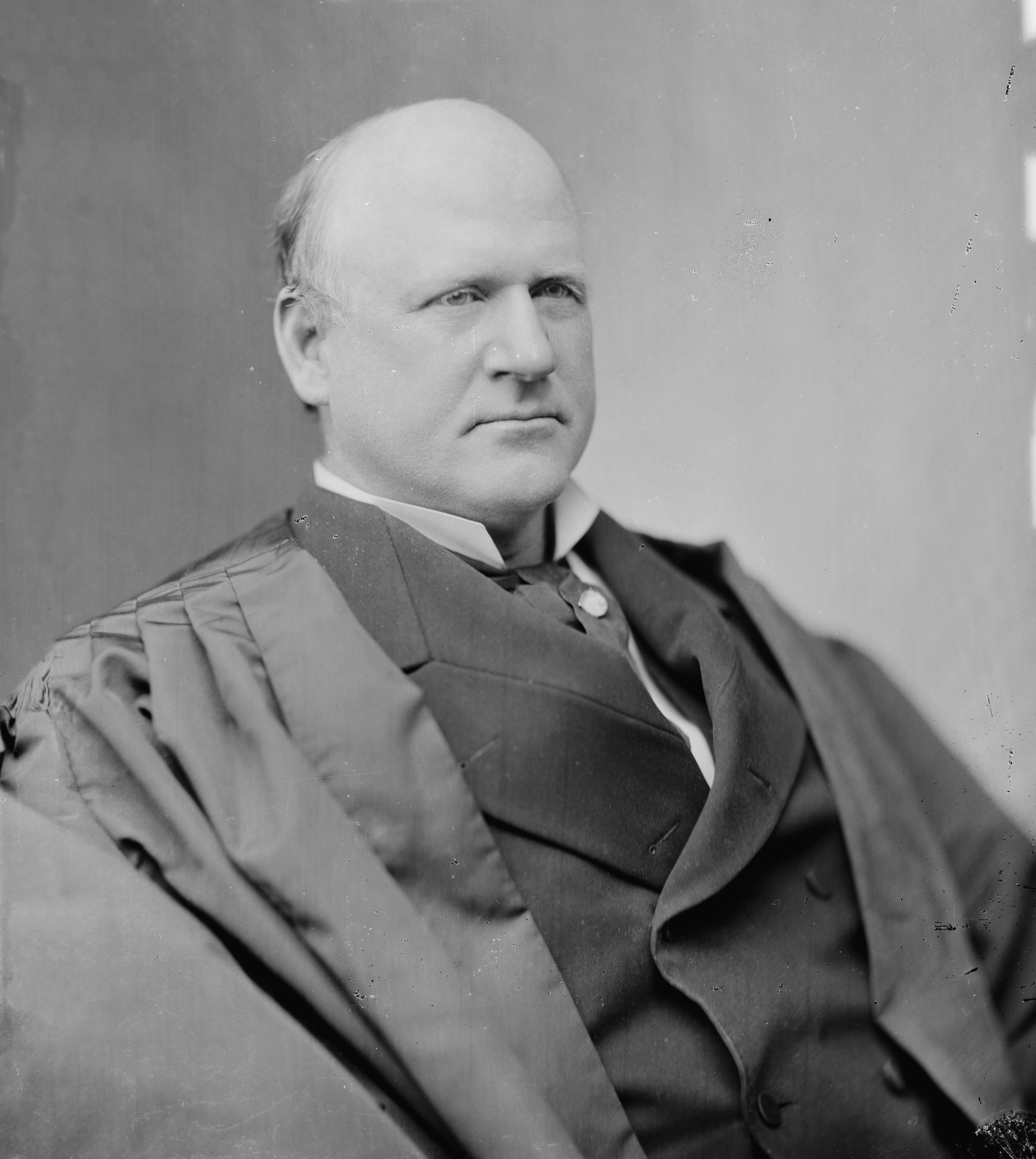
John Marshall Harlan
Lawyer and former Associate Justice of the Supreme Court of the United StatesWikipedia
6
MENTIONS
4
EPISODES
4
PODCASTS
Search complete. 6 mentions across 4 episodes found for "John Marshall Harlan".
Oct 21, 2026

Bill HemmerHOST
The ruling gave a green light to Jim Crow laws across the South, legitimizing separate schools, water fountains, and restaurants.
Bill HemmerHOST
Writing alone in a famous dissent, Justice John Marshall Harlan issued a prophetic warning.
Bill HemmerHOST
"Our Constitution is colorblind.
Bill HemmerHOST
The thin disguise of equal accommodations will not mislead anyone, nor atone for the wrong this day done." That single decision gave legal cover to systemic segregation, splitting daily life in America in two, until Supreme Court justices finally overturned it 60 years later.

Ryan McMakenNARRATOR
Does equality before the law mean that nobody believes himself to be superior or inferior to others? Does the Fourteenth Amendment guarantee that we must all enjoy the same social status? Can the Constitution ensure that no one feels slighted, ignored, or overlooked? Do citizens have a constitutional right to feel welcome and included in everything? In his dissenting opinion in Plessy v.
Ryan McMakenNARRATOR
Ferguson, eighteen ninety-six, Justice John Marshall Harlan emphasized that the Fourteenth Amendment Equal Protection Clause guarantees that all are equal before the law.
Ryan McMakenNARRATOR
His understanding of this principle was that the white race deems itself to be the dominant race in this country, and so it is in prestige, in achievements, in education, in wealth, and in power.
Ryan McMakenNARRATOR
So I doubt not it will continue to be for all time if it remains true to its great heritage and holds fast to the principles of constitutional liberty.

Elizabeth Garner MasarikHOST
That argument didn't work.
Sarah Hanley CousinsHOST
The court that ultimately decided Plessy v. Ferguson consisted of Chief Justice Melville Fuller and Justices Stephen Field, John Marshall Harlan, Horace Gray, David Brewer, Henry Billings Brown.
Sarah Hanley CousinsHOST
George Shearer's Edward Douglas White and Rufus Peckham.
Sarah Hanley CousinsHOST
Man, what a collection of 19th century names.
Sarah Hanley CousinsHOST
Six of the seven justices in the majority came from northern families.
Sarah Hanley CousinsHOST
The only dissenter was the one justice who had been born into a slave-holding family.
Elizabeth Garner MasarikHOST
In his book Separate, Luxembourg creates a narrative around the contrasting lives of the author of the majority opinion in Plessy, Henry Billings Brown, and the author of The Lone Descent, John Marshall Harlan.
Elizabeth Garner MasarikHOST
The two men were close contemporaries, and their early careers ran on nearly parallel tracks before diverging in unexpected ways.

speaker_1ADVERTISER
it."
Clint SmithHOST
On the other side, Justice John Marshall Harlan was the only one who dissented, stating that on a functional level, quote, the white race deems itself to be the dominant race in this country.
Clint SmithHOST
And that behavior is unconstitutional.
Clint SmithHOST
He used the term colorblind to describe the Constitution, arguing that the rights in the Constitution apply to everyone.