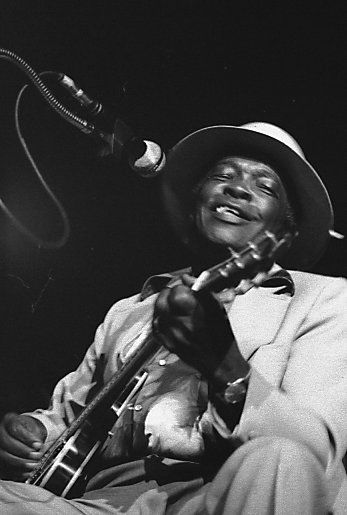
John Lee Hooker
American singer-songwriter and guitaristWikipedia
70
MENTIONS
51
EPISODES
46
PODCASTS
Search complete. 70 mentions across 51 episodes found for "John Lee Hooker".
Sep 17, 2026

Jim SamariaHOST
Yeah, blues or country, right? Yeah.
Jim SamariaHOST
Because John Lee Hooker also recorded an album before a prison audience, and that was titled Live at Soledad Prison.
Jim SamariaHOST
And the cool thing about this album is that Hooker brought his 20-year-old son, John Lee Jr., to be part of the performance.
Mark PlotnickHOST
Yeah, Jim, here's the back story on that.
Jim SamariaHOST
No.
Jim SamariaHOST
Okay.
Jim SamariaHOST
Well, let's listen to John Lee Hooker getting his boogie on for the Soledad audience with the song Bang, Bang, Bang, Bang.
Jim SamariaHOST
And if this tune sounds a little familiar, it's because it's just another take on Hooker's great song, Boom,

Bill BlackwellGUEST
As a young, you know, 14, 13-year-old kid listening to music, you would hear Bob Seger, you would hear Aretha Franklin, you would hear Marvin Gaye.
Bill BlackwellGUEST
You would hear John Lee Hooker, who was, at that time, you know, in the city.
Bill BlackwellGUEST
And so if it was getting airplay or selling records, you would hear all those genres of music, which little disappointed now.
Bill BlackwellGUEST
It's, you know, our industry is so segmented.

Robert KidneyGUEST
Okay.
Robert KidneyGUEST
John Lee Hooker, this is how I remember it.
Robert KidneyGUEST
John Lee Hooker was going to play at the Old Agora, the one that I think burned down.
Robert KidneyGUEST
Hank LeConte.
Robert KidneyGUEST
And it was a great place, wonderful place.
Robert KidneyGUEST
It's where Jimmy Bell was recorded.
Robert KidneyGUEST
The new Agora is another deal, but the old Agora was a fantastic place.
Robert KidneyGUEST
And John Lee Hooker was going to play at the Agora.

Wendy MogelGUEST
"Could you tell them to chillax?" There is a lyric, let me just see if I have it right here.
Wendy MogelGUEST
Okay, so it's John Lee Hooker, and it's, this is the lyric: "One night I was lying down, I heard Mama and Papa talking.
Wendy MogelGUEST
I heard Papa say to Mama, 'Let that boy boogie woogie.
Wendy MogelGUEST
Let that boy boogie woogie, 'cause it's in him and it's got to come out.'" This is true for boys and girls.

RickyHOST
[laughs]
MeredithHOST
John Lee Hooker?
RickyHOST
John Lee Hooker?
MeredithHOST
Baby, please don't go.
RickyHOST
I thought it... [laughs] I thought it was Peter Cetera.

Banning EyreGUEST
And i- it was one of those phenomena where when radio starts, Africans are hearing music from other parts of the world, and they actually recognize themselves in...
Banning EyreGUEST
They heard John Lee Hooker and they, "Oh, that sort of sounds like us." [upbeat music] So, so the, the, the A- the West African element that went into making the blues comes back to Africa in radio in the '50s and '60s, and leads to this whole adaptation of guitars and electric guitars, and playing their own traditional music, except now really rocking out with it, using their own melodic and rhythmic languages.
Banning EyreGUEST
But there's a, there's definitely a conversation back and forth going on there.
Banning EyreGUEST
[upbeat music] [singing] The griot music, I actually think of it, I mean the Mande griot music with the seven-note scales, I actually think of it as being more, more linked to other kinds of American folk music.
Banning EyreGUEST
A lot of folk music of West Africa, a lot of folk music of America, blues included, are like twins separated at birth, you know? And, and, and they, they, they, they've had totally different lives, and they've d- they've gone in very many different directions, but there's still something there that unites them.
Banning EyreGUEST
And I think this is why when African music started to become promoted, shall we say, in America by record companies, concert pref- presenters, our radio show, the music that most, that most succeeded, that, that got the most tours, the most record sales, was mostly from West Africa, which is where most of the African Americans came from or have ancestry.
Banning EyreGUEST
So, so people without understanding or analyzing at all could just recognize themselves in the music, much the way the Africans recognized themselves when they heard John Lee Hooker.
Banning EyreGUEST
And so there's this, there's this intuitive thing that, that made those artists more understandable.

Derek TrucksGUEST
It was probably 100, 150 people.
Derek TrucksGUEST
I saw John Lee Hooker there.
Derek TrucksGUEST
Met Coco Taylor there at, at nine.
Derek TrucksGUEST
Like, there was the re- like, the, the blues scene then was they were playing for 50 people, like guys that were huge in the '60s and then had careers after that.

Derek TrucksGUEST
It was probably 100, 150 people.
Derek TrucksGUEST
I saw John Lee Hooker there.
Derek TrucksGUEST
I met Coco Taylor there at, at nine.
Derek TrucksGUEST
Like, there was the re- Like, the, the blues scene then was they were playing for 50 people, like guys that were huge in the '60s and then had careers after that, but the '80s were just a dead time.

Big Daddy Ray HansenHOST
I have two for you.
Big Daddy Ray HansenHOST
He'll cover the John Lee Hooker tune, Dimples.
Big Daddy Ray HansenHOST
But first, here is James Buddy Rogers with the B.B. King tune, Never Make a Move Too Soon.
Shawn AmosSOUNDBITE_SPEAKER
Three days of snow in Birmingham Thought you would wonder where I am I rang your number all night long There's no comfort on the telephone I ran out and caught a midnight flight You left me with I ran it up ten times fifty grand I cashed it in, held it in my hand That kind of word gets around And makes a lost love come about I hear you knocking at my door But you ain't living with me no more Look out baby I think you made your move too soon I've been from Spain to Tokyo, from Africa to Ohio.
55 MINS LATER
Katie KnippSOUNDBITE_SPEAKER
And my name's Kaylee.
Katie KnippSOUNDBITE_SPEAKER
Come here.
Big Daddy Ray HansenHOST
In 2022, guitarist Anthony Pauly was performing with his soul orchestra on the legendary Blues Cruise when he hit it off with vocalist Willie Jordan, who had played with his good friend Elvin Bishop and for two years with John Lee Hooker.
Big Daddy Ray HansenHOST
Well, conversation turned into a full-fledged plan, and soon Willie joined the 12-piece soul orchestra as a vocalist, a gig he's had for the last four years.

Jesse Fox MaysharkHOST
And while the blues as a musical form long since spread across the globe, the festival remains focused on its regional and African American roots.
Jesse Fox MaysharkHOST
Over the years, it has featured now deceased blues legends like Muddy Waters, John Lee Hooker, and Big Joe Williams.
Jesse Fox MaysharkHOST
This year's headliners include the Los Angeles R&B and soul singer Leela James, and Clarksdale, Mississippi blues singer O.B. Buchana.
Jesse Fox MaysharkHOST
Its most direct connection to blues heritage comes through 92-year-old Grammy-winning bluesman Bobby Rush.
41 more episodes mention John Lee Hooker.
Create an account to see the whole feed, search across every transcript, and follow the entities you care about.