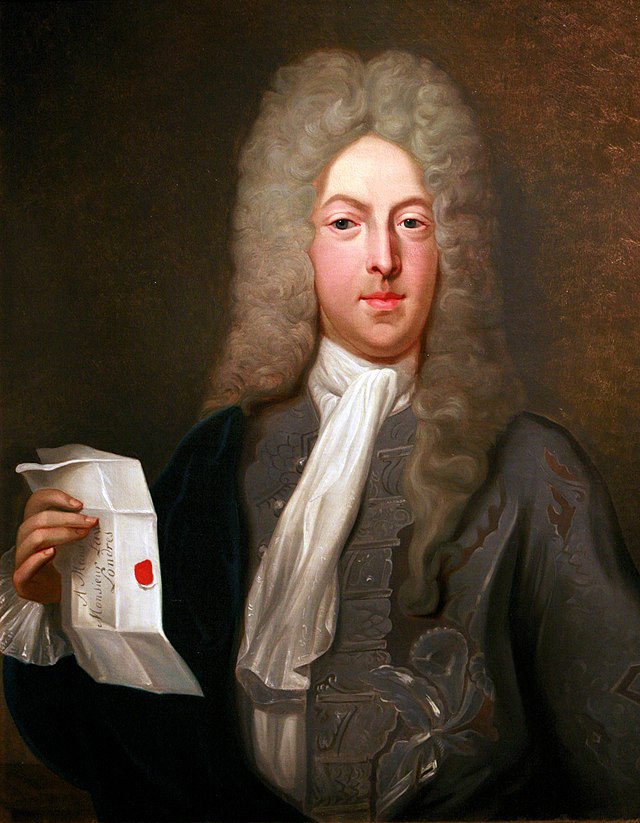
John Law
Scottish economist and financierWikipedia
20
MENTIONS
12
EPISODES
11
PODCASTS
Search complete. 20 mentions across 12 episodes found for "John Law".
Oct 12, 2026

Patrick BoyleHOST
There are many other reasons for America's huge growth such as the huge land mass and natural resources, but economic historians argue that Britain's public borrowing monopolized the available capital, reducing the amount of credit available to British businesses.
Patrick BoyleHOST
If you enjoyed this video, you should watch this video on John Law and the Mississippi Company next, which is all about the bubble that was happening in France at the same time.
Patrick BoyleHOST
Don't forget to check out our sponsor Rocket Money using the link in the description.
Patrick BoyleHOST
Have a great day and see you in the next video.

Don QHOST
History does this trick more than once.
Don QHOST
John Law's Mississippi bubble eats French savings and leaves the speculators holding land claims.
Don QHOST
The Continental Congress prints until the phrase, not worth a continental, is an insult.
Don QHOST
Weimar prints until the insult is in a wheelbarrow.

speaker_1HOST
Yes.
speaker_1HOST
In Paris, an exiled Scottish economist named John Law had taken control of the Mississippi Company.
speaker_1HOST
Law was a brilliant but dangerous financial engineer.
speaker_1HOST
His ultimate objective was macroeconomic.

BennyHOST
They did it then.
BennyHOST
They did it how they let John Law in, as I wrote about.
BennyHOST
They're doing it now.
BennyHOST
And I have a French buddy who likes to talk to me about bonds, who was a bond trader for a long time, and he, he actually called it that oats would be, uh, outside of, of the Italian bond market.

speaker_3NARRATOR
Not every perpetual promise held.
speaker_3NARRATOR
In 1719, John Law's company took over France's national debt, swapping it for shares bought with paper money from the bank he ran.
speaker_3NARRATOR
In 1720, the paper collapsed and the promise with it.
speaker_3NARRATOR
In 1752, Britain folded many of its debts into one perpetual, the consoles, 3% a year on every 100 pounds.

Mark ThorntonHOST
you know, to solve everybody's problems.
Mark ThorntonHOST
I mean, that was John Law's offer to the King of France, that you put me in charge of your colonies, you put me in charge of your national debt, you put me in charge of your currency and your central bank, and I'll take care of everything.
Mark ThorntonHOST
You'll have plenty of money to spend, and the economy will get back to economic growth.
Mark ThorntonHOST
And we'll make, you know, everybody will make zillions of money.
Mark ThorntonHOST
It describes a character whose initial lie spins completely out of control, ultimately leading to ruin.
Mark ThorntonHOST
Now, this perfectly mirrors the financial dynamics today, but also the massive tangled web of deception of John Law's Mississippi bubble in the early 1720s.
Mark ThorntonHOST
John Law attempted to deceive the public into believing that unlimited paper money could indefinitely substitute for real wealth and gold.
Mark ThorntonHOST
It involved controlling trade policy, big government mercantilist policy, national debt, interest rates, and currency manipulation, as well as the world's first enormous stock market bubble.
Mark ThorntonHOST
And as the deception grew over time, the financial web became so complex and fragile that it completely collapsed.
Mark ThorntonHOST
Richard Cantillon saw right through this, and he shorted John Law's system using sophisticated exchange rate maneuvers and other things and walked away an incredibly wealthy man.
Mark ThorntonHOST
In the aftermath, Cantillon wrote a manuscript which gave the world a textbook in economic theory for the first time.
Mark ThorntonHOST
Our own tangled web also includes a massive national debt, and this is true of many countries, a global bear market in bonds, where bond prices are falling and interest rates are on a very long-term trajectory upwards.

Alexander MikaberidzeGUEST
So they, the, the failure here is the really failure of imagination, meaning they couldn't convince people that there's something better, uh, overseas.
Alexander MikaberidzeGUEST
And, and trust me, they, they tried, right? They tried, especially in, in the book I've devoted a chapter on, uh, on the famous, um, Mississippi Company bubble that really shapes the French economic and financial life, uh, in, at, at the start of the 20th century when John Law, the finance kinda wizard and who will be giving the position almost like a finance minister of France, tries to reorganize French finances.
Alexander MikaberidzeGUEST
And part of that re- reform hinged on developing an economic enterprise in, in Louisiana.
Alexander MikaberidzeGUEST
And in order to convince people that, hey, Louisiana is actually a great place to move and, and live, they tried to publish prints and wrote these remarkable pamphlets extolling Louisiana as, as a, as a utopian paradise where there are mountains of gold and silver, and you only need to have a shovel to, to strike rich.

Ryan McMakenNARRATOR
Clearly, even a monetarily illiterate public would never consent to this.
Ryan McMakenNARRATOR
Is this another example of government taking the liberty of acting in our interests? John Law's disastrous experiment with fiat money, culminating during his brief tenure as Comptroller General of France in 1720, should have served as a permanent warning to every government thereafter.
Ryan McMakenNARRATOR
But if anything, it's been an inspiration.
Ryan McMakenNARRATOR
The U.S. Fed regime is now over $40 trillion in debt with more on the way.
Ryan McMakenNARRATOR
Of 56 documented hyperinflations, including John Law's and defined according to the Kagan rule, all of them were fiat money economies.
Ryan McMakenNARRATOR
According to prevalent wisdom, economic turmoil follows from anarchy.
Ryan McMakenNARRATOR
How did government achieve what is usually associated with its absence? Madison's Angel Theory of Government In the summer of 1787, Federalists James Madison, Alexander Hamilton, and John Jay led a coup in Philadelphia against the national government of the Articles of Confederation.
2 more episodes mention John Law.
Create an account to see the whole feed, search across every transcript, and follow the entities you care about.